
 Goethe Write is here – the writing app for Mac, iPhone and iPad.Download now
Travel writing · 1816
Italian Journey
In September 1786 Goethe slipped away from Karlsbad and travelled over the Brenner to Verona, Venice, Rome, Naples and Sicily. Thirty years later he shaped his diaries and letters into this book.
Italienische Reise
Travel writing1816written 1786–1788; 1813–182944,798 wordsTranslation: A. J. W. Morrison (Alexander James William Morrison)
.goethex file for Mac, iPhone and iPad · No Goethe Write yet? Download now
At a glance
A travel book that is also the story of a transformation. Goethe flees office and habit for the south; he looks, draws, collects stones and plants, and comes back after almost two years a different man. Only three decades later does he shape this book from his diary and letters – half memory, half re-creation. It shaped the German image of Italy for two centuries.
Yes, at last I have arrived in this capital of the world!
Ja, ich bin endlich in dieser Hauptstadt der Welt angelangt!
At three in the morning on 3 September 1786, Goethe left Karlsbad without telling anyone where he was going. He was thirty-seven, a minister of the duchy of Weimar for ten years, and exhausted. He travelled under the name of Johann Philipp Möller, a merchant, over Regensburg, Munich and the Brenner pass to Lake Garda, Verona, Vicenza, Padua and Venice, and arrived in Rome on 29 October. He stayed in Italy for almost two years.
What it contains
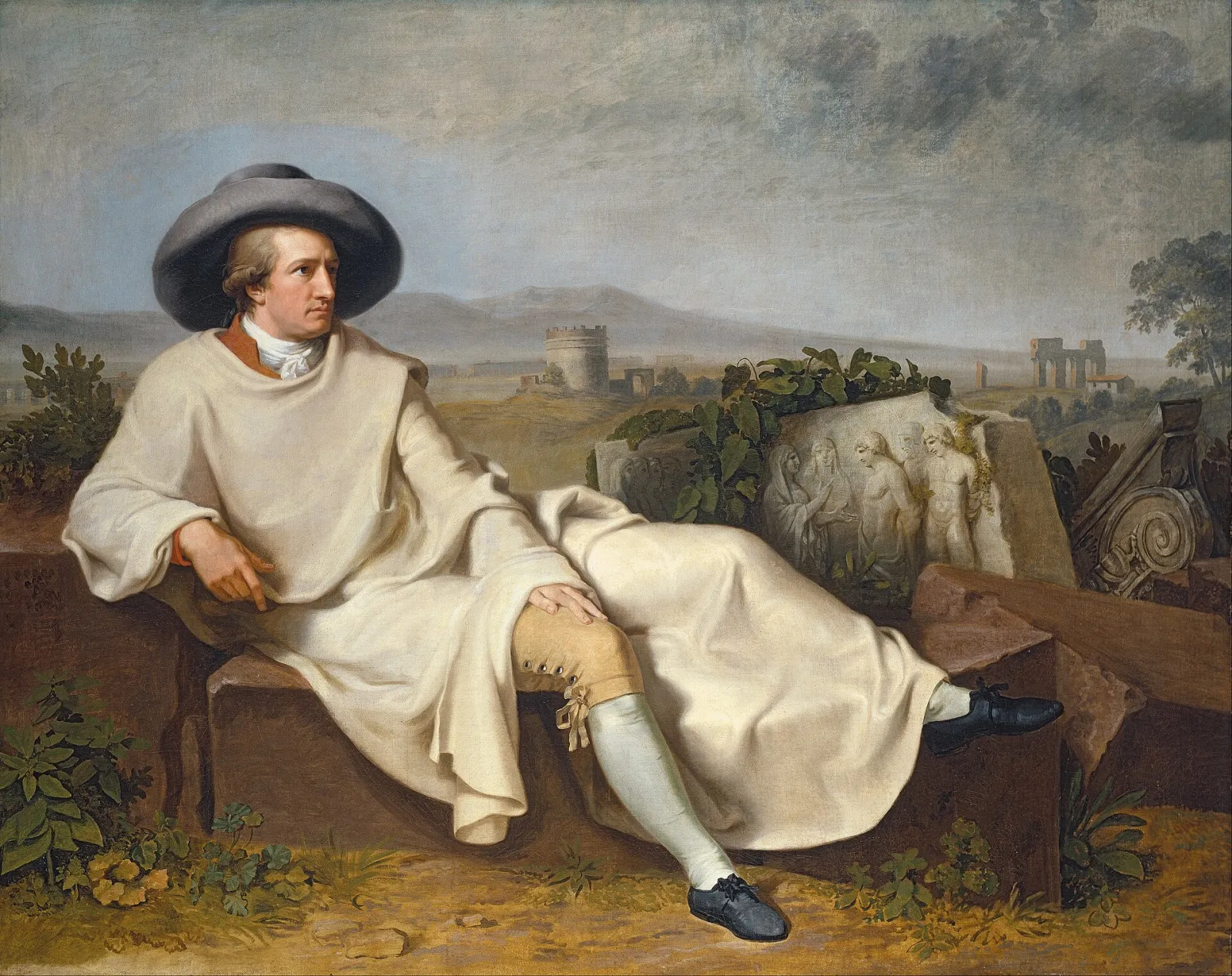
The book follows the journey day by day: the first lemon trees, the Roman amphitheatre at Verona, Palladio’s buildings, the Venetian lagoon, St Peter’s and the Sistine Chapel, the painters of the German colony in Rome, among them Tischbein, who painted him in the Campagna. In February 1787 he went south to Naples, climbed Vesuvius three times and sailed to Sicily, where he read the Odyssey and looked for the “primal plant” in the public garden at Palermo. The second Roman stay, until April 1788, is told partly in reports written later. Throughout, Goethe looks, draws, measures, collects stones and plants and works on his plays.
How it was written
The book is not a diary but a reconstruction. Between 1813 and 1817 Goethe went back to his travel diary, his letters to Charlotte von Stein and Herder and his notes, selected, rewrote and arranged them. The first two parts appeared in 1816 and 1817 as the second section of his autobiography Aus meinem Leben; the account of the second stay in Rome followed in 1829. The motto he gave it, “Auch ich in Arkadien!” – “I too in Arcadia!” – says what Italy meant to him: the land where he was reborn.
About this text
The German text here is the complete book as Goethe published it, with the description of the Roman Carnival that he had first printed in 1789. Of the second Roman stay, the digital source used here contains only the Carnival; the remaining chapters will follow from the Weimar edition. The English, French and Spanish translations cover the first part, from Karlsbad to Rome.
Why it matters
The Italian Journey is the founding book of a whole way of travelling: to go south not for business or pilgrimage but to see, and to be changed. It shaped how Germans, and many others, imagined Italy for two centuries. It is also the best portrait of Goethe at the turning point of his life – curious, happy, sometimes impatient, learning to see.
Where to begin
Each dated entry is a page of its own. Read the first weeks in one go, from Karlsbad to Venice, then the arrival in Rome. Naples and Sicily are the most adventurous part: Vesuvius erupting, a storm at sea, the temples of Agrigento.
This edition
The German text follows the Hamburg edition (1948 ff.), taken from the TextGrid Digital Library (CC BY 3.0) without the editors’ notes, and checked by us for scanning and typesetting errors. It is divided into 281 sections, each on a page of its own, and runs to about 127,842 words – roughly 9 hours of reading. Translations: English, French, Spanish – nineteenth-century versions in the public domain, named with their translators. You can download every version as a .goethex file and open it in Goethe Write, with its structure intact.
Contents
From Carlsbad to the Brenner
- 1Ratisbon, September 4, 17865 min readGoethe steals out of Carlsbad at three in the morning, travels by Egra and Waldsassen, and at Ratisbon watches the Jesuit pupils' annual play.
- 2Munich, September 6, 17862 min readComing from Ratisbon by Abbach, he spends a day in Munich looking at the picture gallery and the antiques.
- 3Mittelwald, September 7, 17864 min readOn an unusually fine day he drives past the Isar and the Walchensee into the mountains as far as Mittelwald.
- 4On the Brenner, September 8, 1786, Evening13 min readBy way of Innsbruck he reaches the Brenner, records his notes on weather, rocks and plants, and takes his Iphigenia along as a fellow-traveller.
From the Brenner to Verona
- 5Trent, morning of the 11th Sept.6 min readAfter fifty hours on the road he is at Trent and tells of the night drive from the Brenner and the fruit market at Botzen.
- 6Trent, the evening of the 10th Sept.3 min readHe walks through the old city, looks at the picture of the Council in the church and is shown the so-called Devil's House.
- 7Evening of September 111 min readAt Roveredo, where the language turns Italian, he must manage for the first time with a postilion and a landlord who speak no German.
- 8Torbole, 12th September (after dinner)3 min readAt Torbole on the Lake of Garda he enjoys the view and the wind on the lake and recalls Virgil's line on the Benacus.
- 9Evening of September 131 min readAt three in the morning he sets out from Torbole with two rowers and is driven by a contrary wind into the harbour of Malsesine.
- 10Sept. 11th14 min readSketching the ruined castle of Malsesine, he is suspected of spying and questioned before the podestà and the actuary, until Gregorio, who once served in Frankfort, speaks for him.
From Verona to Venice
- 11Verona, Sept. 16th2 min readHe visits the amphitheatre, the first great monument of antiquity he has seen, and feels it is meant to be seen full of people, not empty.
- 12Verona, Sept. 161 min readHe describes the ever-closed Porta stupa or del Palio and the guesses about its purpose.
- 13Verona, Sept. 164 min readHe looks at the theatre with the bust of the Marquis Maffei and at the ancient tombstones of the collection there.
- 14Verona, Sept. 162 min readNear the Arena he watches four noble Veronese playing ball against four players from Vicenza.
- 15Verona, September 176 min readHe briefly notes the pictures he has seen and explains at length the Italian way of counting the hours compared with the German.
- 16Verona, Sept. 173 min readHe describes the lively crowd in the streets, the open shops and workshops, and life in the open air.
- 17Vicenza, Sept. 191 min readHe describes the pleasant road from Verona along the mountains to Vicenza.
- 18Vicenza, Sept. 192 min readOnly a few hours after arriving, he has seen the Olympic Theatre and the buildings of Palladio.
- 19Sept. 201 min readHe reports on a long night at the opera, a piece patched together from scraps of other operas.
- 20Sept. 211 min readHe visits the botanist Dr. Tura, whose herbarium and botanical garden have come to nothing.
- 21Sept. 21. Evening2 min readHe calls on the old architect Scamozzi and describes buildings of Palladio, among them the Rotonda.
- 22Sept. 222 min readHe attends a meeting of the academy of the Olympians, which debates whether invention or imitation has done more for the arts.
- 23Sept. 222 min readHe goes to Tiene, where a new building is rising on an old plan, and praises how the good old period is honoured here.
- 24Padua, Sept. 26. Evening1 min readCrammed with his luggage into a little one-seated chaise called a Sediola, he drives in four hours from Vicenza to Padua.
- 25Padua, Sept. 177 min readHe obtains a faithful copy of Palladio's works and visits the university and the botanical garden.
Venice
- 26Venice2 min readOn the evening of 28 September he first sees Venice, remembers his father's model gondola and takes lodgings at the Queen of England.
- 27Venice, September 28, 17864 min readHe tells of the journey on the Brenta from Padua, during which he falls in with two pilgrims.
- 28Sept. 29 (Michaelmas-Day). Evening4 min readHe watches the Venetian people and reflects on how need drove their forefathers to settle on these islands.
- 29Sept. 301 min readWithout a guide he loses himself in the remotest quarters and comes to know the bridges and alleys of the labyrinth.
- 30Sept. 30. Evening1 min readWith a plan of the city he climbs the tower of S. Mark and surveys the city and the lagunes.
- 31October 11 min readOn a Sunday he notices the dirt of the streets and considers how they might be cleaned.
- 32Oct. 2, 17862 min readAt the Carità he studies the convent building in which Palladio meant to recreate the private house of the ancients.
- 33Oct. 31 min readHe visits the church Il Redentore and judges Palladio's churches.
- 34October 31 min readHe describes a side altar splendidly adorned by the Capuchins in honour of S. Francis.
- 35October 31 min readAt the church of the Mendicanti he hears an oratorio performed by the girls of the conservatorium behind the grating.
- 36October 31 min readAn evening at the opera at S. Moses disappoints him because poem, music and singers lack inner energy.
- 37October 54 min readIn the ducal palace he follows a public lawsuit in which one advocate behaves like an exaggerated buffo.
- 38Oct. 41 min readAt the theatre of S. Luke he enjoys an extempore play in masks.
- 39October 41 min readHe compares the public speakers of the city: story-tellers in the square, advocates, preachers and actors.
- 40Oct. 51 min readHe visits the arsenal and learns something of shipbuilding.
- 41Oct. 51 min readHe describes the Bucentaur as a state-galley.
- 42Oct. 5. Night1 min readHe comes home laughing from a tragedy after which the audience calls the dead back onto the stage.
- 43Oct. 61 min readHe draws lessons from the tragedy about Italian declamation and Gozzi's joining of masks with tragic characters.
- 44Oct. 61 min readHe weighs what is faulty and what is admirable in Palladio's finished churches.
- 45Oct. 61 min readCrebillon's Electra at the theatre of S. Crisostomo bores him despite good actors.
- 46Oct. 62 min readHe sees the high mass at the church of S. Justina, which the Doge attends every year in memory of a victory over the Turks.
- 47Oct. 63 min readIn the evening he has the boatmen sing Tasso and Ariosto to their own melodies.
- 48Venice, Oct. 8, 17861 min readAt the palace Pisani Moretta he admires Paul Veronese's picture of the family of Darius before Alexander.
- 49October 8, 17862 min readHe reflects on how the bright light of the city formed the eye of the Venetian painters.
- 50Venice, October 8, 17863 min readIn the Farsetti palace he looks at a collection of casts from the best antiques.
- 51October 8, 17861 min readHe goes out to the Lido, hears and sees the sea, and finds the grave of the English consul Smith.
- 52Oct. 8, 17861 min readOn the sea-coast he finds plants whose juicy, tough nature he traces to the salt air.
- 53Venice, Oct. 9, 17863 min readHe goes as far as Pelestrina to the great sea walls of the republic and observes ebb and flood.
- 54Venice, Oct. 9, 17863 min readFrom the tower of S. Mark he sees the lagunes at low water and watches the crabs and limpets on the shore.
- 55Venice, Oct. 10, 17864 min readAt the theatre of S. Luke he sees Goldoni's comedy of the quarrels of the people of Chiozza and enjoys the people's delight.
- 56Venice, October 11, 17861 min readHe falls in with an old Frenchman who knows no Italian and feels quite lost.
- 57Venice, Oct. 12, 17864 min readHe sees the new piece L'Inglicismo in Italia and reports on his study of Palladio and Vitruvius.
- 58Venice, Oct. 14, 1786. 2 o'clock, morning1 min readIn his last moments before leaving by the packet-boat for Ferrara, he is glad to leave Venice.
From Ferrara to Rome
- 59Oct. 16, 1786. Early and on board the packet1 min readOn deck, while his fellow-travellers sleep below, he spends the nights of the passage to Ferrara.
- 60Ferrara, Oct. 16, 1786. At night1 min readIn half-deserted Ferrara he feels out of humour for the first time and is shown Ariosto's tomb and the so-called prison of Tasso.
- 61Cento, Oct. 17, 17863 min readIn Guercino's native town of Cento, a friendly little place, he looks at the painter's pictures.
- 62Bologna, Oct. 18, 1786. Night4 min readA quick guide hurries him through the palaces and churches of Bologna; he admires Raphael's Cecilia and looks at the leaning tower.
- 63Bologna, Oct. 19, 178610 min readHe compares the painters of the city, above all Guido, plans an Iphigenia in Delphi, and on an excursion to the hills gathers stones.
- 64Oct. 20, 1786, in the night1 min readHis longing drives him irresistibly onward; he means to go on to Rome with a vetturino.
- 65Legano on the Apennines, Oct. 21, 17861 min readHaving left Bologna in haste, he sits in a wretched inn at Legano with a papal officer from Perugia.
- 66Oct. 22, 1786. Evening2 min readAt Ciredo in the Apennines an Englishman and his so-called sister join the party, and he describes the mountains.
- 67Perugia, October, 25, 1786. Evening15 min readAfter bad inns he writes of Florence, Arezzo and Perugia, of the captain's questions about Protestants, and of the temple of Minerva at Assisi.
- 68Terni, Oct. 27, 1786. Evening5 min readAt Terni, damaged by an earthquake, he tells of the road by Spoleto and its aqueduct.
- 69Citta Castellana, October 28, 17862 min readOn the last evening before Rome he writes of the volcanic country, the bridge and the view of Soracte.
Rome
Places
- Brenner PassThe crossing into the south, 8 September 1786.
- VeronaThe amphitheatre, the first great ancient building Goethe sees.
- VicenzaPalladio’s buildings, among them the Teatro Olimpico and the Rotonda.
- VeniceArrival on 28 September 1786; the sea for the first time.
- RomeArrival on 29 October 1786; lodgings with Tischbein on the Corso, today the Casa di Goethe.
- NaplesVesuvius, Pompeii, Paestum; February to June 1787.
- PalermoThe public garden and the idea of the primal plant, April 1787.
- AgrigentoThe Greek temples in the valley.
- MessinaThe city wrecked by the earthquake of 1783; departure from Sicily and a storm at sea.
Tischbein’s “Goethe in the Roman Campagna”
In Rome Goethe lodged with the painter Johann Heinrich Wilhelm Tischbein in the house on the Corso. In the winter of 1786/87 Tischbein began a large portrait of his friend: Goethe in a wide, pale travelling cloak and a broad-brimmed hat, reclining on the ruins of an obelisk, behind him the plain of the Campagna with the tomb of Caecilia Metella and a relief from the story of Iphigenia – an allusion to the play Goethe was working on.
The oil painting (164 × 206 cm) was painted in 1787 and, it seems, never quite finished. It came to the Städel in Frankfurt as a gift in 1887 and hangs there still. It is the best-known picture of Goethe of all and has shaped, more than any text, the idea of the poet as a traveller in the south. Andy Warhol made a series of screenprints after it in 1982.
Famous lines
As early as 3 o'clock in the morning I stole out of Carlsbad, for otherwise I should not have been allowed to depart quietly.
Ratisbon, September 4, 1786 · The first sentence of the book, 3 September 1786. Now it stood written on my page in the Book of Fate, that on the evening of the 28th of September, by 5 o'clock, German time, I should see Venice for the first time
Venice · Arrival in Venice. this strange island-city, this heaven-like republic
Venice · Venice as a “beaver republic”, a city built into the water. Morrison’s English of 1849 has “heaven-like” instead – apparently a misreading of Goethe’s word. Well, at last I am arrived in this great capital of the world.
Rome, November 1, 1786 · Rome, 1 November 1786. Ich lebe nun hier mit einer Klarheit und Ruhe, von der ich lange kein Gefühl hatte.
Den 10. November 1786. · Rome, 10 November 1786: “I now live here with a clarity and calm I had long not felt.” ich zähle einen zweiten Geburtstag, eine wahre Wiedergeburt, von dem Tage, da ich Rom betrat.
Den 3. Dezember. · Rome, 3 December 1786: “I count a second birthday, a true rebirth, from the day I entered Rome.” Man sage, erzähle, male, was man will, hier ist mehr als alles.
Neapel, den 27. Februar 1787. · Naples, 27 February 1787: “Say, tell, paint what you will – here is more than everything.” Neapel ist ein Paradies, jedermann lebt in einer Art von trunkner Selbstvergessenheit.
Caserta, den 16. März 1787. · Caserta, 16 March 1787: “Naples is a paradise; everyone lives in a kind of drunken self-forgetfulness.” Italien ohne Sizilien macht gar kein Bild in der Seele: hier ist erst der Schlüssel zu allem.
Palermo, den 13. April 1787. · Palermo, 13 April 1787: “Italy without Sicily leaves no image in the soul: here is the key to everything.”
Reception and afterlife
When the book appeared in 1816 the journey was thirty years past, and readers took it less as a travel guide than as a self-portrait of the famous poet. The arrangement of letters and diary entries, which Goethe smoothed and ordered afterwards – destroying many of the originals – made it the model of the educational journey: you go to Italy to see and to become someone else.
Its influence reaches far beyond literature. Generations of painters, archaeologists and travellers followed Goethe’s route; Heinrich Heine, August von Platen, later Jacob Burckhardt and many others wrote against him or with him. The house on the Corso where Goethe lodged with Tischbein has been a museum, the Casa di Goethe, since 1997. The early essay Das Römische Carneval (1789) was taken into the book.
Translations came early: into English by A. J. W. Morrison (1849) in Bohn’s Standard Library, into French by Jacques Porchat (1862), into Spanish by Fanny G. Garrido (1891) – the versions that can be read here. The standard modern English translation is by W. H. Auden and Elizabeth Mayer (1962).
Download
- Goethe Write project (.goethex) 160 KB
- Plain text (.txt) 252 KB
The .goethex file opens in Goethe Write as a project of its own, with every part as a text of its own. The plain text carries the source and licence at the top.
Read next
- 1795Römische ElegienTwenty elegies of love in Rome, written after Goethe’s return to Weimar: the city of ruins and gods, a young woman, nights of counting hexameters on her back. His most daring poems.
- 1787Iphigenie auf TaurisAgamemnon’s daughter, a priestess among the Scythians, must choose between a lie that would save her brother and the truth that could cost them everything. She chooses the truth.
- 1790Versuch die Metamorphose der Pflanzen zu erklärenGoethe’s short botanical treatise of 1790: all the organs of a flowering plant – seed leaves, stem leaves, sepals, petals, stamens, pistil, fruit – are transformations of one and the same organ, the leaf.
Sources of these notes
- Goethes Werke, Hamburger Ausgabe, Bd. 11, hg. von Erich Trunz und Herbert von Einem (Hamburg 1950 ff.)
- J. H. W. Tischbein, Goethe in der Campagna (1787), Städel Museum, Frankfurt am Main
- Goethe, Das Römische Carneval (Weimar/Gotha 1789)
- A. J. W. Morrison (Übers.), Travels in Italy, in: The Auto-Biography of Goethe, Bd. 2 (London: Bohn 1849)
- Fanny G. Garrido (trad.), Viaje á Italia, tomo I (Madrid 1891)
Study this text with Goethe Academy ›
Goethe Write mode: write it yourself
- Start a new project from the “Novel” template: three parts with five chapters, each with guiding questions.
- Rearrange chapters in the outline at any time.
- Keep sources and notes in the Research folder, next to the text.
- Save snapshots and compare them as the book grows.