

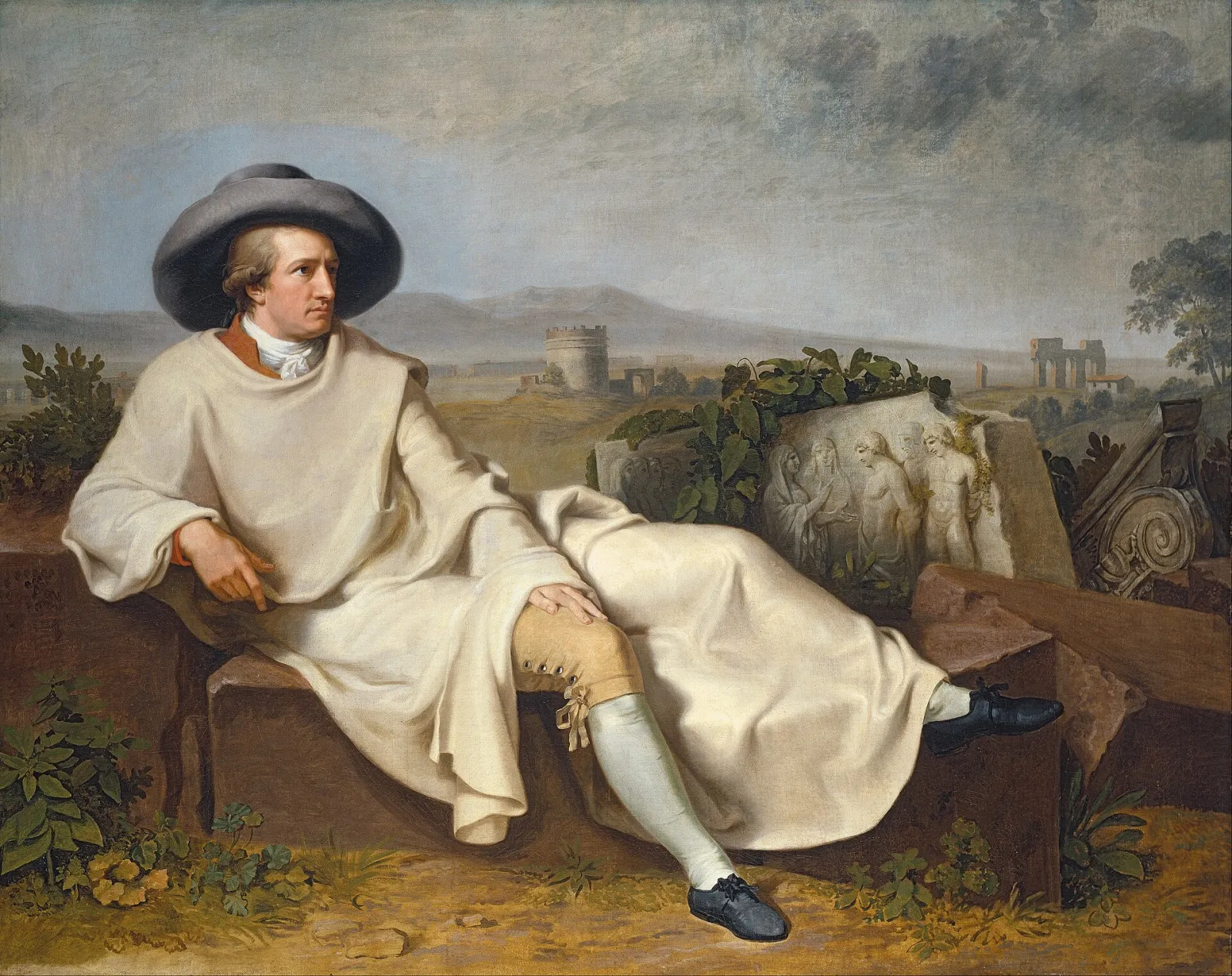
Johann Heinrich Wilhelm Tischbein came from a large Hessian family of painters. After training in Hamburg and Holland and work in Berlin, he went to Rome in 1779 and again, with a stipend from the Duke of Saxe-Gotha arranged partly through Goethe, in 1783. He and Goethe had corresponded before they met.
When Goethe arrived in Rome on 29 October 1786 he took lodgings in Tischbein's house on the Corso, opposite the Palazzo Rondanini. Tischbein guided him through the city and the galleries, introduced him to the German artists, and travelled with him to Naples in February 1787. In 1786–1787 he painted the large portrait Goethe in the Roman Campagna (now in the Städel Museum, Frankfurt), the most famous image of the poet: reclining on fallen ancient stones in a wide white travelling cloak, with the Campagna and its ruins behind.
In Naples Tischbein stayed on and became director of the academy of painting (1789–1799). He fled the French in 1799, later lived in Hamburg and Eutin, where he worked as court painter to the Duke of Oldenburg, and wrote memoirs, Aus meinem Leben (published 1861). He died in Eutin in 1829.
Goethe's view of Tischbein cooled in Naples, where the painter stayed at court while Goethe went on to Sicily with Kniep; some of Goethe's later remarks are reserved. Still, the friendship produced not only the Campagna portrait but many drawings, including the sheet of Goethe at the window of the house on the Corso, now in the Frankfurt Goethe House.
Importance for Goethe
Johann Heinrich Wilhelm Tischbein, a German painter in Rome, took Goethe into his lodgings on the Corso when he arrived in autumn 1786. He guided him through the city, opened the artists’ circles to him and accompanied him to Naples in 1787.
His painting “Goethe in the Roman Campagna” (1787) is the best-known image of Goethe. In Naples they parted, as Tischbein found a position there; he introduced Goethe to the painter Kniep for Sicily.
Goethe drew his characters from people he knew. Goethe Write keeps your characters, their notes and relationships together. All features ›
Goethe Write mode: write it yourself
- Create a character with a character sheet: role, age, goal, conflict and notes.
- Link your characters to each other in the relationships view, as Goethe’s life links the people around him.
- Place events on the timeline and see who meets whom, and when.
Questions
- Who painted “Goethe in the Roman Campagna”?
- Johann Heinrich Wilhelm Tischbein, in Rome in 1786–87; the painting hangs in the Städel Museum in Frankfurt.
- Where did Goethe live in Rome?
- With Tischbein on the Via del Corso, in the house now called Casa di Goethe, a museum.
Text sources
- IR 1786–1787
- Tischbein, Aus meinem Leben (1861)