
Yes, I have at last arrived in this capital of the world!
Ja, ich bin endlich in dieser Hauptstadt der Welt angelangt!
At three o'clock in the morning of 3 September 1786, a week after his thirty-seventh birthday, Goethe climbed into a post chaise in Carlsbad with a small trunk and a satchel and drove south. Only his secretary and confidant Philipp Seidel knew where he was going; the duke had been asked for indefinite leave in vague terms and had granted it; Charlotte von Stein was told nothing. He travelled under the name of Johann Philipp Möller, a merchant from Leipzig. He had wanted to see Italy since childhood, when he had looked at the views of Rome in his father's hall; twice he had stood at the threshold, on the Gotthard in 1775 and 1779, and turned back. This time he did not turn back.
Over the Alps
He crossed the Brenner on 8 September and wrote of the joy of seeing the first southern plants, the warm air, the fruit. In Verona he saw his first Roman monument, the amphitheatre. In Vicenza he discovered the architect Andrea Palladio, whose villas and churches showed him how the ancient world could be reborn in a modern one; he bought Palladio's books and studied them for the rest of the journey. From 28 September to 14 October he was in Venice, where he watched the boatmen sing Tasso, saw the sea for the first time, explored the arsenal and the paintings of Titian and Veronese, and went to the theatre almost every night. Then he hurried on through Ferrara, Bologna and the Apennines, barely stopping in Florence, as if drawn by a magnet.
Rome
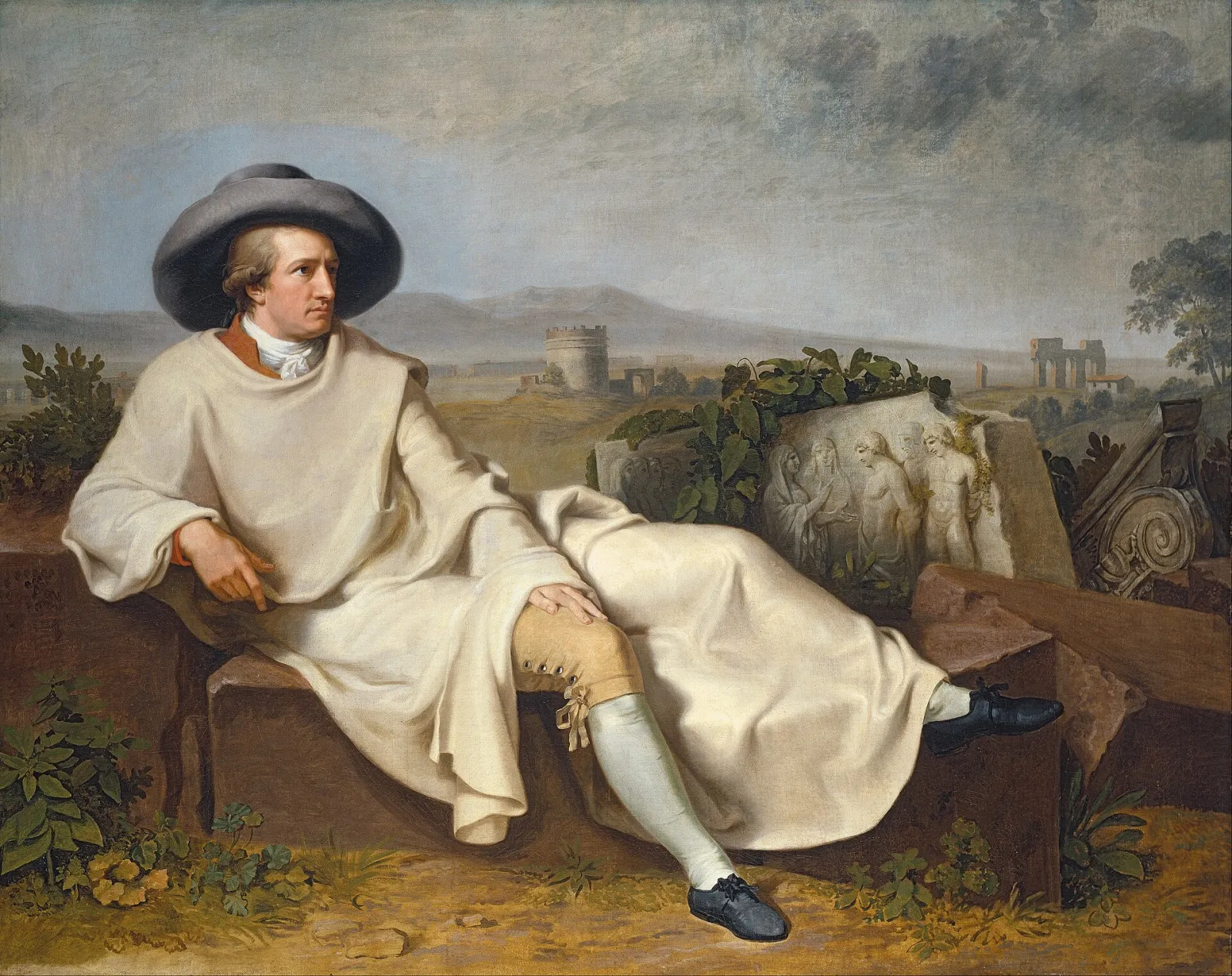
On 29 October 1786 he entered Rome through the Porta del Popolo. He lodged on the Corso with the painter Johann Heinrich Wilhelm Tischbein, with whom he had corresponded, and kept up his incognito as "Filippo Miller, German painter", though it was soon an open secret. Decades later he told Eckermann that only in Rome had he felt what it really means to be a human being (conversation of 9 October 1828). He walked the city systematically, drew, read Winckelmann on the spot, visited the galleries and ruins with the painters of the German colony, and set himself to learn to see. With Tischbein he went out to the Campagna; Tischbein began the great portrait that now hangs in Frankfurt's Städel Museum, Goethe in the Roman Campagna, showing him in a white travelling cloak, resting on fallen ancient stones.
He found new friends: the young writer Karl Philipp Moritz, who had broken his arm in a fall from a horse and whom Goethe nursed; the Swiss-born painter Angelika Kauffmann, celebrated across Europe, in whose house he spent Sunday afternoons; and the Swiss painter Johann Heinrich Meyer, who became his lifelong adviser on art.
Naples and Sicily
On 22 February 1787 he left for Naples with Tischbein. Naples overwhelmed him: the bay, the crowds, the life of the streets. He climbed Vesuvius three times, once during an eruption, dodging stones; he visited Pompeii and Paestum, where the Doric temples first repelled and then convinced him. He met the landscape painter Philipp Hackert, who taught him to draw more freely, and Sir William Hamilton, the British envoy, and his companion Emma Hart.
At the end of March he sailed to Sicily with the young painter Christoph Heinrich Kniep. In Palermo, in the public garden, he looked at the Mediterranean plants and pursued the idea of the Urpflanze, the "primal plant", a model from which all plants could be derived – not, as he came to see, a plant one could find, but a type, a law of formation. He travelled on to Segesta, Agrigento and Catania and back via Messina, and was nearly shipwrecked on the return to Naples in mid-May. "Italy without Sicily," he wrote, "leaves no image in the soul: here is the key to everything."
The second Roman stay
He returned to Rome on 6 June 1787 and stayed almost eleven months more. He now lived more openly, took part in the carnival – and later wrote a description of the Roman carnival of 1788 – drew and painted, and decided at last that he was not meant to be a painter but a poet. In Rome he finished the verse version of Iphigenia (published 1787), completed Egmont (sent to Weimar in September 1787), wrote new scenes for Faust – among them The Witch's Kitchen, in the Borghese gardens – and worked on Tasso. The duke, in letters, released him from most of his offices while confirming his salary and seat in the council; he would return as a minister without portfolio, responsible for science, art and the university.
The Roman Elegies, written after his return, suggest that in Rome he had a love affair, with a young woman called Faustina in the poems; who she was, and whether she existed as described, is not known.
Farewell
On the moonlit night before his departure he walked once more through the city to the Capitol and the Colosseum. He left Rome on 23 April 1788, travelling slowly through Florence, Milan, Lake Como and the Splügen Pass, and reached Weimar on 18 June 1788. He had been away for twenty-one months. The Italian Journey, which he edited from his diaries and letters nearly thirty years later (1816–1817, with the Second Roman Stay in 1829), is the record of a rebirth.
Sources of this chapter
Goethe, Italienische Reise (1816–1817) and Zweiter römischer Aufenthalt (1829); travel diary for Charlotte von Stein (Weimar Edition III, vol. 1); letters from Italy (Weimar Edition IV, vols. 8–9); Geschichte meiner botanischen Studien; Das römische Carneval (1789). K. Ph. Moritz, Reisen eines Deutschen in Italien (1792–1793). Lewes, Life and Works (1855). Bielschowsky, Goethe, vol. 1 (1896).
Sources of this chapter
- Goethe, Italienische Reise, parts 1–2 (1816–1817) and Zweiter römischer Aufenthalt (1829)
- Goethe, Tagebuch der italienischen Reise für Frau von Stein (1786), Weimar Edition III, vol. 1
- Goethe's letters from Italy to Charlotte von Stein, Herder and Carl August, Weimar Edition IV, vols. 8–9
- Goethe, Geschichte meiner botanischen Studien (1817/1831): the Urpflanze
- K. Ph. Moritz, Reisen eines Deutschen in Italien (1792–1793)
- G. H. Lewes, The Life and Works of Goethe (1855), book 4, chapters 1–5
- A. Bielschowsky, Goethe, vol. 1 (1896), chapter 15