

Over all the hilltops
Is rest.
Über allen Gipfeln
Ist Ruh.
Weimar in 1775 was a town of about six thousand inhabitants, with unpaved streets, a ducal palace that had burned down the year before, and a duchy of roughly one hundred thousand people that was poor, agricultural and in debt. Its court was small but not dull. The dowager duchess Anna Amalia, who had governed during her son's minority, was musical, curious and fond of company; she had brought the poet Christoph Martin Wieland to Weimar as tutor of her sons in 1772. The new duke, Carl August, was eighteen, a passionate hunter and rider, impatient, generous and eager to change things.
The genius period
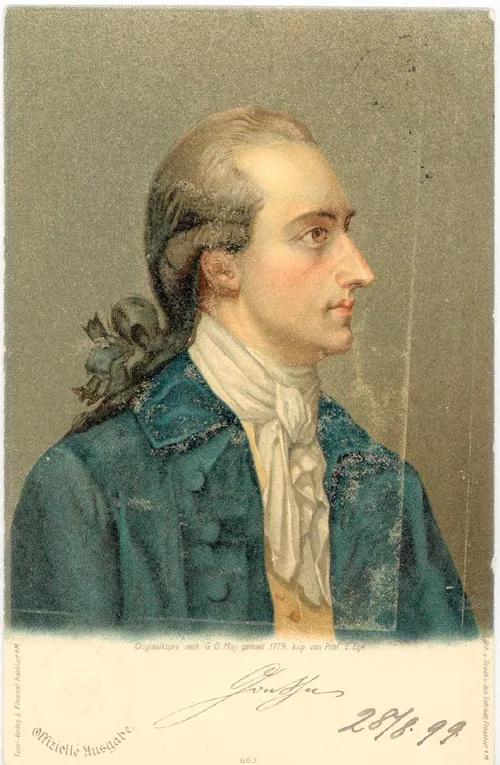
Goethe's first months were wild. He and the duke rode, hunted, skated, drank and played pranks; the court was shocked, and rumours reached Klopstock, who wrote a warning letter. But Carl August quickly decided that he wanted Goethe not as a guest but as a servant of the state. Against the resistance of his senior minister, Jakob Friedrich von Fritsch, who threatened to resign, he appointed Goethe on 11 June 1776 Privy Legation Councillor with a seat and vote in the Privy Council (Geheimes Consilium), the duchy's highest body. Goethe was twenty-six, a commoner and a foreigner. He accepted, and he became a citizen of Weimar.
In April 1776 the duke gave him a small house with a garden on the slope above the river Ilm. Goethe laid out the garden, planted trees and slept there, often under the open sky, for six years. The garden house remained his refuge for the rest of his life.
The offices
Over the next years the list of his responsibilities grew. In 1777 he took over the commission to reopen the old silver and copper mine at Ilmenau; on 24 February 1784 he gave the speech at the opening of the new shaft. In January 1779 he took over the war commission, which dealt with recruiting, and the road-building commission. In September 1779 he became Privy Councillor (Geheimer Rat). In 1782 he was made head of the Chamber, the ducal treasury, and had to put the finances in order, which meant cutting the army – he reduced it sharply – and the court's expenses. He studied geology for the mines, botany for the forests and agriculture, and anatomy at the university of Jena. He kept careful accounts, wrote memoranda and travelled through the duchy, inspecting villages after fires and floods.
The official work also confronted him with hard choices. In the autumn of 1783 the duke asked his councillors whether the death penalty for infanticide should be abolished in the case of Johanna Catharina Höhn, a young servant who had killed her newborn child. Goethe, in a written vote of 4 November, agreed with his colleagues that the penalty should be kept. Höhn was executed in Weimar on 28 November 1783. The decision stands in uncomfortable contrast with the pity he gives to Gretchen in Faust.
In 1782 Emperor Joseph II ennobled him, at the duke's request, so that he could appear at court on equal terms; the diploma is dated 10 April 1782. From then on he was Johann Wolfgang von Goethe. In June 1782 he moved into a large rented house on the Frauenplan in the centre of town, which the duke later bought and gave to him.
Charlotte von Stein
Within weeks of his arrival he met Charlotte von Stein, a lady-in-waiting to Anna Amalia, wife of the duke's master of the horse, Josias von Stein, and mother of seven children, of whom three survived. She was thirty-three, seven years older than Goethe, intelligent, reserved and melancholy. For ten years she was the centre of his emotional life. He wrote to her almost daily, sometimes several times a day – some seventeen hundred letters and notes survive – sent her flowers, drawings and verses, and read her everything he wrote. She schooled him in restraint and courtesy; he took her eldest surviving son Fritz into his house for some years and educated him. Whether the relationship was ever physical is unknown; Charlotte burned her own letters to him. In the poem Why did you give us the deep glances (1776) he wrote that in an earlier life she had been his sister or his wife. Her influence is felt in the calm, civilised women of Iphigenia and Tasso.
Journeys
In December 1777, alone and on horseback, he rode into the Harz mountains under the pretext of inspecting mines, visited a young man who had written to him in despair, and on 10 December climbed the Brocken in snow – a feat the local forester thought impossible in winter. The poem Harzreise im Winter came out of this journey. In September 1779 he accompanied the duke on a second journey to Switzerland, going on to Geneva, Chamonix and the Gotthard; on the way he visited Friederike Brion in Sesenheim and Lili, now Frau von Türckheim, in Strasbourg, and was received kindly by both.
Writing in Weimar
His literary output slowed, but it changed. He wrote short plays and operettas for the court's amateur theatre, in which he acted himself and in which the singer Corona Schröter, whom he had brought from Leipzig, took the leading parts. On 6 April 1779 the prose version of Iphigenia in Tauris was performed, with Corona as Iphigenia and Goethe as Orestes. He wrote the first books of a novel about the theatre, Wilhelm Meister's Theatrical Mission, and worked on Egmont and Tasso. He wrote the ballads The Erl-King (1782) and The Fisherman, the hymn The Divine (Das Göttliche), and the poem Ilmenau (1783), in which he looked back on his first wild years with the duke. And on the evening of 6 September 1780, in a wooden hut on the Kickelhahn hill above Ilmenau, he wrote on the wall eight lines that begin "Over all the hilltops is rest". In 1780 he joined the Freemasons' lodge Amalia.
Science
From the mines came geology; from the duke's forests and gardens, botany; from the anatomical theatre in Jena, osteology. On 27 March 1784 he wrote excitedly to Herder that he had found the intermaxillary bone in the human skull – the bone between the upper jaw's two halves that anatomists believed distinguished animals from humans. Others had seen traces of it before him, and the French anatomist Félix Vicq d'Azyr had described it, but Goethe's conclusion was his own: that human beings share one structural plan with the other animals. The scholarly world received it coolly.
Crisis
By 1786 he was thirty-seven, exhausted by administration, frustrated by the slowness of his writing and caught in a relationship that demanded much and gave him less and less. The edition of his collected works that he had promised the publisher Göschen required him to finish fragments he could no longer finish in Weimar. In the summer of 1786 he went to Carlsbad with the duke, Herder and Charlotte von Stein, celebrated his thirty-seventh birthday there – and then, without telling anyone except his secretary, left.
Sources of this chapter
Goethe's diaries 1776–1786 (Weimar Edition III, vol. 1). Letters to Charlotte von Stein (Weimar Edition IV, vols. 3–7) and to Herder, 27 March 1784. Official papers (appointment decree of 11 June 1776; vote of 4 November 1783). Harzreise im Winter; Briefe aus der Schweiz; Geschichte meiner botanischen Studien. Lewes, Life and Works (1855), books 4–5. Bielschowsky, Goethe, vol. 1 (1896).
Sources of this chapter
- Goethe's diaries 1776–1786, Weimar Edition III, vol. 1
- Goethe's letters to Charlotte von Stein, Weimar Edition IV, vols. 3–7
- Goethe, Amtliche Schriften (official papers), facts only from the documents
- Goethe, Harzreise im Winter (1777, printed 1789)
- Goethe, Briefe aus der Schweiz, part 2 (1796/1808)
- Goethe, Geschichte meiner botanischen Studien (1817/1831)
- G. H. Lewes, The Life and Works of Goethe (1855), books 4–5
- A. Bielschowsky, Goethe, vol. 1 (1896), chapters 11–14