

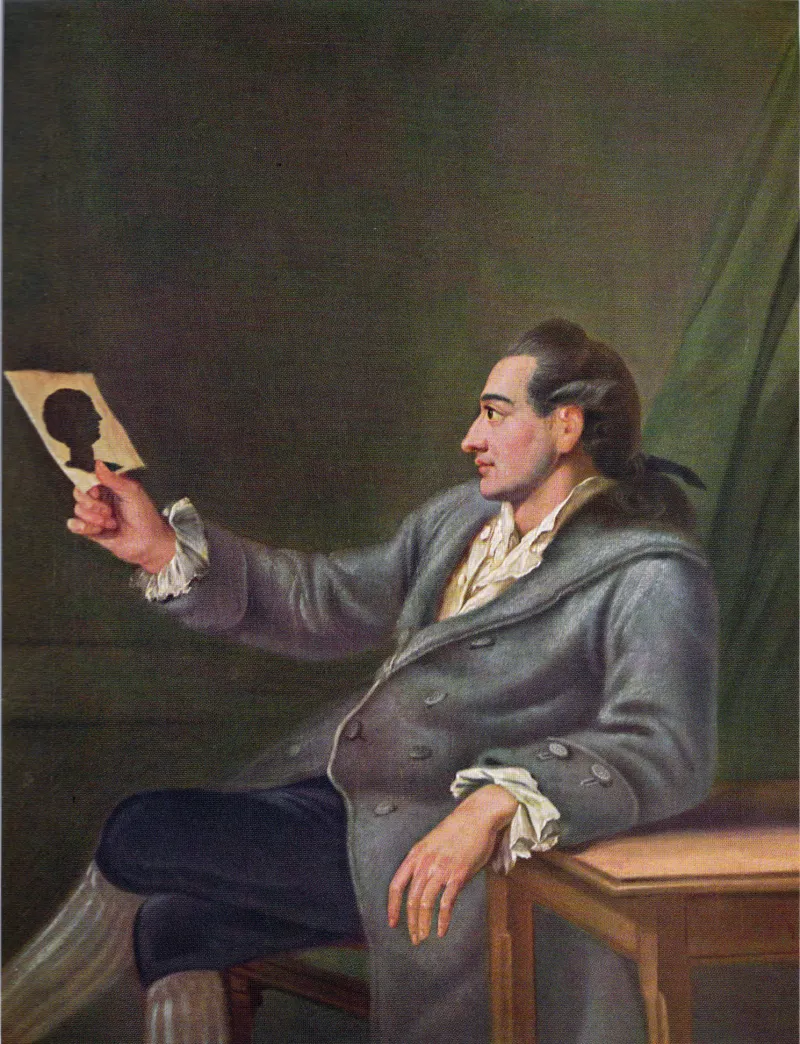
Child, child, no further! As if whipped on by invisible spirits, the sun-horses of time run away with the light chariot of our fate.
Kind, Kind! nicht weiter! Wie von unsichtbaren Geistern gepeitscht, gehen die Sonnenpferde der Zeit mit unsers Schicksals leichtem Wagen durch.
The year 1775 was the most restless of Goethe's young life. He was twenty-five, famous, overworked and in love, and by its end he had broken an engagement, crossed the Alps for the first time, set off for Italy and turned back, and arrived in a small Thuringian capital where he would stay for the rest of his life.
Lili
Early in 1775 a friend took him to a musical evening in the house of the widow Schönemann, whose late husband had founded one of Frankfurt's leading banks. Her daughter Anna Elisabeth, called Lili, sixteen years old, played the piano. Goethe fell in love – more seriously, he said in old age, than ever before or after. Lili was beautiful, lively, well educated and used to admiration, and she belonged to a world of wealth, balls and visits that was not his own. He wrote poems for her that are among his most graceful: New Love, New Life (Neue Liebe, neues Leben), To Belinda (An Belinden), Lili's Menagerie (Lilis Park), in which he pictures himself as a bear among her tame admirers. The two families were wary of each other: the Goethes were Lutheran and comfortable, the Schönemanns Calvinist and grand. Nevertheless, through the intercession of a family friend, Helene Delph of Heidelberg, the two were engaged around Easter 1775.
Flight to Switzerland
Almost at once Goethe felt trapped. When the brothers Christian and Friedrich Leopold zu Stolberg, young counts and poets of the Göttingen circle, came through Frankfurt in May on their way to Switzerland, he went with them, and with Count Christian von Haugwitz; to tease the public, all four wore the blue coat and yellow waistcoat of Werther. He visited his sister Cornelia in Emmendingen – she advised him to break off the engagement – then went on to Zurich, where he stayed with Lavater. On 15 June, rowing on the Lake of Zurich, he wrote the poem On the Lake (Auf dem See), one of the first in which he looks at the landscape with the clear eyes of his later work. On 22 June he stood on the St Gotthard Pass and looked down towards Italy. He did not go on. He turned back, carrying a little golden heart that Lili had given him, and was in Frankfurt again by late July.
The end of the engagement
Back home, the engagement dragged on through the summer, tormenting both. He never fully explained why it failed; the differences of family and religion, Lili's world, his own fear of a settled life all played a part. By the autumn the engagement was dissolved. Lili married the Strasbourg banker Bernhard Friedrich von Türckheim in 1778; in the hard years of the Revolution she showed great courage, fleeing with her children disguised as a peasant woman. In his letters of these months to Countess Auguste zu Stolberg, the sister of his travelling companions, whom he never met but to whom he wrote with complete frankness, we can follow his despair day by day.
In these months he wrote the play Stella (1776), in which a man loves two women – in its first version it ends with all three living together – and the opera Erwin and Elmire, and he began Egmont.
The invitation
In September 1775 Carl August came of age and took over the government of Saxe-Weimar-Eisenach. He married Princess Luise of Hesse-Darmstadt in Karlsruhe on 3 October and on his way home passed through Frankfurt, where he invited Goethe to visit Weimar. A chamberlain, Johann August Alexander von Kalb, was to collect him with a new carriage. Goethe said farewell to his friends and waited. The carriage did not come. After days of waiting, half embarrassed and half relieved, he decided to go south instead – to Italy, as his father had always wished – and on 30 October he set out. He stopped in Heidelberg with Helene Delph, who already had plans to marry him to someone else. There, in the early hours, a courier caught up with him: Kalb had been delayed and was now in Frankfurt. Goethe turned round. The last words of Poetry and Truth describe this moment, with a quotation from his own Egmont about the horses of time running away with the chariot of fate.
He travelled with Kalb through Thuringia and arrived in Weimar early in the morning of 7 November 1775. He intended to stay a few weeks.
The work of 1775
The year of Lili was also one of the most productive of Goethe's youth. He continued the scenes of Faust that he had begun in the early 1770s; the manuscript he took with him to Weimar, copied there by the lady-in-waiting Luise von Göchhausen and rediscovered in 1887, is known as the Urfaust. He wrote Stella, a 'play for lovers' about a man between two women, which ended in its first version (1776) with an unconventional reconciliation and was later given a tragic ending. He wrote the singspiele Erwin und Elmire and Claudine von Villa Bella, and he began Egmont, the drama of the Dutch nobleman who goes to his death trusting in his own freedom.
Many of the poems now counted among his finest also belong to this year: 'New Love, New Life', 'To Belinda', 'Lili's Park', and 'On the Lake', written on the Lake of Zurich during the flight to Switzerland. They record a love that both delighted and imprisoned him.
Between two worlds
The engagement exposed the gap between Goethe's world and Lili's. The Schönemanns were a wealthy Reformed banking family, accustomed to parties, music and fashionable company; Goethe was a Lutheran advocate with a famous name, a modest practice and a reputation for wildness. Both families had doubts, and Goethe's own restlessness made things worse. In Poetry and Truth he describes how a family friend, Demoiselle Delph, arranged the engagement almost by surprise, and how he afterwards felt himself bound and watched.
What awaited him in Weimar
The duchy he was going to was small and poor. Its capital, Weimar, had some six thousand inhabitants; the palace had burned down in 1774, and the court lived in temporary quarters. But the dowager duchess Anna Amalia had already made the town a place of culture: Wieland lived there as the young duke's former tutor, there was an amateur theatre, music and a good library. Carl August, eighteen years old, impetuous and eager, wanted to bring new life to his court. Neither he nor Goethe could know that the visit would last fifty-six years.
Sources of this chapter
Goethe, Dichtung und Wahrheit, books 16–20 (1833): Lili, the Swiss journey, the waiting and departure. Letters to Auguste zu Stolberg (Weimar Edition IV, vol. 2). Diary of the Swiss journey (Weimar Edition III, vol. 1). Auf dem See. Lewes, Life and Works (1855), book 3. Bielschowsky, Goethe, vol. 1 (1896).
Sources of this chapter
- Goethe, Dichtung und Wahrheit, part 4, books 16–20 (1833)
- Goethe's letters to Auguste zu Stolberg, 1775, Weimar Edition IV, vol. 2
- Goethe's diary of the Swiss journey, June 1775, Weimar Edition III, vol. 1
- Goethe, Auf dem See (dated 15 June 1775 in the manuscript)
- G. H. Lewes, The Life and Works of Goethe (1855), book 3, chapters 5–7
- A. Bielschowsky, Goethe, vol. 1 (1896), chapter 10