From the quill in Weimar to the desk on your Mac.
Goethe Write is named after a writer who worked on one text for most of his life. This is the story of the idea behind it, what we learned from his desk, and where we want to take it.
I · The idea
Why Goethe.
Johann Wolfgang von Goethe wrote poems, plays, novels, letters, scientific studies and official papers, often several at once. He came to Weimar in 1775 and made it his home for the rest of his life. In his house on the Frauenplan he worked among his books, his collections and the people who helped him write.
What draws us to him is not the monument but the workshop: the drafts, the second thoughts, the patience. Faust grew over some sixty years, from the first scenes of his youth to the second part he finished shortly before his death. A writer who works like that needs a desk that keeps everything, loses nothing and stays quiet.
That is the desk we want to build. A writing app named after Goethe has to earn the name every day – not by quoting him, but by serving the work.
Ihr naht euch wieder, schwankende Gestalten,
Die früh sich einst dem trüben Blick gezeigt.
Again you draw near, you wavering figures,
who once appeared, long ago, to my clouded eyes. (our translation)
II · Then
From the quill to the Mac.
Goethe rarely wrote alone. For many of his later works he walked up and down the room and dictated, while helpers such as Friedrich Wilhelm Riemer, Johann August Friedrich John and Johann Peter Eckermann wrote, copied and read back. He kept a diary for decades, often worked standing at a high desk, and had his library a few steps from his study.
Two centuries later the tools have changed; the work has not. A scene still has to be found, written, cut and written again. Goethe Write is a native Mac app for that work: screenplays in industry format and books on real pages, with the outline, the timeline, the characters and the research of a work in one project.
And the helpers? Goethe Write has one, if you want it: Goethe, a writing assistant that works with your own key at the AI provider you choose. It suggests; you decide. It is part of Goethe Cloud, and everything else in the app works without it.
Then and now.
Six habits of the house on the Frauenplan, and what became of them in Goethe Write.
Weimar
Helpers at his side
Riemer, John and Eckermann wrote down, copied and read back. The decisions stayed his.
Goethe Write
Goethe, the assistant
Works with your own key at one of six providers. Every change it suggests is tracked, and texts you hide from it are never sent.
Weimar
The high desk
In his study, a plain room far plainer than the rooms where he received guests, Goethe often wrote standing.
Goethe Write
Focus and Typewriter
Focus leaves nothing but the page. Typewriter keeps the line you are writing in the middle of the window.
Weimar
The diary
For decades he noted, day by day, what he had worked on and with whom.
Goethe Write
The writing history
The last four weeks at a glance: your writing days, the average, the best day and the days in a row.
Weimar
The library next door
His books stood a few steps from his desk; what he read went into what he wrote.
Goethe Write
Research beside the text
PDFs, scans and notes open next to your scene. Text recognition makes scanned pages searchable, and Use Quote takes a passage into your text.
Weimar
Faust, sixty years long
Begun in his twenties, finished shortly before his death, revised again and again in between.
Goethe Write
Snapshots and alternatives
Keep a text as it is, try another version, compare the two paragraph by paragraph. Longer passages you cut are kept under Deleted Passages.
Weimar
Rehearsals at the theatre
As director of the Weimar court theatre, Goethe worked through the text with the actors before it reached the stage.
Goethe Write
Table reads and read links
Everyone here opens the same scene on every connected device. A read link shows your work in any browser, and comments arrive in your project.
The desk today.
One window for the whole work, light or dark, as calm as a room with a single lamp.
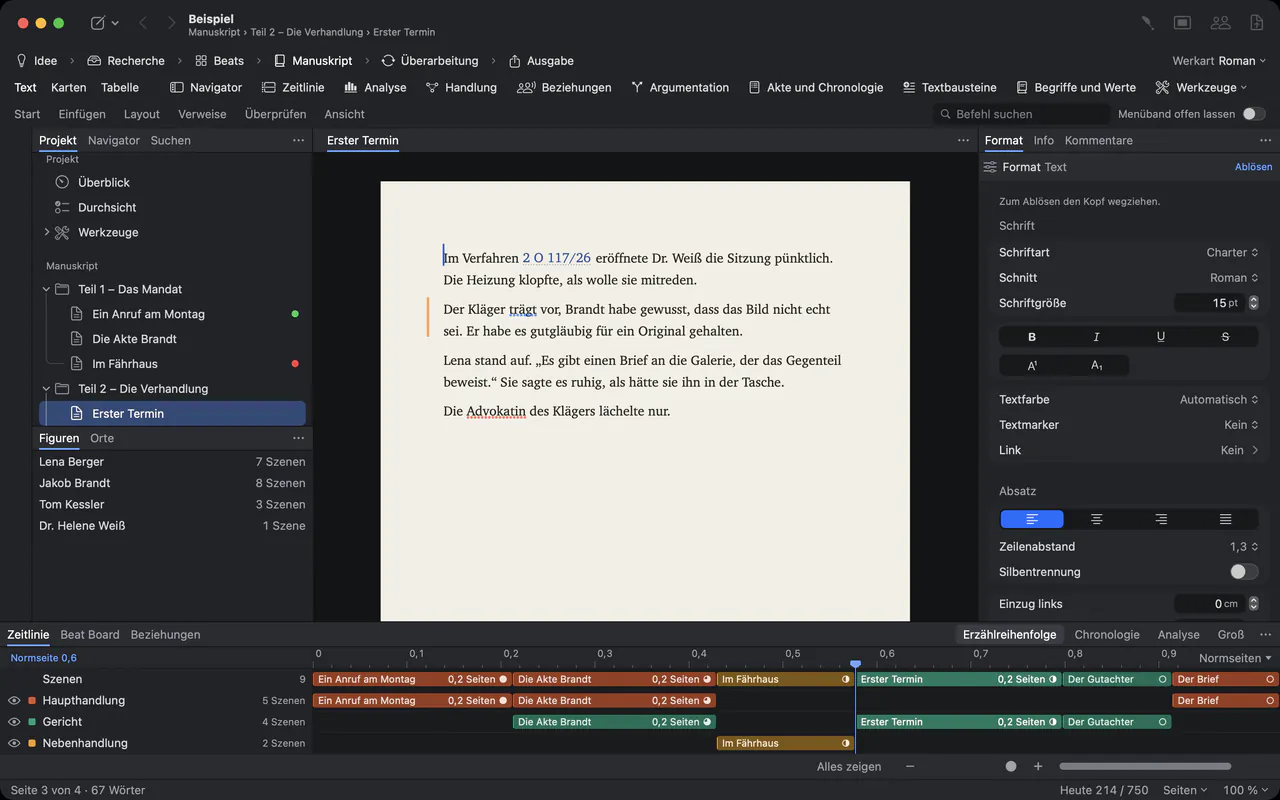
Denn was man schwarz auf weiß besitzt,
Kann man getrost nach Hause tragen.
For what you own in black and white
you can carry home with confidence. (our translation)
III · Now
What we want to achieve.
We want writers to own their work, in every sense. Projects are files on your Mac, not rows in someone else’s database. Writing, saving, importing and exporting need no account and no internet connection.
We want the work to outlast the app. Goethe Write saves in an open format with a public specification, so your texts stay readable without us: Goethe Format 1.
We want craft before gimmicks. A screenplay format that is right to the line, pages that look like the printed book, versions that are never lost. The assistant is there when you call it, and quiet when you don’t.
And we want writers to work together without giving anything away. Guests pay nothing, and the key to a read link never reaches our server.
Was glänzt, ist für den Augenblick geboren,
Das Echte bleibt der Nachwelt unverloren.
What glitters is born for the moment;
what is genuine stays, not lost to those who come after. (our translation)
IV · Tomorrow
From the idea to the big stage.
The Prelude on the Stage in Faust is a conversation between a theatre director, a poet and a comic actor about what a play needs before the curtain rises. It is the oldest argument of our trade, and it is still ours: between the moment and what lasts.
Every work starts small: a scene, a line, a name. We built Goethe Write so it can go the whole way from there – to the producer, the publisher, the theatre, the screen – without changing tools on the way.
Goethe Write is on the Mac App Store; on iPhone and iPad it is free. It is made by Nami Shams and Team and published by ICSL FZE.
If you want to meet the man behind the name, our Goethe Library has his life and his works, Faust among them.
diese sehr ernsten Scherze
these very serious jests (our translation)
Serious work, set down in black and white.
A writing app for long work, named after a writer who knew it.