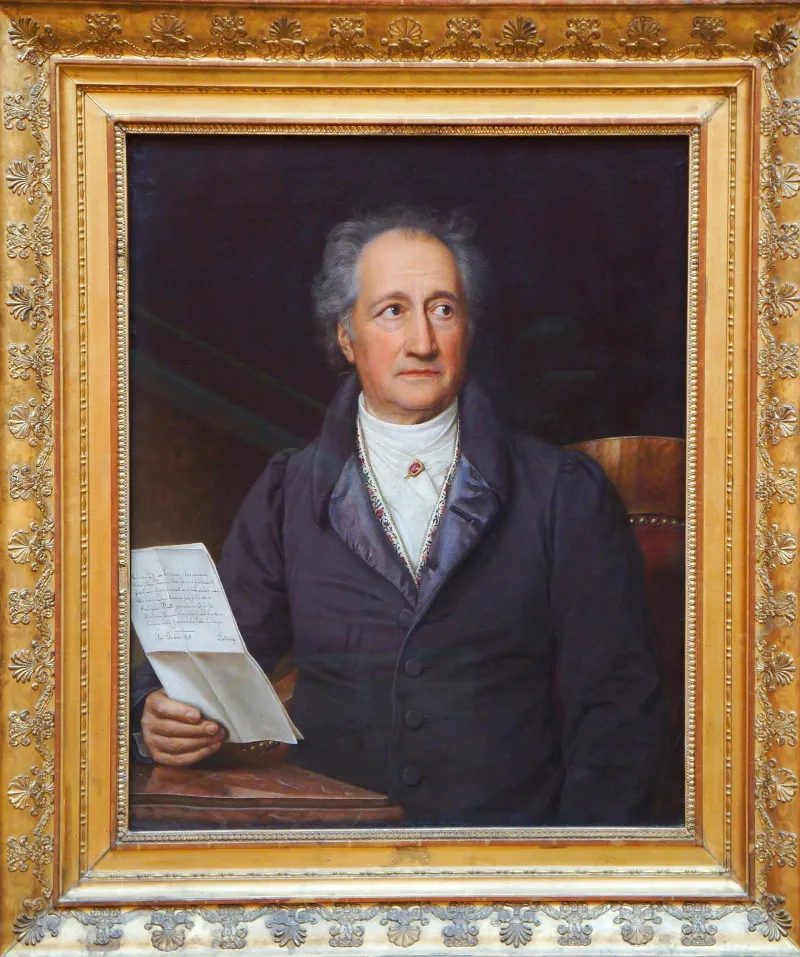
 Goethe Write is here – the writing app for Mac, iPhone and iPad.Download now
Drama · 1808
Faust, Part One
The scholar who has studied everything and knows nothing makes a wager with Mephistopheles – and draws Gretchen into his ruin. Goethe’s best-known work, sixty years in the making.
Faust. Eine Tragödie
Drama1808written 1772–180633,882 wordsTranslation: Bayard Taylor
.goethex file for Mac, iPhone and iPad · No Goethe Write yet? Download now
At a glance
Faust I joins two dramas: the scholar’s tragedy of a man who bets with the devil on a single fulfilled moment, and the tragedy of Gretchen, a young woman who through this love becomes a mother, the unwitting cause of her mother’s and brother’s deaths, and a child-murderer. Goethe worked on it from about 1772 to 1806; the Urfaust, the Fragment of 1790 and the finished First Part of 1808 show three stages. The play ends not with Faust’s fall but with Gretchen saved by a voice from above. It is the most quoted work of German literature and has occupied opera, music and film ever since.
And here I stand, poor fool that I am,
No wiser than I was before;
Da steh’ ich nun, ich armer Thor!
Und bin so klug als wie zuvor;
A night in a narrow Gothic study. Faust, doctor of every faculty, admits that all his learning has brought him nowhere. He turns to magic, conjures the Earth Spirit and is thrown back; on Easter morning the bells keep him from poison. Then a black poodle follows him home, and out of it steps Mephistopheles. The two do not sign an ordinary pact. Faust bets that the devil will never give him a moment so fulfilling that he would ask it to stay. If he ever says “Linger awhile, you are so fair”, he is lost.
What happens
What follows is two dramas braided into one. The first is the “scholar’s tragedy”: Faust’s despair, the wager, the witch’s kitchen that makes him young again. The second is the “Gretchen tragedy”. Faust seduces Margarete, a girl of fourteen or so from a small town; her mother dies of the sleeping draught he gives her, her brother Valentin dies on Faust’s sword, and she drowns the child she bears him. The play ends in a prison cell on the morning of her execution. Faust wants to carry her off; she refuses and gives herself to God’s judgement. “She is judged,” says Mephistopheles. A voice from above answers: “She is saved.”
How it was written
Goethe began Faust in Frankfurt in the early 1770s, when he was in his twenties and the old puppet play of Doctor Faustus was still performed at fairs. He took an early version with him to Weimar in 1775; a copy made by the lady-in-waiting Luise von Göchhausen was found only in 1887 and is known as the “Urfaust”. In 1790 he published Faust. Ein Fragment. Schiller urged him to go on, and between 1797 and 1806 Goethe added the dedication, the prelude in the theatre, the prologue in heaven and the wager. The finished First Part appeared at Easter 1808 in volume eight of Cotta’s edition of his works.
Why it matters
Faust is the work through which German speakers quote Goethe without knowing it: “Two souls, alas, reside within my breast”, “Grey, dear friend, is all theory”, “the heart of the matter” (des Pudels Kern). It is also one of the few plays that holds the whole range of verse: doggerel, madrigal, folk song, the solemn stanzas of the dedication. Its question has not aged: what does a person owe to his longing for more, and who pays for it? Goethe gives no easy answer. Faust is restless, charming and guilty; Gretchen, the one who loses everything, is the one who is saved.
Read it first for the scenes: “Night”, “Before the City Gate”, “Study”, “Gretchen’s Room” with the song at the spinning wheel, and “Dungeon”, one of the most shattering last scenes in the theatre. The Second Part, published after Goethe’s death, carries Faust on into the great world.
Where to begin
If you have never read verse drama, read the first scene aloud: Goethe wrote for the ear, and the rhythm carries you. The Gretchen scenes can be read on their own as a short tragedy, from “Street” to “Dungeon”.
This edition
The German text follows the first edition of 1808, checked line by line against page images of the print. It is divided into 28 sections, each on a page of its own, and runs to about 28,294 words – roughly 2 hours of reading. Translations: English, French, Spanish – nineteenth-century versions in the public domain, named with their translators. You can download every version as a .goethex file and open it in Goethe Write, with its structure intact.
Contents
Dedication, Prelude and Prologue
- 1DEDICATION1 min readThe poet addresses the forms of his youth that crowd around him again and remembers the friends he has lost.
- 2PRELUDE ON THE STAGE7 min readA theatre manager, a dramatic poet and a merry-andrew argue about what a play should offer its audience.
- 3PROLOGUE IN HEAVEN4 min readThe archangels praise creation, and the Lord allows Mephistopheles to try to lead Faust astray.
FIRST PART OF THE TRAGEDY
- 4NIGHT14 min readFaust despairs of learning, conjures the Earth-Spirit, is interrupted by Wagner and is kept from drinking poison by the Easter chorus.
- 5BEFORE THE CITY-GATE12 min readOn Easter Day Faust walks with Wagner among the townspeople outside the gate, and a black poodle follows them home.
- 6THE STUDY9 min readIn the study the poodle turns into Mephistopheles, who introduces himself and has spirits sing Faust to sleep.
- 7THE STUDY17 min readFaust makes his pact with Mephistopheles and signs it in blood, while Mephistopheles, wearing Faust's gown, advises a student.
- 8AUERBACH’S CELLAR IN LEIPZIG10 min readMephistopheles takes Faust to a Leipzig tavern and fools the drinking companions with magic wine.
- 9WITCHES’ KITCHEN9 min readIn the witch's kitchen Faust sees the image of a woman in a mirror and drinks the witch's rejuvenating potion.
- 10A STREET2 min readFaust speaks to Margaret in the street, is rebuffed and demands that Mephistopheles win her for him.
- 11EVENING4 min readFaust and Mephistopheles leave a casket of jewels in Margaret's room, which she finds after singing the ballad of the King of Thule.
- 12PROMENADE2 min readMephistopheles reports angrily that Margaret's mother has given the jewels to the priest, and Faust demands new ones.
- 13THE NEIGHBOR’S HOUSE6 min readAt the house of her neighbour Martha, Mephistopheles reports her husband's death and arranges a meeting in the garden.
- 14STREET2 min readMephistopheles asks Faust to give false witness about the death of Martha's husband, and Faust reluctantly agrees.
- 15GARDEN5 min readTwo couples walk up and down in the garden; Margaret tells of her life and asks a star-flower whether Faust loves her.
- 16A GARDEN-ARBOR1 min readIn the garden-arbor Faust and Margaret kiss until Mephistopheles and Martha call them away.
- 17FOREST AND CAVERN5 min readAlone in the wilderness Faust thanks the sublime Spirit, until Mephistopheles mocks him and drives him back to Margaret.
- 18MARGARET’S ROOM1 min readMargaret sits alone at her spinning-wheel and sings of her lost peace and her longing for Faust.
- 19MARTHA’S GARDEN4 min readMargaret asks Faust about his religion and accepts the sleeping-draught for her mother.
- 20AT THE FOUNTAIN1 min readAt the fountain Lisbeth tells of a seduced girl's disgrace, and Margaret recognises her own situation.
- 21DONJON1 min readMargaret prays before the image of the Mater Dolorosa to be saved from shame and death.
- 22NIGHT5 min readValentine confronts Faust and Mephistopheles outside Margaret's door, is stabbed and curses his sister as he dies.
- 23CATHEDRAL1 min readIn the cathedral an evil spirit torments Margaret during the service until she faints.
- 24WALPURGIS-NIGHT12 min readOn Walpurgis Night Mephistopheles leads Faust to the witches' revels on the mountain, where Faust sees an image of Margaret.
- 25WALPURGIS-NIGHT’S DREAM / OBERON AND TITANIA’S GOLDEN WEDDING / INTERMEZZO4 min readAn interlude celebrates the golden wedding of Oberon and Titania with short satirical appearances by many figures.
- 26DREARY DAY3 min readFaust learns that Margaret is in prison, rages at Mephistopheles and forces him to help free her.
- 27NIGHT1 min readFaust and Mephistopheles race past the raven-stone on black horses.
- 28DUNGEON7 min readFaust tries to lead the condemned Margaret out of the dungeon, but she gives herself up to the judgment of God and a voice proclaims that she is saved.
Characters
- FaustDoctor of every faculty, despairing of knowledge, who wagers with Mephistopheles.
- MephistophelesThe devil as man of the world and mocker, “the spirit that denies”.
- MargareteGretchen, a young townswoman whose love for Faust leads her into guilt, madness and prison.
- MartheGretchen’s neighbour, a widow-in-waiting who makes the garden meetings possible.
- WagnerFaust’s assistant, diligent and content with books – his opposite.
- ValentinGretchen’s brother, a soldier; dies in a duel with Faust, cursing his sister.
- Der HerrGod in the Prologue in Heaven, who lets Mephistopheles try Faust.
- GeistThe Earth Spirit, whom Faust conjures and who throws him back.
- SchülerA student to whom Mephistopheles, in Faust’s gown, explains the faculties.
- Die HexeBrews in the witch’s kitchen the potion that makes Faust young.
- LieschenTells at the well of a seduced girl – Gretchen hears her own fate.
- Böser GeistWhispers Gretchen’s guilt to her in the cathedral.
Places
- Faust’s studyA high-vaulted, narrow Gothic room: monologue, Earth Spirit, Easter night, pact.
- Auerbach’s Cellar, LeipzigWine cellar Goethe knew as a student; here Mephistopheles shows Faust ‘jolly company’.
- Gretchen’s room and Martha’s gardenThe small world of the love story: jewel box, spinning wheel, the question about religion.
- Harz mountains, the Brocken (Walpurgis Night)Witches’ sabbath on the night before 1 May; Goethe had climbed the Brocken in winter 1777.
- PrisonFinal scene: Gretchen refuses to escape and is ‘saved’.
Famous lines
I’ve studied now PhilosophyAnd Jurisprudence, Medicine,—
NIGHT · Opening of Faust’s first monologue in the scene ‘Night’. Two souls, alas! reside within my breast,
BEFORE THE CITY-GATE · Outside the city gate, to Wagner: the split between earthly desire and the urge upward. This was the poodle’s real core,
THE STUDY · Mephistopheles steps out of the poodle as a travelling scholar. I am the Spirit that Denies!
THE STUDY · Mephistopheles introduces himself – just after calling himself part of the power that wills evil and works good. Part of that Power, not understood,Which always wills the Bad, and always works the Good.
THE STUDY · His answer when Faust asks who he is. “Ah, still delay—thou art so fair!”
THE STUDY · The wager: if Faust ever says this, he belongs to Mephistopheles. And green alone Life’s golden tree.
THE STUDY · Mephistopheles, in Faust’s gown, to the student. How is’t with thy religion, pray?
MARTHA’S GARDEN · The ‘Gretchen question’ in Martha’s garden – proverbial in German for the question that cannot be dodged. My peace is gone,My heart is sore:
MARGARET’S ROOM · Gretchen at the spinning wheel; Schubert set the song in 1814. She is judged!
DUNGEON · Mephistopheles in the prison; a voice from above answers: ‘Is saved!’
Reception and afterlife
The first complete performance of Part One was given by August Klingemann at the court theatre in Braunschweig on 19 January 1829. Weimar followed the same year for Goethe’s eightieth birthday (29 August 1829); Goethe himself never prepared the play for the stage. In the twentieth century Gustaf Gründgens’ production at the Deutsches Schauspielhaus in Hamburg (1957), with Gründgens as Mephisto, shaped a generation’s idea of the play; it was filmed in 1960 (directed by Peter Gorski).
Few works have inspired so much music. Franz Schubert composed Gretchen am Spinnrade on 19 October 1814, aged seventeen. Hector Berlioz’s ‘dramatic legend’ La damnation de Faust was first given at the Opéra-Comique in Paris on 6 December 1846, Charles Gounod’s opera Faust at the Théâtre-Lyrique in Paris on 19 March 1859 – it became one of the most performed operas of the century. Arrigo Boito’s Mefistofele failed at La Scala, Milan, on 5 March 1868 and only succeeded in its shortened version (Bologna 1875). Robert Schumann wrote his Scenes from Goethe’s Faust between 1844 and 1853; Franz Liszt’s A Faust Symphony (1854–1857) portrays Faust, Gretchen and Mephistopheles in three movements.
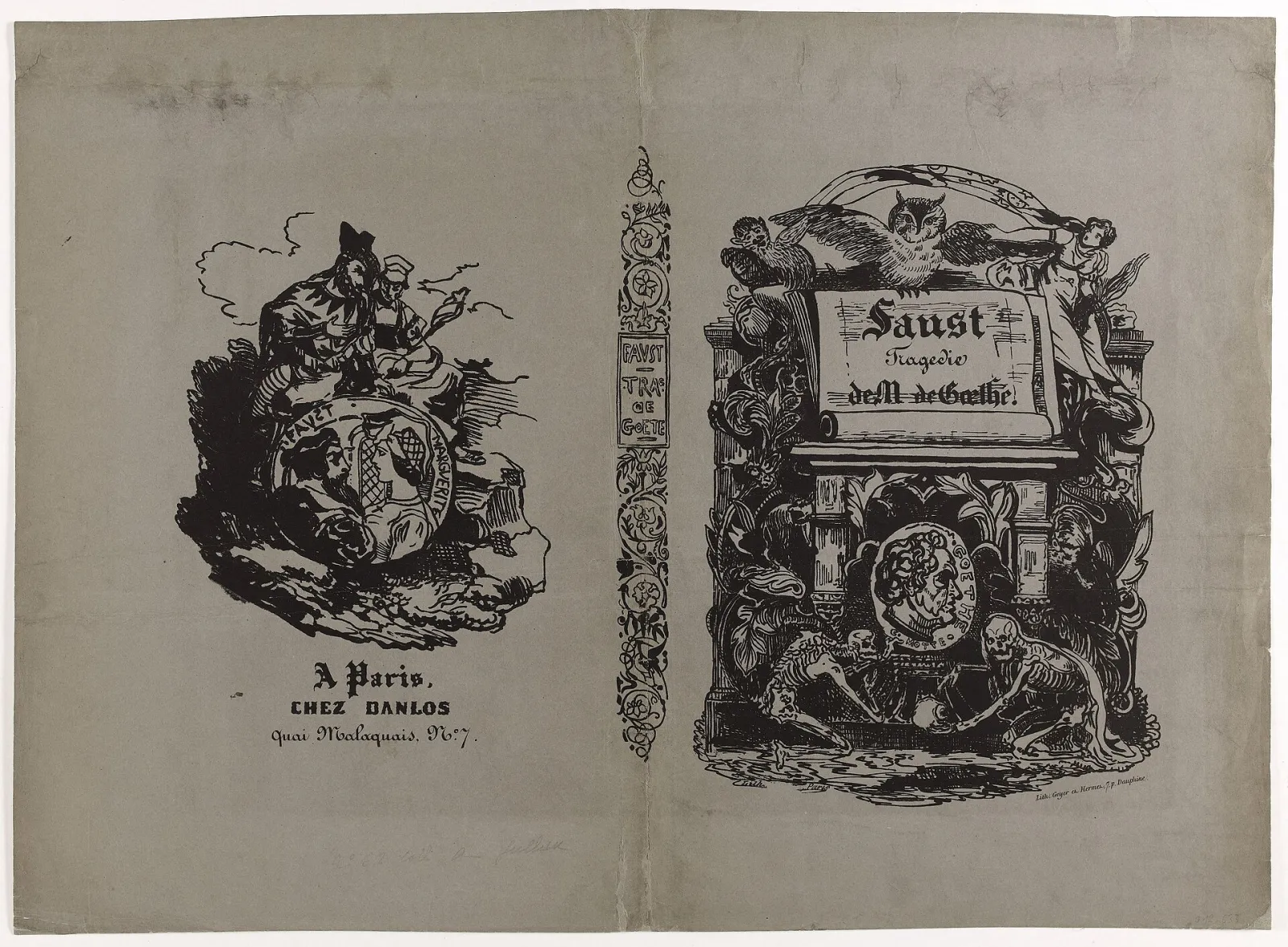
F. W. Murnau’s silent film Faust (Ufa, 1926), with Emil Jannings as Mephisto, blends Goethe with the older chapbook. Eugène Delacroix made a series of lithographs for the French edition in 1828, which Goethe praised. The same year saw Gérard de Nerval’s translation, which Goethe valued highly according to Eckermann; Bayard Taylor translated the work into English (1870–1871), Teodoro Llorente into Spanish (1882).
Download
- Goethe Write project (.goethex) 122 KB
- Plain text (.txt) 195 KB
The .goethex file opens in Goethe Write as a project of its own, with every part as a text of its own. The plain text carries the source and licence at the top.
Read next
- 1887Faust in ursprünglicher Gestalt (Urfaust)The earliest surviving form of Faust, written by the young Goethe in Frankfurt and known only from a copy made at the Weimar court. It contains the scholar’s despair, the student scene, Auerbach’s cellar and almost the whole Gretchen tragedy.
- 1832Faust. Der Tragödie zweiter TeilFaust wakes in an alpine meadow and goes out into the great world: the emperor’s court, ancient Greece and Helen, war, land won from the sea – and in the end, salvation. Goethe sealed it in 1831.
- 1774The Sorrows of Young WertherA novel in letters: a young man falls in love with Lotte, who is promised to another, and cannot live with it. The book that made Goethe famous across Europe at twenty-five.
Sources of these notes
- Goethe, Faust. Eine Tragödie, Tübingen: Cotta 1808 – Digitalisat der Herzogin Anna Amalia Bibliothek
- Faust I (Goethe), Seitenscans der Ausgabe 1808 – Wikimedia Commons
- Goethe, Faust, übers. von Bayard Taylor (1870–1871)
- Goethe, Faust, trad. Gérard de Nerval, Paris 1828 – Gallica
- Albrecht Schöne (Hg.), Johann Wolfgang Goethe: Faust. Texte und Kommentare (Frankfurter Ausgabe, 1994)
- Johann Peter Eckermann, Gespräche mit Goethe in den letzten Jahren seines Lebens (1836–1848)
Why it matters
“Faust, Part One” (1808) is the best-known work of German literature. Goethe worked on it from the 1770s (the ‘Urfaust’) until 1806; it premiered in Braunschweig in 1829.
It joins two tragedies: the scholar’s tragedy of Faust, who wants to know ‘what holds the world together at its core’ and makes a pact with Mephistopheles, and the Gretchen tragedy, in which his love ruins a young woman.
Writing a book of your own? Goethe Write gives it chapters, an outline, a timeline and characters – on the Mac, iPhone and iPad. All features ›
Comparisons: Goethe and Schiller compared · Faust Part One and Part Two compared · Faust and Werther: two of Goethe’s heroes
Study this text with Goethe Academy ›
Goethe Write mode: write it yourself
- Start a new project from the “Novel” template: three parts with five chapters, each with guiding questions.
- Rearrange chapters in the outline at any time.
- Keep sources and notes in the Research folder, next to the text.
- Save snapshots and compare them as the book grows.
Questions about the work
- What is Faust Part One about?
- The scholar Faust makes a wager with Mephistopheles, is made young again, seduces Gretchen and brings her to ruin; at the end a voice from above declares her saved.