

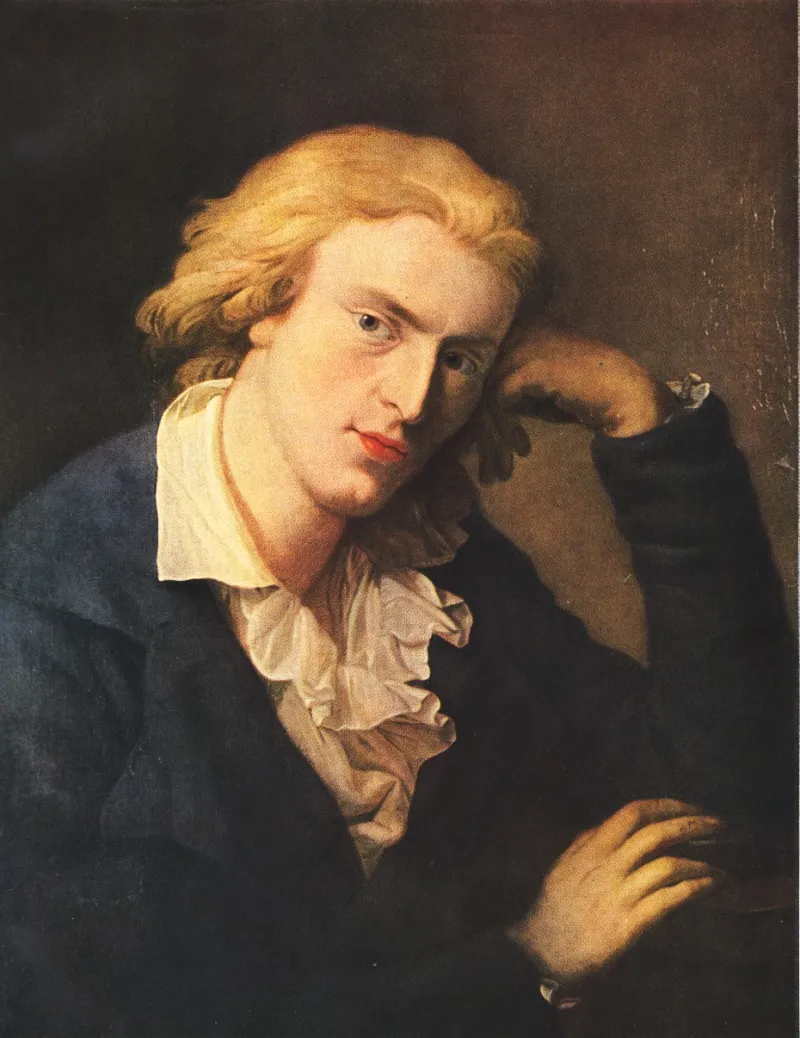
For behind him, in a shadowy glow,
Lay what binds us all: the common and the low.
Und hinter ihm, in wesenlosem Scheine,
Lag, was uns alle bändigt, das Gemeine.
In July 1794 Goethe and Schiller both attended a meeting of the Natural History Society in Jena. Leaving together, they fell into conversation. Schiller remarked that the fragmentary way of treating nature they had just heard could not appeal to the layman. Goethe agreed and, back at Schiller's house, explained his metamorphosis of plants, sketching a symbolic plant with a few strokes of the pen. Schiller listened and shook his head: "That is not an experience, that is an idea." Goethe, slightly annoyed, replied that he was glad to have ideas without knowing it and even to see them with his eyes. They argued, and in arguing found each other. Goethe described the encounter twenty-three years later in a short essay called A Happy Event (Glückliches Ereignis).
The letter of 23 August
A few weeks later, on 23 August 1794, Schiller wrote Goethe a long letter for his forty-fifth birthday in which he described Goethe's way of thinking better than Goethe himself could: a mind that proceeded intuitively from the whole of nature to the individual, a Greek born in the north who had to recreate, by thought, the world he had not been given by birth. Goethe answered that this was the best birthday present he had ever received. In September Schiller spent two weeks in Goethe's house in Weimar. Their correspondence, which Goethe himself edited and published in 1828–1829, runs to more than a thousand letters.
Die Horen and the Xenien
Schiller was founding a monthly journal, Die Horen (The Horae), published by Johann Friedrich Cotta in Tübingen, and Goethe became a contributor, printing there the Roman Elegies (1795), stories and essays. The journal was ambitious and not a commercial success, and the reviews were hostile. In answer the two friends wrote together, in the winter of 1795–96, hundreds of satirical distichs – two-line epigrams in classical metre – aimed at their critics and at the literary scene. They appeared as Xenien ("guest gifts") in Schiller's Musen-Almanach for 1797 and caused an uproar.
Wilhelm Meister
With Schiller's encouragement and detailed criticism, Goethe reworked his old theatrical novel into Wilhelm Meister's Apprenticeship (1795–96). The hero, a merchant's son, leaves the business for the theatre, discovers that he is not an actor, and finds his way through a secret society, the Tower, into an active life. The novel includes the songs of the child Mignon – "Do you know the land where the lemon trees bloom?" – and of the old Harper, and became the model of the German novel of education. Schiller's letters about each book are among the finest criticism of the time.
Ballads and Hermann and Dorothea
The year 1797 they called their "ballad year": in friendly competition they wrote narrative poems for the next Musen-Almanach. Goethe's include The Sorcerer's Apprentice, The Treasure Seeker, The Bride of Corinth and The God and the Bayadere. In 1797 he also published Hermann and Dorothea, an epic in hexameters about a young farmer's son who marries a refugee from the war on the left bank of the Rhine; it became the most widely read of his longer works during his lifetime. He took up Faust again, at Schiller's urging, and wrote the Dedication and the Prologue in Heaven. That summer he visited Frankfurt for the last time with Christiane and August, then travelled on to Switzerland for the third time.
The theatre of Weimar
In December 1799 Schiller moved from Jena to Weimar, and the two were now neighbours. Goethe staged Schiller's great plays at the court theatre: Wallenstein's Camp opened the renovated theatre on 12 October 1798, followed by The Piccolomini and Wallenstein's Death in 1799, Mary Stuart (1800), The Maid of Orleans (1801 in Leipzig, 1803 in Weimar), The Bride of Messina (1803) and William Tell (17 March 1804). Goethe trained the actors in verse speaking and stage movement; notes he dictated to two young actors in 1803 were later published as Rules for Actors. Together the two men also translated and adapted plays by Shakespeare, Racine, Voltaire and Gozzi.
Science, art and the young Romantics
These were also the years of the young Romantics in Jena – the brothers August Wilhelm and Friedrich Schlegel, Novalis, Ludwig Tieck, the philosophers Fichte and Schelling – who revered Goethe while he kept a friendly distance. With Johann Heinrich Meyer he edited the art journal Propyläen (1798–1800) and organised annual prize competitions for artists. He continued his work on colour and on the morphology of animals, and his friendship with Alexander von Humboldt began.
In January 1801 he fell gravely ill with a facial erysipelas and was unconscious for days; Christiane nursed him. Herder, estranged from him in his last years, died in December 1803. Goethe's play The Natural Daughter (1803), planned as the first part of a trilogy on the Revolution, remained a fragment.
The death of Schiller
Both men were often ill in the winter of 1804–05. Schiller worked on a new tragedy, Demetrius; Goethe was so unwell that his friends hid the news from him when Schiller died, of a lung disease, on the evening of 9 May 1805. He was forty-five. Goethe guessed it from Christiane's face the next morning. "I am losing half of my existence," he wrote to the composer Carl Friedrich Zelter in June. For the memorial performance of Schiller's Song of the Bell in Lauchstädt that August, Goethe wrote an Epilogue, which ends with the image of Schiller leaving behind, "in a shadowy glow, what binds us all, the common".
Sources of this chapter
Briefwechsel zwischen Schiller und Goethe (1828–1829), including Schiller's letter of 23 August 1794. Goethe, Glückliches Ereignis (1817); Tag- und Jahreshefte 1794–1805; Weimarisches Hoftheater (1802); Epilog zu Schillers Glocke (1805); letter to Zelter, 1 June 1805. Boyesen, Goethe and Schiller (1879). Lewes, Life and Works (1855), book 6.
Sources of this chapter
- Briefwechsel zwischen Schiller und Goethe, ed. Goethe (6 vols., 1828–1829)
- Goethe, Glückliches Ereignis (1817)
- Goethe, Tag- und Jahreshefte 1794–1805 (1830)
- Goethe, Epilog zu Schillers Glocke (1805, enlarged 1815)
- Goethe, Weimarisches Hoftheater (1802)
- H. H. Boyesen, Goethe and Schiller: Their Lives and Works (1879)
- G. H. Lewes, The Life and Works of Goethe (1855), book 6