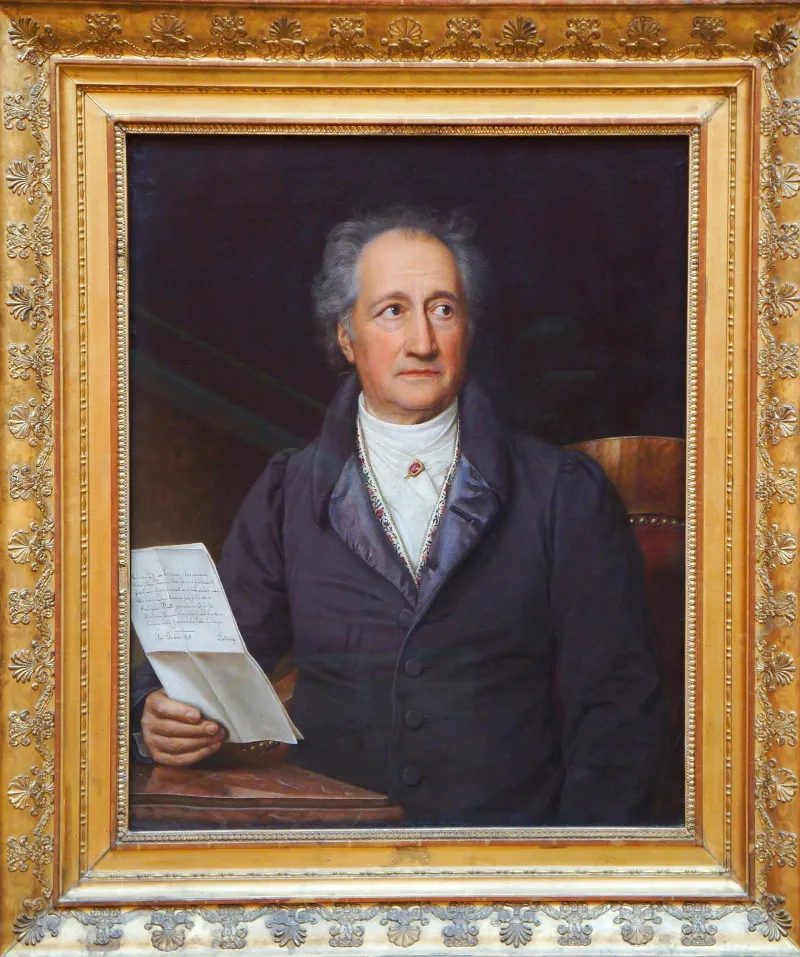

Johann Heinrich Meyer, from Stäfa on the Lake of Zurich, studied painting and went to Rome in 1784. Goethe met him there in 1786 and was impressed by his knowledge of art. In 1791 Meyer came to Weimar, lived for some years in Goethe's house and became teacher and later director of the ducal drawing school.
For four decades he was Goethe's closest collaborator on art: they travelled together to Switzerland and Italy in 1797 (Meyer went ahead), edited the journal Propyläen (1798–1800), organised the Weimar prize competitions for artists and wrote together in On Art and Antiquity. Goethe signed many essays jointly with him as 'W.K.F.' (Weimarische Kunstfreunde, Weimar friends of art). Known in Weimar as 'Kunschtmeyer' because of his Swiss accent, he died in Weimar in October 1832, a few months after Goethe.
Born in Stäfa on Lake Zurich on 16 March 1760, Meyer met Goethe in Rome in 1786 and became his closest adviser on art for over forty years. In 1791 he moved to Weimar and lived for years in Goethe's house; the Weimar circle called him 'Kunschtmeyer' after his Swiss pronunciation. Together they edited the journal Propyläen (1798–1800), set the Weimar art competitions (1799–1805) and wrote Winckelmann and his Century (1805). From 1807 Meyer directed the Weimar drawing school. He married in 1803 and died in Jena on 14 October 1832, a few months after Goethe.
Importance for Goethe
Johann Heinrich Meyer, a Swiss painter, met Goethe in Rome in 1786 and became his most important adviser on art. In 1791 Goethe brought him to Weimar, where he lived in Goethe’s house and became teacher, later director, of the Free Drawing School.
With Meyer Goethe edited the art journal “Propyläen” (1798–1800), organised the Weimar prize competitions for artists and produced “Winckelmann and His Century” (1805). Meyer, nicknamed “Kunschtmeyer” for his Swiss accent, stayed at Goethe’s side until his death.
Goethe drew his characters from people he knew. Goethe Write keeps your characters, their notes and relationships together. All features ›
Goethe Write mode: write it yourself
- Create a character with a character sheet: role, age, goal, conflict and notes.
- Link your characters to each other in the relationships view, as Goethe’s life links the people around him.
- Place events on the timeline and see who meets whom, and when.
Questions
- Who was Johann Heinrich Meyer to Goethe?
- His art adviser and friend from Rome in 1786, co-editor of the “Propyläen” and head of the Weimar drawing school.
- How did Goethe and Meyer meet?
- In Rome in 1786, where Meyer was studying antiquity as a young painter.
Text sources
- IR
- TuJ
- Propyläen (1798–1800)