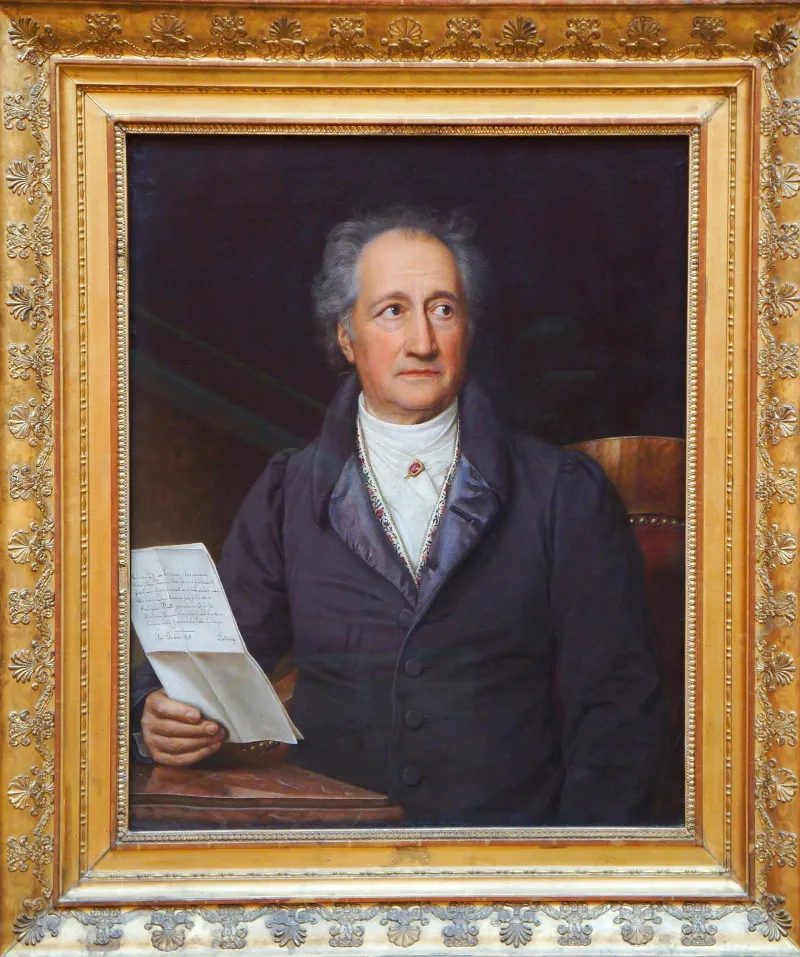

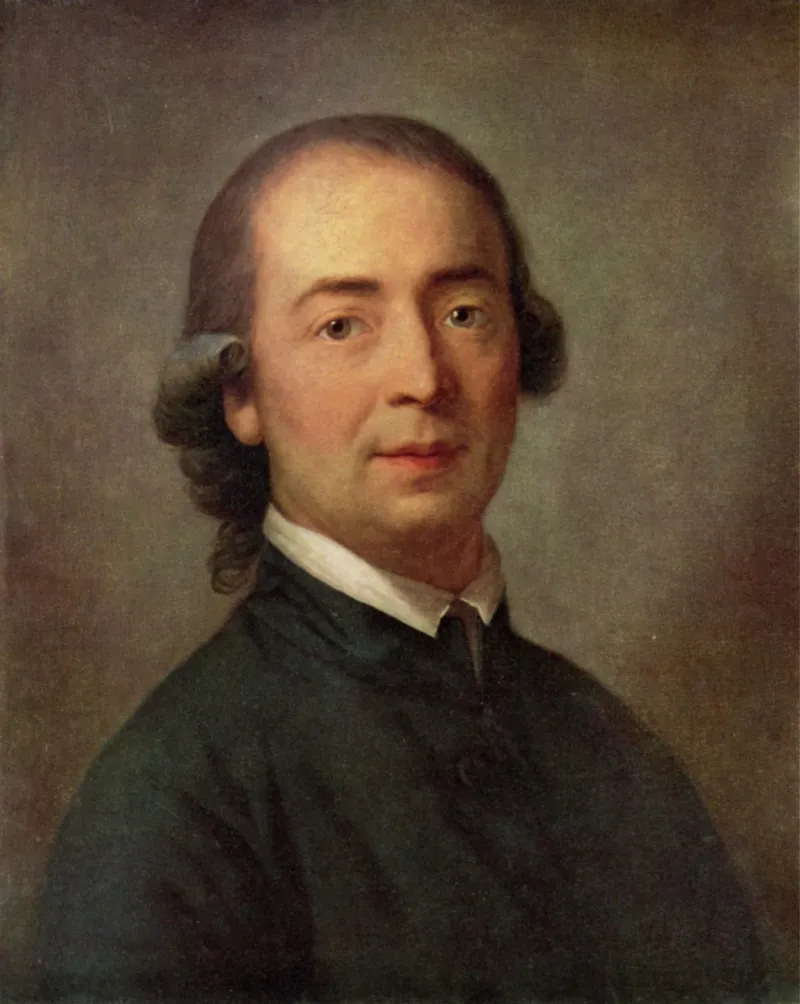
Johann Gottfried Herder was born on 25 August 1744 in Mohrungen in East Prussia (today Morąg, Poland), the son of a poor schoolmaster and cantor. In 1762 he went to Königsberg, nominally to study medicine but in fact theology and philosophy; he attended Kant's lectures and became the friend of Johann Georg Hamann, the eccentric 'Magus of the North', whose ideas about language and poetry shaped him for life. From 1764 he taught at the cathedral school in Riga and preached there, and published the Fragments on Recent German Literature (1767) and the Critical Forests (1769).
In 1769 he left Riga by sea; the Journal of my Voyage in the Year 1769 records the plans and self-doubts of that journey. In Darmstadt, in 1770, he met and became engaged to Caroline Flachsland, whom he married in 1773. In September 1770 he came to Strasbourg as travelling tutor to a prince of Holstein-Eutin and stayed through the winter to undergo a painful and unsuccessful operation on a tear duct. There the twenty-one-year-old law student Goethe sought him out.
Herder was only five years older but already an author of reputation, and he was often sarcastic with his admirer. Goethe described the meeting in Poetry and Truth (Book 10) as the most important event of his Strasbourg time: Herder opened his eyes to Homer, Ossian, Shakespeare, the Bible as poetry and above all folk song, and to the idea that poetry is the 'mother tongue of the human race'. Goethe collected folk songs in Alsace for him. The collection Of German Character and Art (1773) contains Herder's essays on Ossian and Shakespeare and Goethe's essay on Strasbourg Cathedral.
From 1771 Herder was court preacher and consistorial councillor in Bückeburg. In 1776, on Goethe's recommendation, Carl August called him to Weimar as general superintendent, the head of the Lutheran church of the duchy, court preacher and pastor of the town church of St Peter and Paul. He kept these offices for the rest of his life and worked hard to reform the schools.
In Weimar he wrote his principal works: the collection of folk songs (Volkslieder, 1778–79, later known as Voices of the Peoples in Songs), On the Spirit of Hebrew Poetry (1782–83), the Ideas on the Philosophy of the History of Mankind (1784–91), God: Some Conversations (1787) on Spinoza, the Letters for the Advancement of Humanity (1793–97) and the Cid romances. In the mid-1780s he and Goethe were very close again: they read Spinoza together, and Goethe's thinking about nature and history fed into the Ideas.
In the 1790s they drifted apart. Herder disapproved of Goethe's liaison with Christiane, of the alliance with Schiller and of Kant's philosophy, which he attacked in the Metacritique (1799); he sympathised longer with the French Revolution; and he felt overworked and underpaid. He was ennobled by the Elector of Bavaria in 1801. Herder died in Weimar on 18 December 1803 and is buried in the town church, now often called the Herder Church.
Herder's influence on Goethe's youth can hardly be overstated, and his ideas about language, nations and history – the value of every people's poetry, history as organic growth – reached far beyond Germany, into Slavic and Baltic national movements and modern anthropology.
Herder's house in Weimar, beside the church, was for some years a second home to Goethe; Caroline Herder was a close friend and correspondent, and the families visited often. The renewed closeness of the mid-1780s is reflected in Goethe's letters from Italy, many of them addressed to the Herders.
The monument by Ludwig Schaller in front of the church, unveiled in 1850, bears his motto 'Light, Love, Life'.
Importance for Goethe
Meeting Johann Gottfried Herder in Strasbourg in autumn 1770 was a turning point for Goethe. Herder turned him towards Homer, Shakespeare, Ossian, the Bible as poetry and folk song; Goethe went on to collect folk songs in Alsace. “Götz” and the Storm and Stress poems are hard to imagine without Herder.
In 1776 Goethe obtained for him the post of General Superintendent in Weimar. In the 1780s they worked closely together, for instance on Herder’s “Ideas on the Philosophy of the History of Mankind” and Goethe’s nature studies. After 1789 they drifted apart; Herder died in 1803.
Goethe drew his characters from people he knew. Goethe Write keeps your characters, their notes and relationships together. All features ›
Comparisons: Goethe and Herder
Goethe Write mode: write it yourself
- Create a character with a character sheet: role, age, goal, conflict and notes.
- Link your characters to each other in the relationships view, as Goethe’s life links the people around him.
- Place events on the timeline and see who meets whom, and when.
Questions
- How did Goethe and Herder meet?
- In September 1770 in Strasbourg, where Herder was undergoing eye surgery and Goethe visited him daily.
- What did Goethe owe Herder?
- A view of Shakespeare, Homer and folk song as original poetry – the basis of his Storm and Stress.
Text sources
- DuW II 10
- Goethe to Herder, 27 Mar 1784
- Herder, Von deutscher Art und Kunst (1773)
- TuJ 1803
- Goethe, Dichtung und Wahrheit, Buch 10 (1812)