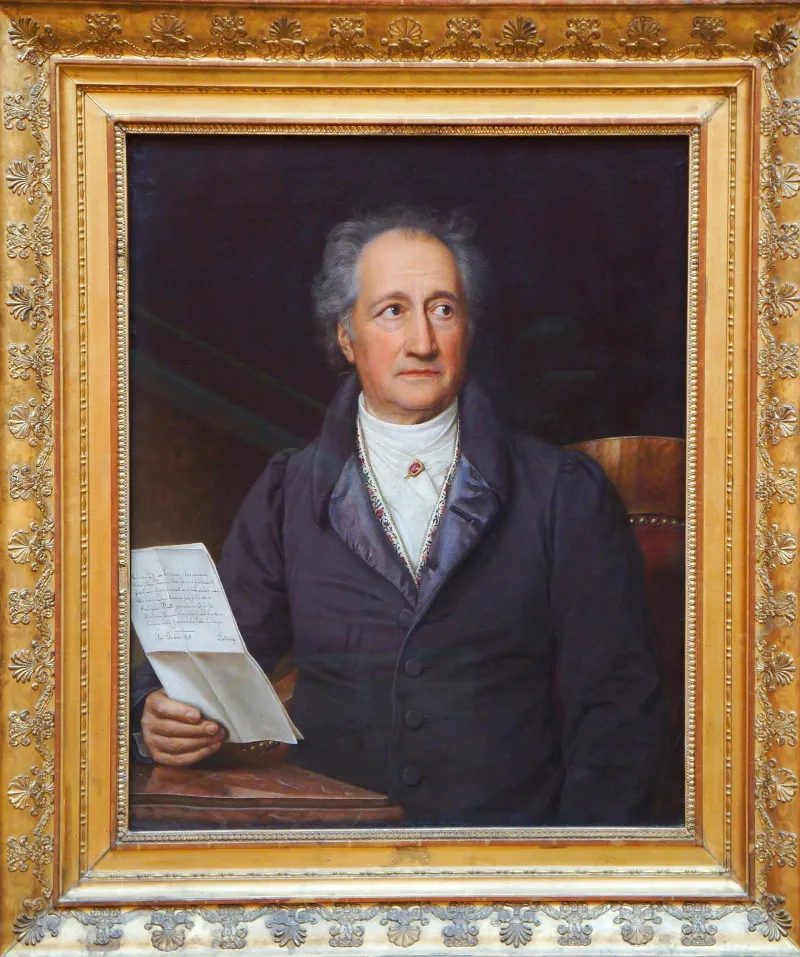

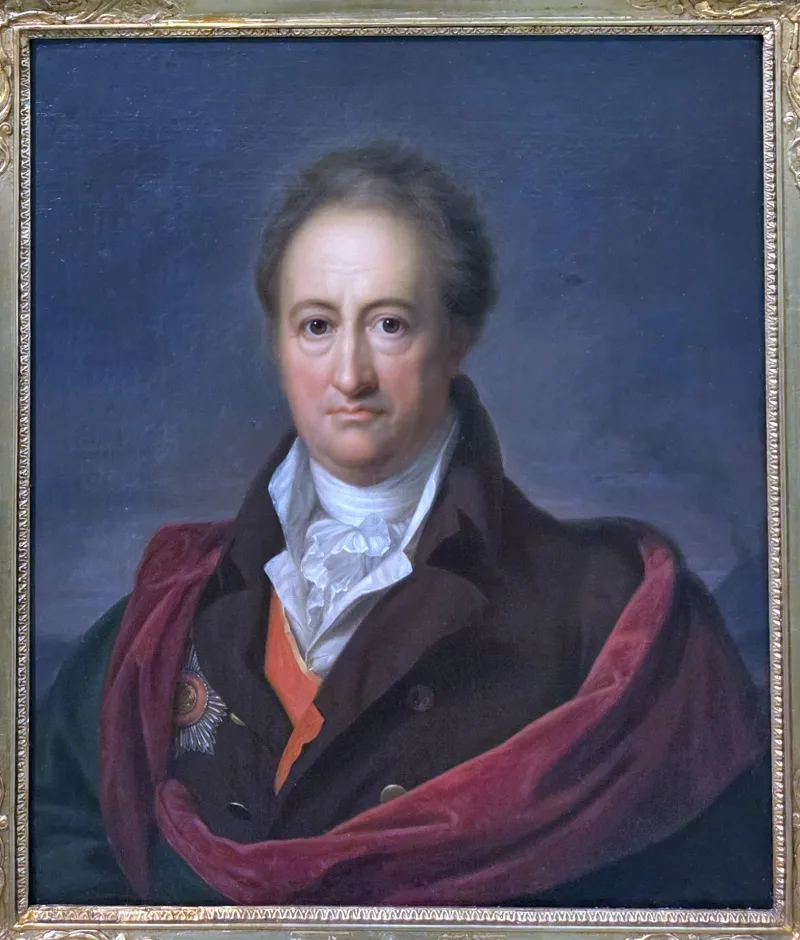
You come again, you wavering shapes,
That once appeared to my clouded gaze.
Ihr naht euch wieder, schwankende Gestalten,
Die früh sich einst dem trüben Blick gezeigt.
Without Schiller Weimar was quieter, and Goethe threw himself into work: he edited Schiller's unfinished Demetrius (and gave it up), published his study Winckelmann and His Century (1805), and lectured to a small circle of ladies on physics. Then the war came to Weimar.
Jena, 1806
On 14 October 1806 Napoleon defeated the Prussian army and its Saxon allies at Jena, while his marshal Davout won at Auerstedt. Carl August, a Prussian general, was with the defeated army. In the evening French troops poured into Weimar and plundered the town. Soldiers forced their way into the house on the Frauenplan; two of them threatened Goethe in his bedroom at night, and Christiane, with the help of servants and a lodger, drove them out. A senior French officer was then billeted in the house and protected it, and Marshal Lannes and others were guests. The duchy survived because the duchess Luise stood her ground before Napoleon.
Five days later, on 19 October 1806, Goethe married Christiane in the vestry of the Jakobskirche in Weimar, with their son August, now sixteen, and Goethe's secretary Riemer as witnesses. The rings were dated 14 October, the day of the battle. Weimar society, which had ignored her for eighteen years, now had to receive her – though some, like Charlotte von Stein, did so coolly. The writer Johanna Schopenhauer, newly arrived in Weimar, invited her at once; "if Goethe gives her his name," she remarked, "we can surely give her a cup of tea".
Losses
Anna Amalia, the dowager duchess, died on 10 April 1807; Goethe wrote the official obituary. On 13 September 1808 his mother died in Frankfurt at seventy-seven, cheerful to the end; he had not seen her since 1797. That year also saw the publication, at Easter 1808, of Faust. A Tragedy – what we now call Faust I – in the edition of his works published by Cotta. Almost forty years after he began it, the story of Faust and Gretchen was in print.
Napoleon
In the autumn of 1808 Napoleon held a congress of princes in Erfurt to impress Tsar Alexander I. On 2 October he summoned Goethe. Goethe's own brief note, dictated years later, records that the emperor looked at him and said, "You are a man" ("Vous êtes un homme!"), asked about his age and his works, talked about Werther – which he had read many times and whose plot he criticised in one detail – and about tragedy, remarking that fate in modern tragedy is politics. A few days later, in Weimar, they met again, and Napoleon urged him to come to Paris and write a Death of Caesar. Goethe was awarded the cross of the Legion of Honour, which he wore proudly. He admired Napoleon as a demonic force of history to the end and was mocked by German patriots for it.
Novels and colours
In 1807–1808 he fell in love, briefly and without hope, with Minna Herzlieb, the eighteen-year-old foster daughter of the Jena bookseller Frommann, and wrote sonnets for her. Out of this, out of reflection on marriage and out of chemistry came the novel Elective Affinities (Die Wahlverwandtschaften, 1809): two couples on a country estate are drawn to each other as chemical elements combine and separate, with fatal consequences. It was received with confusion and moral disapproval, and has been admired ever since for its precision.
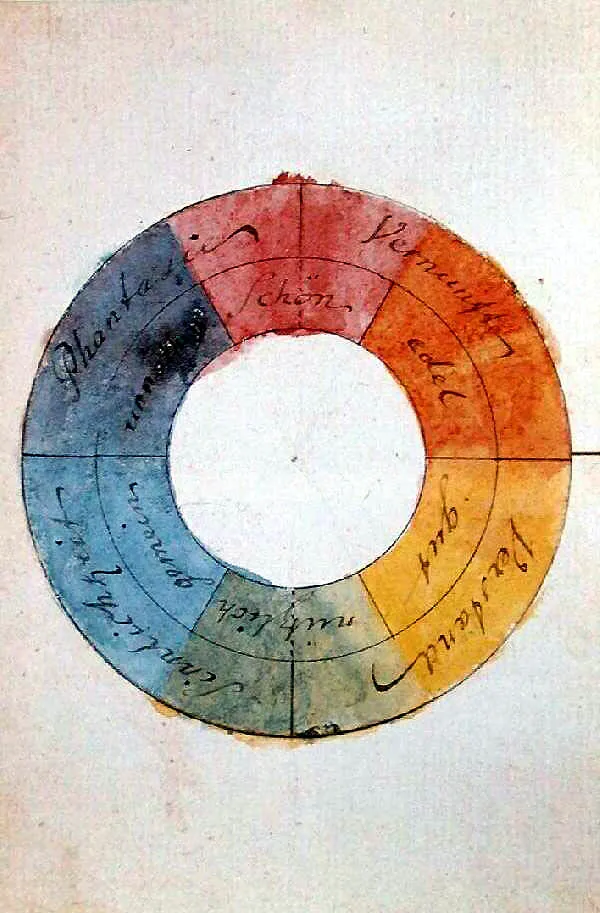
In May 1810 the Theory of Colours (Zur Farbenlehre) appeared in two volumes with plates, the fruit of twenty years of experiments. Its didactic part describes, with great care, how colours appear to the eye – afterimages, coloured shadows, the colours of turbid media – and is still valued by painters and psychologists of perception. Its polemical part attacks Newton's theory that white light is composed of coloured rays, and there Goethe was wrong. He nevertheless counted the book among his most important achievements.
Memory
At sixty he began to write his autobiography, From My Life: Poetry and Truth (Aus meinem Leben. Dichtung und Wahrheit). The first part appeared in 1811, the second in 1812, the third in 1814; the fourth, covering 1775, only after his death. The title says what it is: a truthful life shaped by an artist's hand.
Bohemia and Beethoven
Almost every summer he now spent several weeks in the Bohemian spas, Carlsbad and Teplitz, for his health and for company. In Teplitz in July 1812 he met Ludwig van Beethoven, whose music he respected and found unsettling; Beethoven had written music for Egmont (1810). Goethe wrote to Zelter that Beethoven's talent amazed him, but that he was "an utterly untamed personality". The often-told story that Beethoven kept his hat on while Goethe bowed to the empress comes from Bettina Brentano and is not reliable.
On 20 January 1813 Christoph Martin Wieland died; Goethe gave a memorial address in the Masonic lodge. The war came back that year: after Napoleon's defeat in Russia, the German states rose against him, and in October 1813 the battle of Leipzig decided his fate in Germany. Goethe's son August volunteered, to his father's displeasure, but was kept in Weimar by the duke.
Sources of this chapter
Goethe, Tag- und Jahreshefte 1805–1813 (1830); Unterredung mit Napoleon (dictated 1824); diaries (Weimar Edition III, vols. 3–5); letters to Zelter (including 2 September 1812 on Beethoven) and Cotta. F. von Müller, Erinnerungen aus den Kriegszeiten (1851). Johanna Schopenhauer's letters to her son (printed 1910s). Lewes, Life and Works (1855), book 6. Bielschowsky, vol. 2 (1904).
Sources of this chapter
- Goethe, Tag- und Jahreshefte 1805–1813 (1830)
- Goethe, Unterredung mit Napoleon (note dictated 1824, printed 1836)
- Goethe's diaries 1806–1813, Weimar Edition III, vols. 3–5
- F. von Müller, Erinnerungen aus den Kriegszeiten 1806–1813 (1851)
- Goethe's letters to Zelter and Cotta, Weimar Edition IV
- G. H. Lewes, The Life and Works of Goethe (1855), book 6
- A. Bielschowsky, Goethe, vol. 2 (1904)