

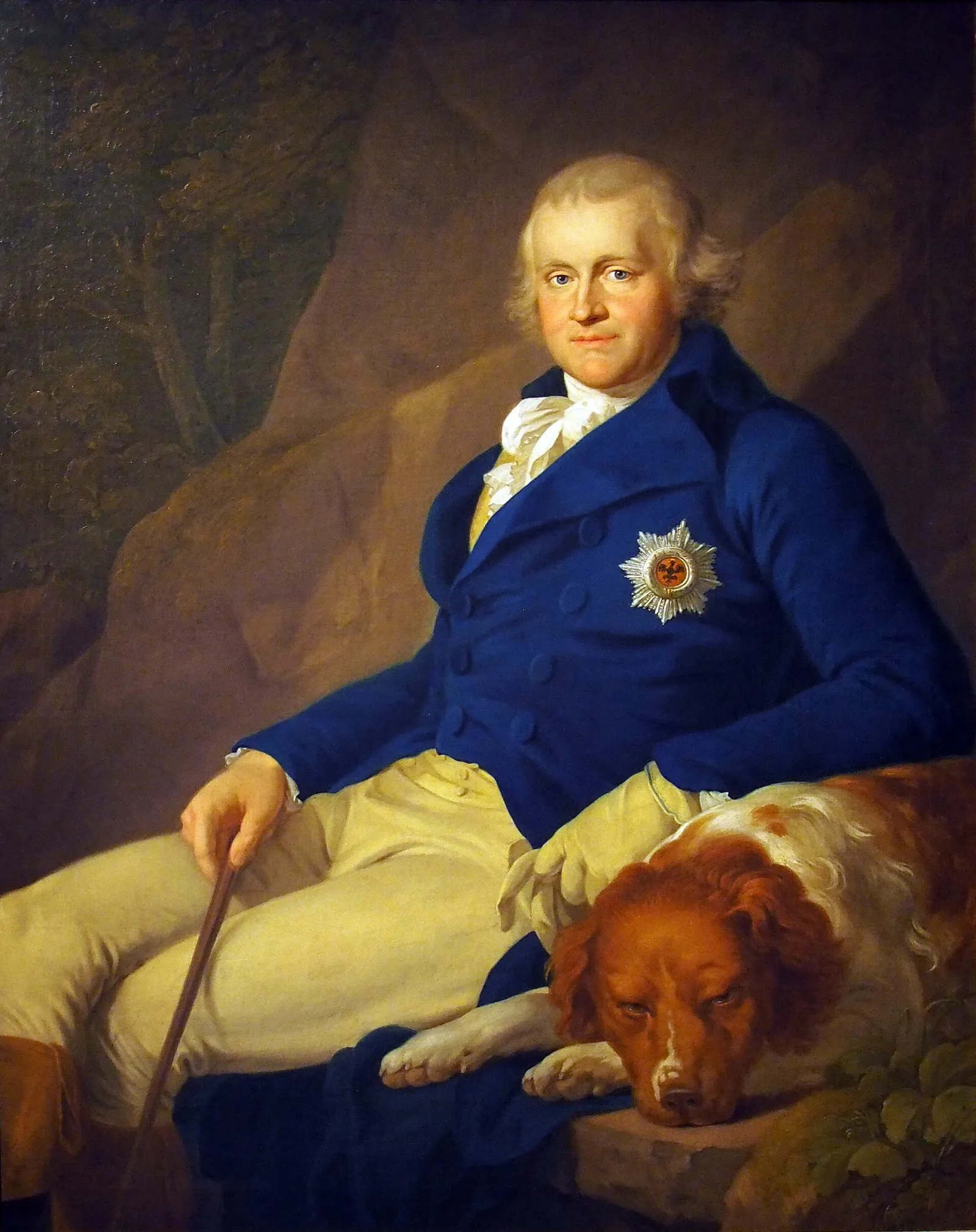
Carl August was born in Weimar on 3 September 1757, the elder son of Duke Ernst August II Konstantin of Saxe-Weimar-Eisenach and Anna Amalia of Brunswick. His father died in 1758, and his mother ruled as regent for seventeen years; his tutors included the writer Christoph Martin Wieland and the soldier and poet Karl Ludwig von Knebel. The duchy was small, poor and largely rural, with about 100,000 inhabitants; Weimar itself had some 6,000.
Knebel introduced the young prince to Goethe in Frankfurt in December 1774. On 3 September 1775 Carl August came of age and took over the government, and on 3 October he married Princess Luise of Hesse-Darmstadt. He invited Goethe to Weimar; the poet arrived on 7 November 1775 and stayed for the rest of his life. The first months were famous for wild rides, hunts and pranks, which alarmed the court and older friends such as Klopstock.
Against the protests of his ministers, the duke appointed Goethe to the Privy Council in June 1776 and gave him ever wider duties: roads, the war commission, mines at Ilmenau, finances. He ennobled him in 1782. When Goethe left for Italy in 1786 Carl August continued his salary; after the return he released him from most routine business while keeping him in charge of the university of Jena, the scientific institutes, the library and, from 1791, the court theatre.
Carl August was also a soldier. He served as a Prussian general, took part in the campaign in France in 1792 and the siege of Mainz in 1793, on both of which Goethe accompanied him and later wrote. After the defeat at Jena and Auerstedt in 1806 the duchy survived only by joining Napoleon's Confederation of the Rhine. At the Congress of Vienna it was enlarged and raised to a grand duchy (1815), and in 1816 Carl August granted one of the first constitutions in the German states, with a guarantee of press freedom that soon caused trouble with Metternich.
Their relationship was a friendship between unequals that lasted more than half a century, with periods of tension. The duke's long liaison with the actress and singer Caroline Jagemann led to the conflict of 1817, when a play with a performing dog was staged against Goethe's will and Goethe gave up the direction of the theatre. In 1825 Weimar celebrated the fiftieth anniversary of both the duke's reign and Goethe's arrival.
Carl August died on 14 June 1828 at Graditz near Torgau, on the way home from Berlin. Goethe withdrew to Dornburg for several weeks to recover. The duke is buried in the ducal vault in Weimar, where Goethe's coffin was placed in 1832.
Carl August had wide interests of his own: he collected minerals and paintings, founded the drawing school and the botanical garden in Jena with Goethe, promoted forestry and agriculture, and in old age took a lively interest in the natural sciences. The many letters between him and Goethe, from formal reports to frank personal notes, show a mutual trust that survived every disagreement.
Goethe summed up the relationship in conversation with Eckermann, saying that the duke had given him freedom and the means to develop. Their double portrait in the Weimar memory culture – the prince and the poet – became, in the nineteenth century, a model of enlightened patronage; historians today also note the limits of the duchy's reforms and the hard sides of its government, including Goethe's own role in harsh decisions such as a death sentence in 1783.
His equestrian statue by Adolf von Donndorf stands on the Platz der Demokratie in Weimar, in front of the Duchess Anna Amalia Library.
Importance for Goethe
Carl August brought Goethe to Weimar in 1775 and, over the objections of his officials, appointed him to the Privy Council in 1776. Goethe’s Weimar life would not have existed without him: minister, mining, roads, the war commission, later the theatre, the University of Jena and the scientific institutions – all came from his hand.
He granted Goethe the long absence in Italy from 1786 and afterwards relieved him of most administrative work. Goethe accompanied him on the 1792 campaign in France (“Campaign in France”) and to the siege of Mainz in 1793. The friendship lasted more than fifty years, until Carl August’s death in 1828.
Goethe drew his characters from people he knew. Goethe Write keeps your characters, their notes and relationships together. All features ›
Goethe Write mode: write it yourself
- Create a character with a character sheet: role, age, goal, conflict and notes.
- Link your characters to each other in the relationships view, as Goethe’s life links the people around him.
- Place events on the timeline and see who meets whom, and when.
Questions
- Why did Goethe go to Weimar?
- Young Duke Carl August invited him in 1775; Goethe stayed because the duke offered him office, influence and friendship.
- What offices did Goethe hold under Carl August?
- From 1776 he sat on the Privy Council and ran the mining, roads and war commissions, for a time the finances, later the court theatre and the supervision of science and the arts.
Text sources
- DuW IV 15, 20
- TuJ
- Briefwechsel Carl August–Goethe (1863)
- Campagne in Frankreich
- Eckermann, Gespräche mit Goethe (1836–1848)