

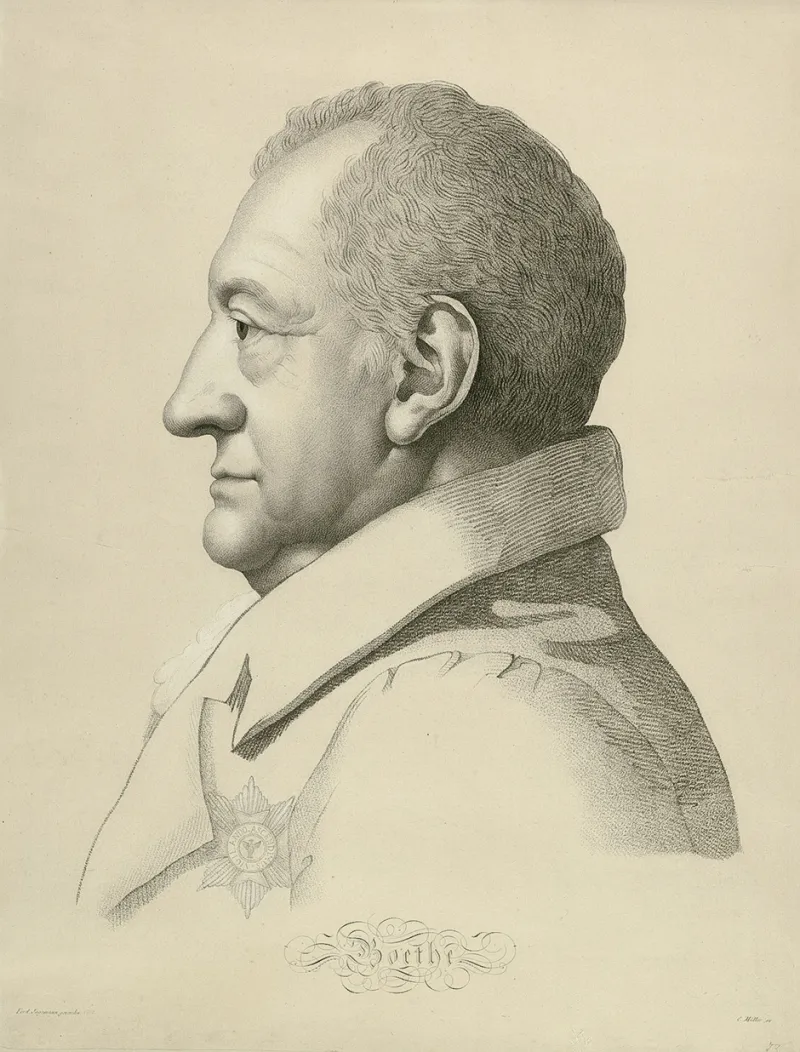
And as long as you do not have this: Die and become! – you are only a dim guest on the dark earth.
Und so lang du das nicht hast,
Dieses: Stirb und werde!
Bist du nur ein trüber Gast
Auf der dunklen Erde.
In 1814 Goethe was sixty-five. Napoleon was on Elba, the war was over, and a new restlessness seized him. In the spring of that year his publisher Cotta sent him the new translation of the Divan of the fourteenth-century Persian poet Hafez by the Viennese orientalist Joseph von Hammer. Goethe read it and felt, as he wrote, that he had to respond creatively or be overwhelmed. Within weeks he was writing poems in a new, light, playful tone – poems of wine, love, travel, faith and doubt, spoken in the masks of the poet Hatem and his beloved. He called the planned collection the West-Eastern Divan.
Rhine and Main
In July 1814 he travelled to the spa of Wiesbaden and on to the Rhine and Main, the landscapes of his youth, for the first time in seventeen years. In Frankfurt he visited the Frankfurt banker and privy councillor Johann Jakob von Willemer and his foster daughter Marianne Jung, a young woman from Linz who had come to Frankfurt as a dancer and singer as a child and whom Willemer had taken into his house; on 27 September 1814 Willemer married her. In August and in the autumn of 1814, and again in the summer of 1815 at the Willemers' country house, the Gerbermühle on the Main, Goethe and Marianne spent weeks together. They exchanged poems in the voices of Hatem and Suleika; and Marianne, who was thirty, wrote several poems of her own – among them the two great songs to the east wind and the west wind – which Goethe included in the Divan under his own name. This was revealed only in 1869, after her death, by the scholar Herman Grimm, to whom she had told it.
They last saw each other in Heidelberg in September 1815. Goethe abruptly cancelled a planned visit to Frankfurt; they never met again, but wrote to each other until his death. In 1815 he also travelled with the art collector Sulpiz Boisserée to see his collection of old German and Netherlandish paintings in Heidelberg, which changed Goethe's view of medieval art.
A new state
At the Congress of Vienna, Saxe-Weimar-Eisenach became a grand duchy and gained territory. In December 1815 Goethe was named Minister of State, with the supervision of all institutions of science and art in Weimar and Jena – a post that suited him perfectly.
Christiane's death
Christiane had been ill for years. In the spring of 1816 she suffered a stroke and then an agonising kidney failure; on 6 June 1816 she died after a week of great pain. Goethe, himself ill, did not go to her deathbed in the last hours. He wrote in his diary of "emptiness and the silence of death in and around me" and composed four lines for her: "You try, O sun, in vain / To shine through the dark clouds! / The whole gain of my life / Is to weep over her loss." A few months later, in September 1816, Charlotte Kestner – the Lotte of Werther – visited Weimar with her daughter, and Goethe received her with stiff courtesy.
Children and grandchildren
On 17 June 1817 his son August married Ottilie von Pogwisch, a lively and unconventional young woman from an impoverished noble family. They lived in the upper floor of the house on the Frauenplan. The marriage was unhappy, but it brought Goethe grandchildren: Walther (1818), Wolfgang (1820) and Alma (1827), whom he loved and spoiled. In April 1817, after an actress who was also the grand duke's mistress, Caroline Jagemann, had arranged for a play with a performing dog to be staged against Goethe's will, he resigned as director of the theatre, after twenty-six years.
Books
These were years of harvest. The Italian Journey appeared in 1816–1817; the journal On Art and Antiquity (Über Kunst und Altertum) from 1816; On Natural Science in General, especially Morphology from 1817. In 1817 he wrote the Primal Words. Orphic (Urworte. Orphisch), five stanzas on daemon, chance, love, necessity and hope. The West-Eastern Divan was published in 1819 with long Notes and Essays that introduced German readers to Persian and Arabic poetry. Wilhelm Meister's Journeyman Years (Wanderjahre) appeared in a first version in 1821; the Campaign in France in 1822.
Marienbad
In the summers of 1821, 1822 and 1823 he went to the new Bohemian spa of Marienbad. There he met Ulrike von Levetzow, the eldest daughter of a family he knew, seventeen years old in 1821. In 1823, aged seventy-four, he asked Grand Duke Carl August to sound out the girl's mother about a marriage. The answer was evasive and kind; Ulrike, who lived to ninety-five and never married, later said she had not wished it. On the journey home in September 1823 Goethe wrote in the carriage the Marienbad Elegy, one of his most personal poems, about loss and the impossibility of renunciation. He had been seriously ill in February 1823, with a heart inflammation that nearly killed him. When he came home he was an old man who had decided to finish his work.
The book of the Divan
The West-Eastern Divan, published by Cotta in 1819 and enlarged in 1827, is the great poetic work of these years. Goethe arranged it in twelve books, each with a Persian and a German title: the Book of the Singer, of Hafis, of Love, of Reflections, of Ill Humour, of Sayings, of Timur, of Suleika, of the Tavern, of Parables, of the Parsee and of Paradise. The opening poem, 'Hegire', written in December 1814, compares the poet's escape into the East with the Prophet's flight from Mecca to Medina: while 'North and West and South are splintering', thrones are bursting and empires trembling, he flees to the pure East to taste the air of the patriarchs. The Napoleonic wars and their end form the dark background of the book.
Goethe prepared himself with the seriousness of a scholar. He read the translations and studies of Joseph von Hammer, the travel accounts of Chardin and others, the Qur'an in German and Latin translations, and the works of the orientalists Heinrich Friedrich von Diez and Silvestre de Sacy; he even practised writing Arabic script. To help readers he added a long prose part, Notes and Essays for a Better Understanding of the West-Eastern Divan, on the history, religions and poetry of the Middle East – one of the earliest attempts by a major European writer to present Islamic and Persian culture with respect and from the inside.
Science in old age
Goethe's scientific work did not stop. From 1817 to 1824 he published two series of booklets, On Natural Science in General and On Morphology, in which he collected old and new essays, among them the history of his own botanical studies and reports on the work of younger scientists. He followed the controversies of the day, from the origin of basalt to the classification of animals.
A new interest was the weather. In 1815 he read the classification of clouds by the English chemist Luke Howard – cirrus, cumulus, stratus and their combinations – and was delighted by it; he wrote the poem 'In Honour of Howard' and corresponded with him. From 1821 Carl August, at Goethe's suggestion, set up a network of weather stations in the grand duchy, one of the first systematic networks of its kind in Germany, and Goethe wrote instructions for the observers. His late essay 'Attempt at a Theory of Weather' (1825) tried to explain atmospheric changes from the earth itself.
Autobiography
These years also saw the continuation of Goethe's autobiography. The Italian Journey appeared in two volumes in 1816 and 1817, compiled from his letters and diaries of 1786–87; the account of the second Roman stay followed only in 1829. The Campaign in France 1792 and the Siege of Mainz came out in 1822. Together with Poetry and Truth they form a long, carefully shaped story of his own development, in which the old Goethe looks back on the young one with both sympathy and distance.
Sources of this chapter
Goethe, West-östlicher Divan (1819) with Noten und Abhandlungen; Tag- und Jahreshefte 1814–1822; diaries (Weimar Edition III), including the entry of 6 June 1816; correspondence with Marianne von Willemer (ed. Creizenach, 1877); Boisserée's diaries (1862); Herman Grimm's report of 1869 on Marianne's poems. Lewes, Life and Works (1855), book 7.
Sources of this chapter
- Goethe, West-östlicher Divan (Stuttgart: Cotta, 1819), with Noten und Abhandlungen
- Goethe, Tag- und Jahreshefte 1814–1822 (1830)
- Goethe's diaries 1814–1823, Weimar Edition III
- Briefwechsel zwischen Goethe und Marianne von Willemer, ed. Th. Creizenach (1877)
- S. Boisserée, Tagebücher and Briefwechsel (1862)
- Ulrike von Levetzow's recollections (printed 1900) – facts only
- G. H. Lewes, The Life and Works of Goethe (1855), book 7