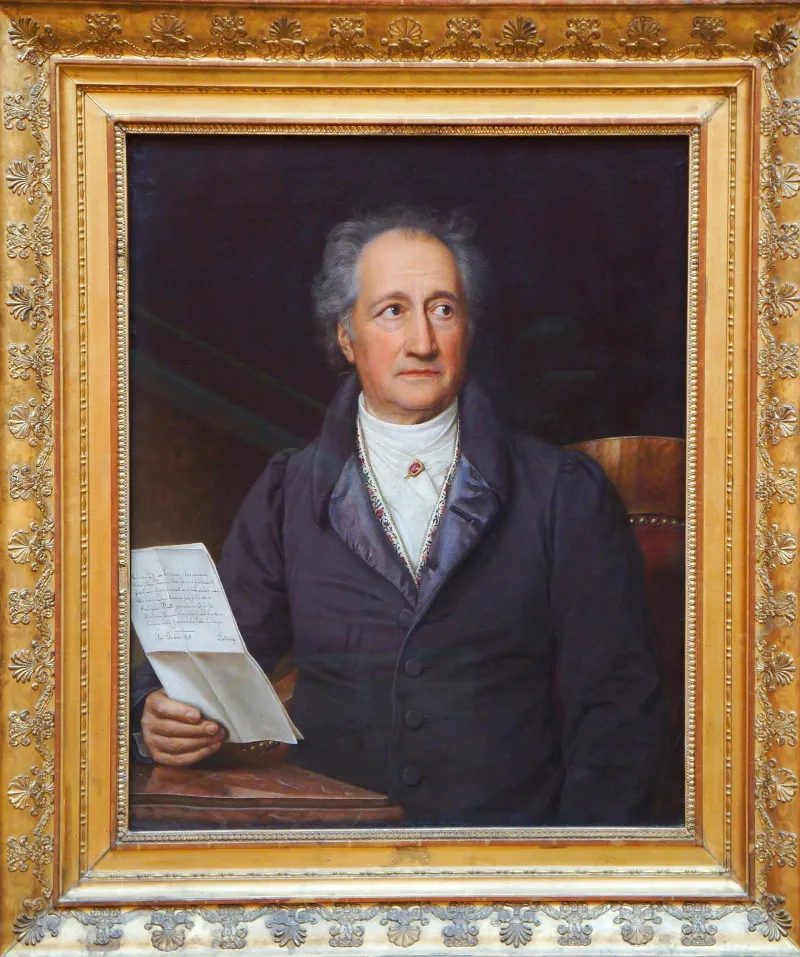

Julius August Walther von Goethe was born in Weimar on Christmas Day 1789, the son of Goethe and Christiane Vulpius; Duke Carl August was his godfather and later legitimised him. He studied law in Heidelberg and Jena and entered the service of the grand duchy, rising to chamberlain and privy chamber councillor. He also helped his father as secretary and manager, looked after the collections and the household accounts.
In 1817 he married Ottilie von Pogwisch; they had three children, Walther, Wolfgang and Alma. The marriage was unhappy, and August, living in the shadow of a famous father whose wishes governed his life, drank heavily. In 1813 his father prevented him from joining the volunteers against Napoleon, which earned him contempt among his peers.
In April 1830 he set out on a journey to Italy, partly in Eckermann's company. He died in Rome on 27 October 1830, probably of smallpox and meningitis, and was buried in the Protestant Cemetery near the pyramid of Cestius, where his tombstone describes him only as 'Goethe filius'.
August's life was shaped by being his father's son. He was ennobled in 1801 when Carl August legitimised him, studied law in Heidelberg (1808–09) and served the duchy as chamberlain and finance official, while also running Goethe's household, collections and correspondence. In 1813 his father prevented him from joining the volunteers against Napoleon, which exposed him to scorn. His marriage to Ottilie von Pogwisch in 1817 was unhappy, and he drank heavily. In 1830 he travelled to Italy with Eckermann, continued alone from Genoa and died in Rome on the night of 26–27 October 1830. He is buried in the Protestant Cemetery near the Pyramid of Cestius; the inscription calls him 'Goethe filius patri antevertens' – the son who went before his father.
Importance for Goethe
August von Goethe was Goethe’s only child to survive, born in 1789 of his union with Christiane Vulpius. Goethe had him legitimised by Duke Carl August in 1801, sent him to study law in Heidelberg and Jena, and kept him close: August became a chamber councillor in Weimar service and at the same time his father’s helper with household, collections and business.
In 1817 he married Ottilie von Pogwisch; their children were Walther, Wolfgang and Alma. In 1830 August travelled to Italy and died in Rome on 27 October 1830; he is buried near the Pyramid of Cestius. Goethe barely withstood the news and soon afterwards suffered a severe haemorrhage.
Goethe drew his characters from people he knew. Goethe Write keeps your characters, their notes and relationships together. All features ›
Goethe Write mode: write it yourself
- Create a character with a character sheet: role, age, goal, conflict and notes.
- Link your characters to each other in the relationships view, as Goethe’s life links the people around him.
- Place events on the timeline and see who meets whom, and when.
Questions
- Did Goethe have children?
- He and Christiane Vulpius had five children; only the eldest, August (1789–1830), survived childhood.
- How did Goethe’s son August die?
- He died in Rome in October 1830 during a journey to Italy and was buried in the Protestant Cemetery by the Pyramid of Cestius.
Text sources
- F. von Müller, Unterhaltungen mit Goethe (1870)
- Eck. 1830