

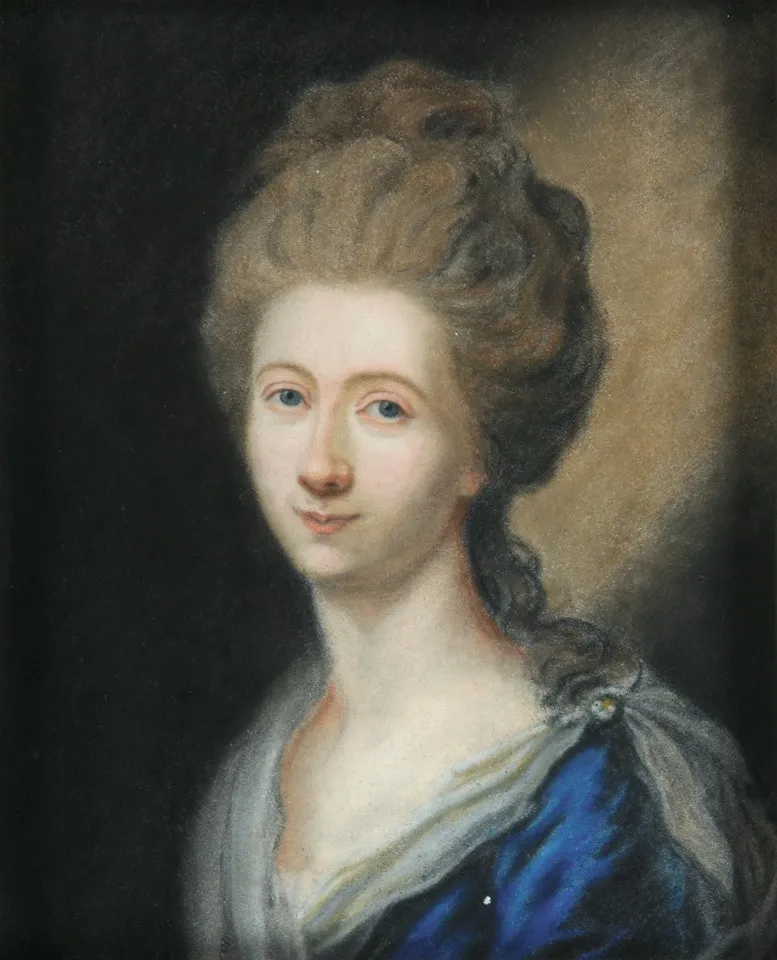
Charlotte Sophie Henriette Buff was the second daughter of Heinrich Adam Buff, bailiff of the Teutonic Order in Wetzlar. After her mother's death in 1771 she ran the household in the Teutonic House and cared for her many younger brothers and sisters – the picture of her cutting bread for the children became one of the most famous scenes of Werther.
Goethe met her on 9 June 1772 on the way to a ball at Volpertshausen. She was nineteen and secretly engaged to Johann Christian Kestner. Throughout the summer Goethe spent his days with her and the children; Lotte was friendly, sensible and clear that she would marry Kestner. On 11 September Goethe left Wetzlar without saying goodbye. She married Kestner on 4 April 1773 and moved to Hanover, where she had twelve children.
When Werther appeared in 1774 the Kestners were hurt by the portrait of the husband and by the exposure of their private lives; Goethe apologised warmly. In 1816, a widow of sixty-three, Charlotte visited Weimar with her daughter and was received by Goethe with cool formality. She died in Hanover in 1828. Her son August Kestner, a diplomat in Rome, later sent Goethe the news of his own son's death there in 1830.
Importance for Goethe
Charlotte Buff (1753–1828) was the daughter of the Teutonic Order’s bailiff in Wetzlar and cared for her younger siblings after her mother’s death. Goethe met her at a ball in June 1772 and fell in love, though she was engaged to Johann Christian Kestner.
Goethe left Wetzlar without farewell in September 1772. Together with the suicide of Karl Wilhelm Jerusalem, this love became the material of “The Sorrows of Young Werther” (1774); Lotte in the novel bears Charlotte Buff’s features. She married Kestner in 1773 and visited Goethe in Weimar in 1816, the meeting behind Thomas Mann’s novel “Lotte in Weimar”.
Goethe drew his characters from people he knew. Goethe Write keeps your characters, their notes and relationships together. All features ›
Goethe Write mode: write it yourself
- Create a character with a character sheet: role, age, goal, conflict and notes.
- Link your characters to each other in the relationships view, as Goethe’s life links the people around him.
- Place events on the timeline and see who meets whom, and when.
Questions
- Was Lotte in The Sorrows of Young Werther a real person?
- She is modelled on Charlotte Buff, whom Goethe loved in Wetzlar in 1772, mixed with traits of other women, especially Maximiliane von La Roche.
- Who are the main characters of The Sorrows of Young Werther?
- Werther, who tells the story in letters; Lotte, whom he loves; Albert, her fiancé and later husband; and Wilhelm, the friend to whom the letters are written.
Text sources
- DuW III 12–13
- A. Kestner, Goethe und Werther (1854)
- Goethe's diary, Sept 1816