

How glad I am to have got away!
Wie froh bin ich, daß ich weg bin!
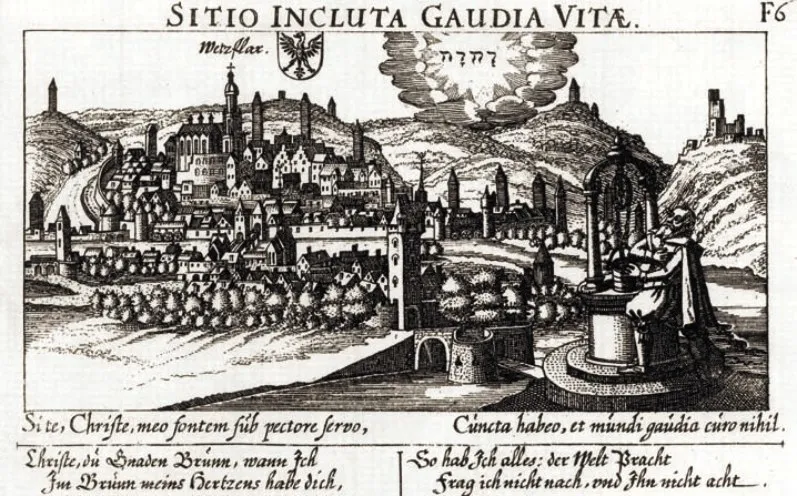
In May 1772, at his father's wish, Goethe went to Wetzlar, a small, steep town on the river Lahn where the Imperial Chamber Court (Reichskammergericht) sat, one of the two supreme courts of the Holy Roman Empire. Young lawyers spent some months there as trainees to learn the practice of imperial law. The court was a symbol of everything that had gone wrong with the Empire: some sixteen thousand cases were pending, some for generations, and a commission of visitation was trying, without success, to clear the backlog. Goethe registered as a trainee, but he seems to have spent little time on files. He read Homer and Pindar, walked into the countryside, drew, and sat at the table of young legation secretaries who amused themselves with a mock order of knights, in which he was called "Götz the Honest".
Lotte
On 9 June 1772 he went to a country ball at Volpertshausen and on the way collected a young woman in a white dress with pink ribbons: Charlotte Buff, nineteen, the second daughter of the bailiff of the Teutonic Order in Wetzlar. Her mother had died the year before, and she was looking after her many younger brothers and sisters. She was engaged, not yet publicly, to Johann Christian Kestner, a secretary of the Hanoverian legation to the court, a decent, steady man eight years older than Goethe. Goethe fell in love with her; he spent his days in the Teutonic House among the children and his evenings with the couple. Kestner, generous and observant, allowed the friendship; Lotte was clear that she would marry Kestner. In August the situation became unbearable, and on 11 September 1772 Goethe left Wetzlar without saying goodbye, leaving two notes behind. On the way home he stayed at Ehrenbreitstein with the writer Sophie von La Roche and was charmed by her daughter Maximiliane, who soon married the Frankfurt merchant Peter Anton Brentano – the mother of Clemens and Bettina Brentano.
Jerusalem
At the end of October news came from Wetzlar. Karl Wilhelm Jerusalem, a young lawyer of the Brunswick legation whom Goethe had known slightly in Leipzig and Wetzlar – melancholy, bookish, unhappily in love with the wife of a colleague, and slighted in society because of his middle-class birth – had shot himself on the night of 29 to 30 October 1772 with pistols borrowed from Kestner. He died around noon the next day. Goethe asked Kestner for details, and Kestner sent him a precise report: the borrowed pistols, the open copy of Lessing's Emilia Galotti on the desk, the blue coat and yellow waistcoat, the burial at night without clergy. Goethe kept the report.
The novel
Kestner and Lotte married on 4 April 1773 and moved to Hanover. Goethe sent them letters, gifts and a wedding ring. For more than a year nothing more happened. Then, early in 1774, in a few weeks of concentrated work – he later said four – he wrote The Sorrows of Young Werther (Die Leiden des jungen Werthers). It is a novel in letters, almost all written by one person, Werther, a young man of sensitive and passionate temperament, to his friend Wilhelm. Werther comes to a small town, loves Lotte, who is engaged to Albert, leaves, returns after she is married, and at Christmas shoots himself with Albert's pistols. Goethe had fused his own summer in Wetzlar with Jerusalem's death, borrowed details from Kestner's report and gave Lotte the black eyes of Maximiliane Brentano.
The book was published anonymously by Weygand in Leipzig in time for the Michaelmas fair of 1774. Its success was immediate and enormous. Young men dressed like Werther in blue coats and yellow waistcoats; there were Werther perfumes, porcelain and parodies; clergymen attacked it as an apology for suicide, and in Leipzig it was banned for a while. The book was translated into French in 1775 and into English in 1779 (from the French); Napoleon later told Goethe he had read it seven times. Whether it really caused a wave of suicides is uncertain; a handful of cases were reported in which young people died with the book about them.
Kestner and Lotte were hurt: they recognised themselves, and Albert seemed to them a caricature of the husband. Goethe apologised in warm letters and promised a revision. When he revised the novel for the edition of his works in 1787, he made Albert more sympathetic and added the episode of a farm servant who kills a rival out of love.
The court and the knights
The Imperial Chamber Court was the symbol of an Empire that could no longer decide anything. Some sixteen thousand cases are said to have been pending, some of them for generations; in 1767 the emperor had sent a visitation commission to reform the court, and when Goethe arrived its work had become bogged down in disputes between the Catholic and Protestant parties. Goethe looked at the files, attended a few sessions and learned, as he later wrote, more about the decay of the old constitution than about law.
Socially Wetzlar was dominated by the legation secretaries and young lawyers who had come from all over the Empire. At the inn 'Zum Kronprinzen' some of them formed a round table modelled on the age of chivalry, with a grand master, knightly names and mock ceremonies; Goethe joined as 'Götz the Honest', a name that recalled the play he had just written. The joke tells something about the mood of the young generation, which looked back to the strong individuals of the past from a present that seemed to them empty and formal.
Fame
At twenty-five, Goethe was the most famous young writer in Germany and was becoming known across Europe. For the rest of his life many visitors thought of him first as the author of Werther, which he found irritating and touching by turns. Lotte Kestner visited him once more, in Weimar in 1816, as a widow of sixty-three; the meeting was formal, and Thomas Mann made a novel of it a century later.
Sources of this chapter
Goethe, Dichtung und Wahrheit, books 12–13 (1814). Die Leiden des jungen Werthers (1774; revised 1787). Letters to Kestner and Lotte (Weimar Edition IV, vol. 2). A. Kestner (ed.), Goethe und Werther (1854), with Kestner's report on Jerusalem. Wetzlar trainee register 1772. Lewes, Life and Works (1855), book 3.
Sources of this chapter
- Goethe, Dichtung und Wahrheit, part 3, books 12–13 (1814)
- Goethe, Die Leiden des jungen Werthers (Leipzig: Weygand, 1774; revised 1787)
- Goethe's letters to Kestner and Charlotte Buff, Weimar Edition IV, vol. 2
- A. Kestner (ed.), Goethe und Werther. Briefe Goethe's (1854), incl. Kestner's report on Jerusalem's death
- Wetzlar register of court trainees (Praktikanten), 1772
- G. H. Lewes, The Life and Works of Goethe (1855), book 3, chapters 1–3