

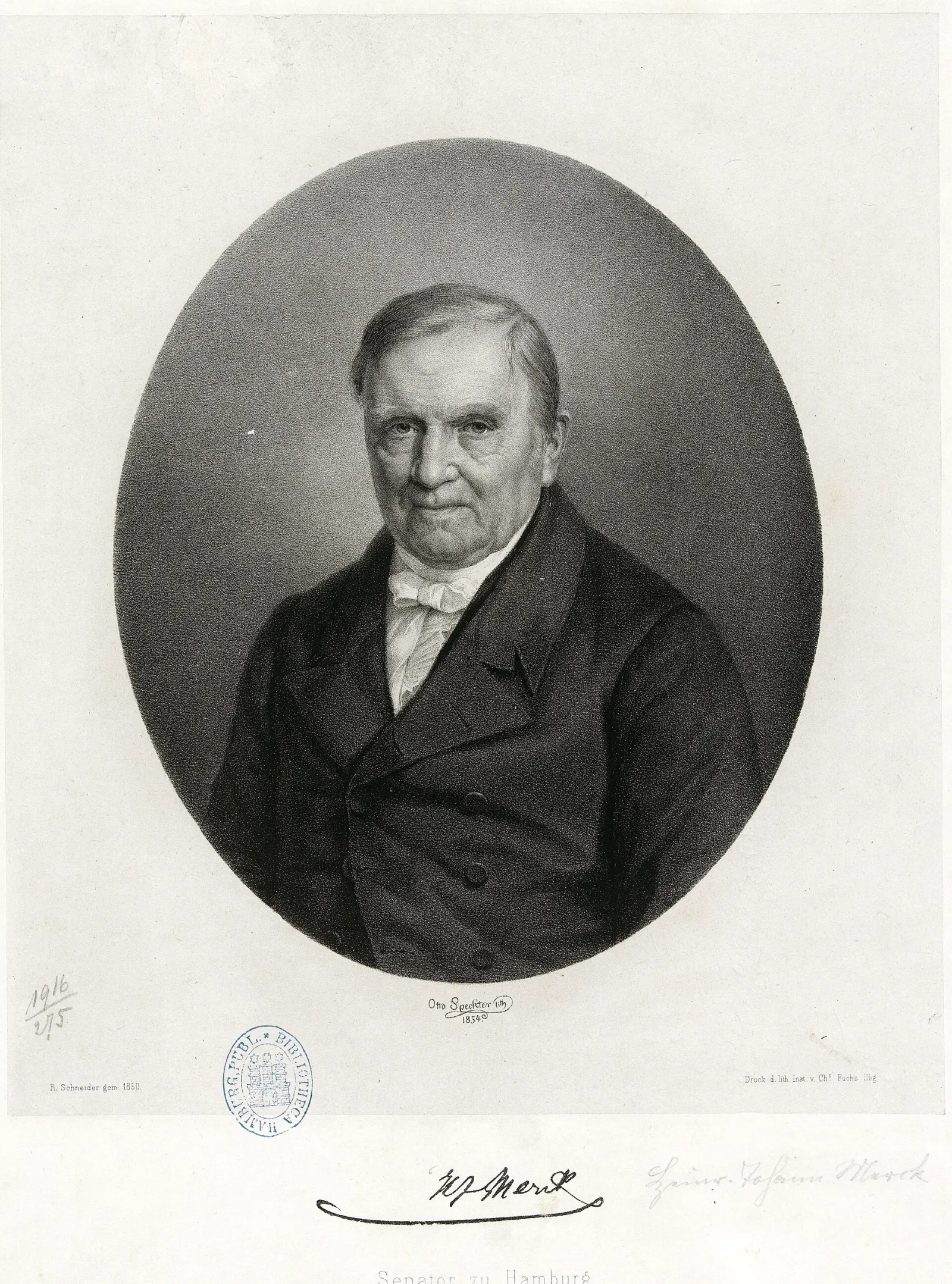
Johann Heinrich Merck was the son of a Darmstadt apothecary, studied in Giessen, Erlangen and Dresden, travelled widely and in 1767 became paymaster of the war department (Kriegszahlmeister) in Hesse-Darmstadt. He was clever, widely read, sarcastic and restless, a gifted critic and a collector of art and fossils.
Goethe met him at the end of 1771 and for four years Merck was his closest literary adviser. Goethe called him his 'Mephistopheles' – the friend whose scepticism protected him from self-deception, and who supplied some traits for the devil in Faust. Merck edited the Frankfurter Gelehrte Anzeigen in 1772, with Goethe among the reviewers; he printed and paid for the first edition of Götz von Berlichingen with Goethe in 1773; he urged him to finish things and publish them.
Merck later wrote for Wieland's journal, collected fossil bones and corresponded with Goethe about anatomy and geology. His business ventures failed, he fell into debt and depression, and on 27 June 1791 he shot himself in Darmstadt. Goethe wrote of him in Poetry and Truth with gratitude and clear-sighted affection.
In his last years Merck turned to natural history, especially fossil bones, on which he corresponded with Goethe and the anatomist Sömmerring. A failing business venture left him in debt; Carl August helped him financially. Suffering from depression, he shot himself in Darmstadt on 27 June 1791. In Poetry and Truth Goethe calls him a 'Mephistopheles' – a portrait coloured by hindsight and not entirely fair.
Importance for Goethe
Johann Heinrich Merck, a war councillor in Darmstadt, was Goethe’s most critical friend in the Frankfurt years 1771–1775. He encouraged him to print “Götz von Berlichingen” at their own expense in 1773 and wrote with him for the “Frankfurter Gelehrte Anzeigen”.
Goethe both valued Merck’s judgement and feared his mockery. Traits of Merck are often thought to have gone into Mephistopheles. Later they shared an enthusiasm for osteology and natural history. Merck took his own life in 1791.
Goethe drew his characters from people he knew. Goethe Write keeps your characters, their notes and relationships together. All features ›
Goethe Write mode: write it yourself
- Create a character with a character sheet: role, age, goal, conflict and notes.
- Link your characters to each other in the relationships view, as Goethe’s life links the people around him.
- Place events on the timeline and see who meets whom, and when.
Questions
- Who was Merck to Goethe?
- A sharp, sardonic friend and critic of his youth, who helped bring “Götz” into print.
- Is Mephistopheles based on Merck?
- That has long been suggested; Goethe himself describes Merck in “Poetry and Truth” as having something Mephistophelean.
Text sources
- DuW III 12–13, 15
- Goethe's letters to Merck, WA IV