

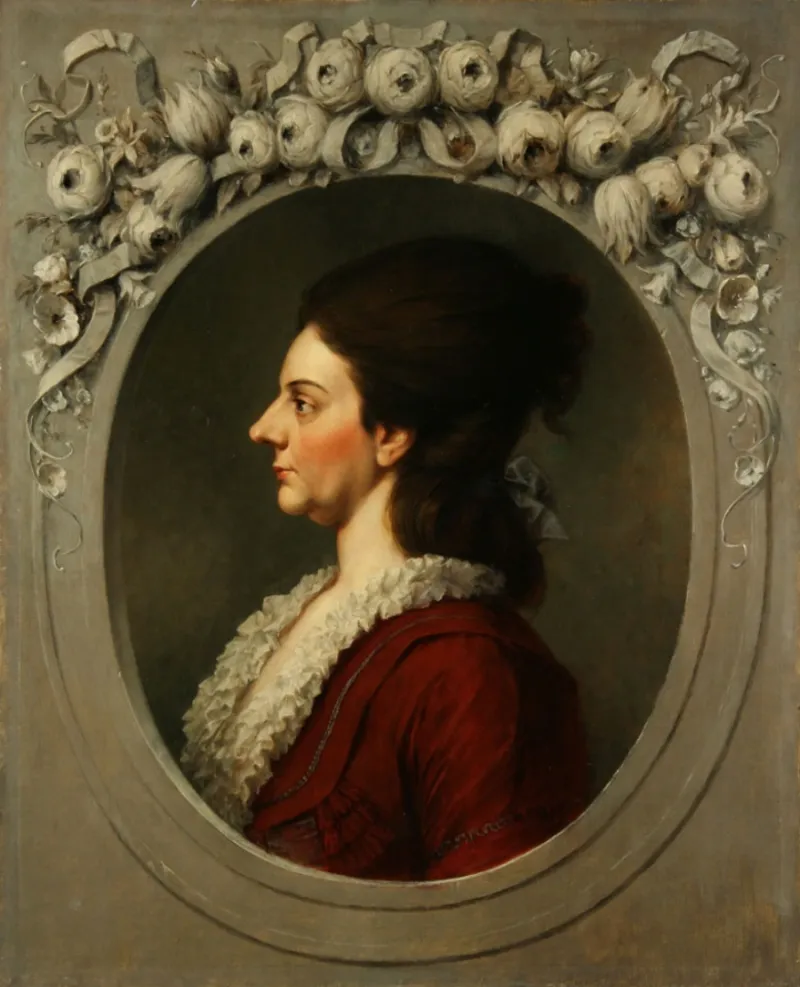
Anna Amalia, a niece of Frederick the Great, was born a princess of Brunswick-Wolfenbüttel and married Duke Ernst August II Konstantin of Saxe-Weimar at sixteen. Widowed at eighteen, she governed the duchy for her infant son Carl August from 1758 to 1775, prudently and economically.
She was a gifted musician and composer and loved literature, conversation and the theatre. In 1772 she brought Christoph Martin Wieland to Weimar as tutor to her sons; after 1775 her residences – the Wittumspalais in Weimar and the summer houses at Ettersburg and Tiefurt – became the meeting place of a circle of writers, artists and musicians, with amateur theatre, readings and a handwritten journal. Later generations called it the Weimar 'Court of the Muses'.
From 1788 to 1790 she travelled in Italy, partly guided by Goethe's advice; he met her in Venice on her return. She also founded the ducal library, today the Duchess Anna Amalia Library. She died in Weimar on 10 April 1807, and Goethe wrote her official obituary.
Anna Amalia was a niece of Frederick the Great, married at sixteen and widowed at eighteen. As regent she called Wieland to Weimar in 1772 as tutor to her sons, and after her son's accession she created around herself, at the Wittumspalais and in her summer residences at Ettersburg and Tiefurt, the circle later called the 'Court of the Muses': amateur theatre, music – she composed a setting of Goethe's Erwin und Elmire (1776) – readings, and the handwritten Tiefurt Journal. In 1788–90 she travelled in Italy. She built up the ducal library, today the Duchess Anna Amalia Library, badly damaged by fire in 2004 and restored. She died on 10 April 1807, and Goethe wrote the official memorial of her life.
Importance for Goethe
Duchess Anna Amalia created the Weimar Goethe came to in 1775. She had brought Wieland in as tutor to her sons and opened the court to literature, music and theatre; her son Carl August invited Goethe. In her circle, at the Wittumspalais, Tiefurt and Ettersburg, Goethe acted and wrote Singspiele such as “Die Fischerin” (1782).
In 1788–1790 she travelled to Italy herself, inspired by Goethe’s reports; he met her in Venice on her way home. When she died in 1807 Goethe wrote an obituary. The Duchess Anna Amalia Library in Weimar, which Goethe later supervised, bears her name.
Goethe drew his characters from people he knew. Goethe Write keeps your characters, their notes and relationships together. All features ›
Goethe Write mode: write it yourself
- Create a character with a character sheet: role, age, goal, conflict and notes.
- Link your characters to each other in the relationships view, as Goethe’s life links the people around him.
- Place events on the timeline and see who meets whom, and when.
Questions
- Who was Anna Amalia to Goethe?
- Duke Carl August’s mother and founder of Weimar’s “court of the Muses”, where Goethe lived, acted and wrote from 1775.
- What was Anna Amalia’s court of the Muses?
- Her circle of poets, musicians and scholars in Weimar, including Wieland, Goethe, Herder, Knebel and Corona Schröter.
Text sources
- Goethe, Zum feyerlichen Andenken der Durchlauchtigsten Fürstin Anna Amalia (1807)
- TuJ 1807