

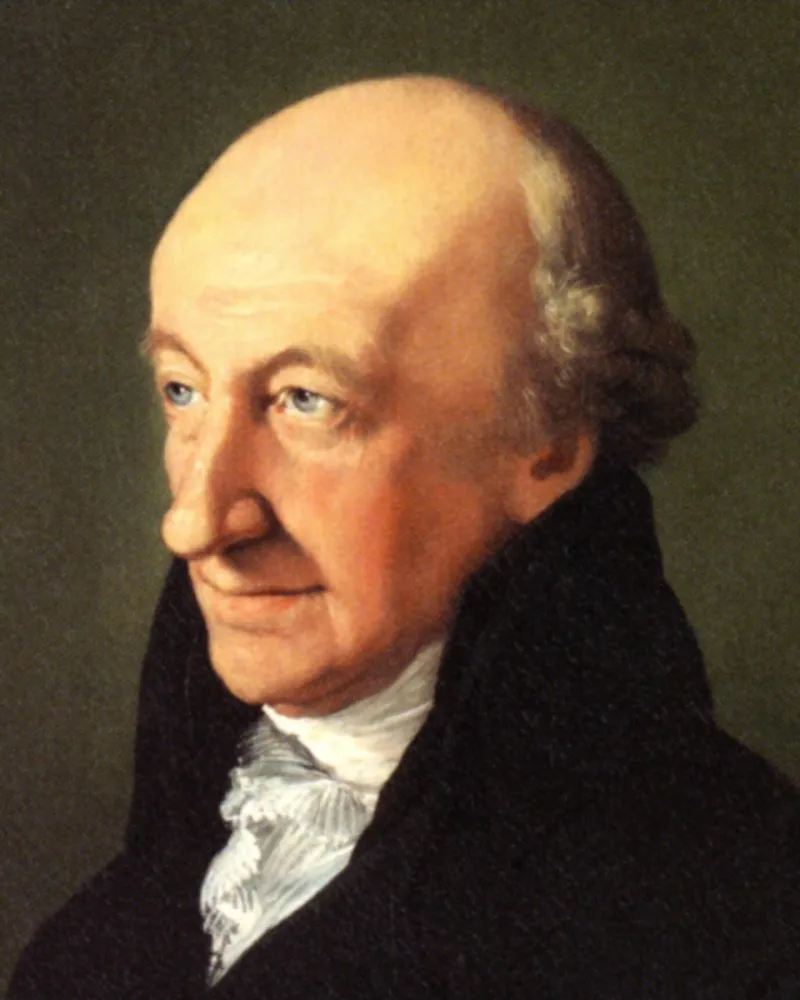
Christoph Martin Wieland, a pastor's son from Swabia, was the most elegant German writer of the Enlightenment: author of the novels Agathon (1766–67) and The Abderites, the verse epic Oberon (1780), and the first German translation of twenty-two plays of Shakespeare (1762–66). In 1772 Anna Amalia called him to Weimar as tutor to her sons. In 1773 he founded the journal Der Teutsche Merkur, which he edited for decades.
In 1774 Goethe mocked him in the farce Gods, Heroes and Wieland; Wieland reviewed it with generous humour. When Goethe arrived in Weimar in 1775, Wieland was enchanted by him – he wrote that his soul was 'as full of Goethe as a dewdrop of the morning sun' – and they remained friends for almost forty years, though never intimate. Wieland lived from 1797 to 1803 on his estate at Ossmannstedt and then again in Weimar. He died on 20 January 1813; Goethe gave the memorial address in the Masonic lodge Amalia.
Wieland's novel Agathon (1766–67), his verse tales such as Musarion and his prose translations of twenty-two Shakespeare plays (1762–66) made him the most elegant German writer of his time. He came to Weimar in 1772 as tutor to Carl August and founded the journal Der Teutsche Merkur (1773–1810). In 1774 Goethe mocked him in the farce Gods, Heroes and Wieland, but in Weimar the two became friends; Wieland wrote enthusiastically of the young genius. His epic Oberon appeared in 1780. From 1797 to 1803 he lived on his estate at Oßmannstedt. Napoleon received him in 1808 and gave him the Legion of Honour. He died on 20 January 1813; Goethe gave the memorial address in the Masonic lodge.
Importance for Goethe
Christoph Martin Wieland was already famous and lived in Weimar as tutor to the princes when Goethe arrived in 1775. Goethe had mocked him in the farce “Gods, Heroes and Wieland” (1774); Wieland took it with humour, welcomed him warmly and became a lifelong companion.
Wieland’s journal “Der Teutsche Merkur” printed Goethe’s work and served as a forum for the Weimar circle. After Wieland’s death in 1813 Goethe gave the memorial address “To the Fraternal Memory of Wieland” in the Amalia Masonic lodge.
Goethe drew his characters from people he knew. Goethe Write keeps your characters, their notes and relationships together. All features ›
Comparisons: Goethe and Wieland
Goethe Write mode: write it yourself
- Create a character with a character sheet: role, age, goal, conflict and notes.
- Link your characters to each other in the relationships view, as Goethe’s life links the people around him.
- Place events on the timeline and see who meets whom, and when.
Questions
- How did Goethe and Wieland get on?
- After Goethe’s early mockery they became friends in Weimar from 1775 and remained so until Wieland’s death in 1813.
- What is “Gods, Heroes and Wieland”?
- A farce by the young Goethe from 1774 mocking Wieland’s treatment of antiquity.
Text sources
- Wieland to Jacobi, Nov 1775
- Goethe, Zu brüderlichem Andenken Wielands (1813)