

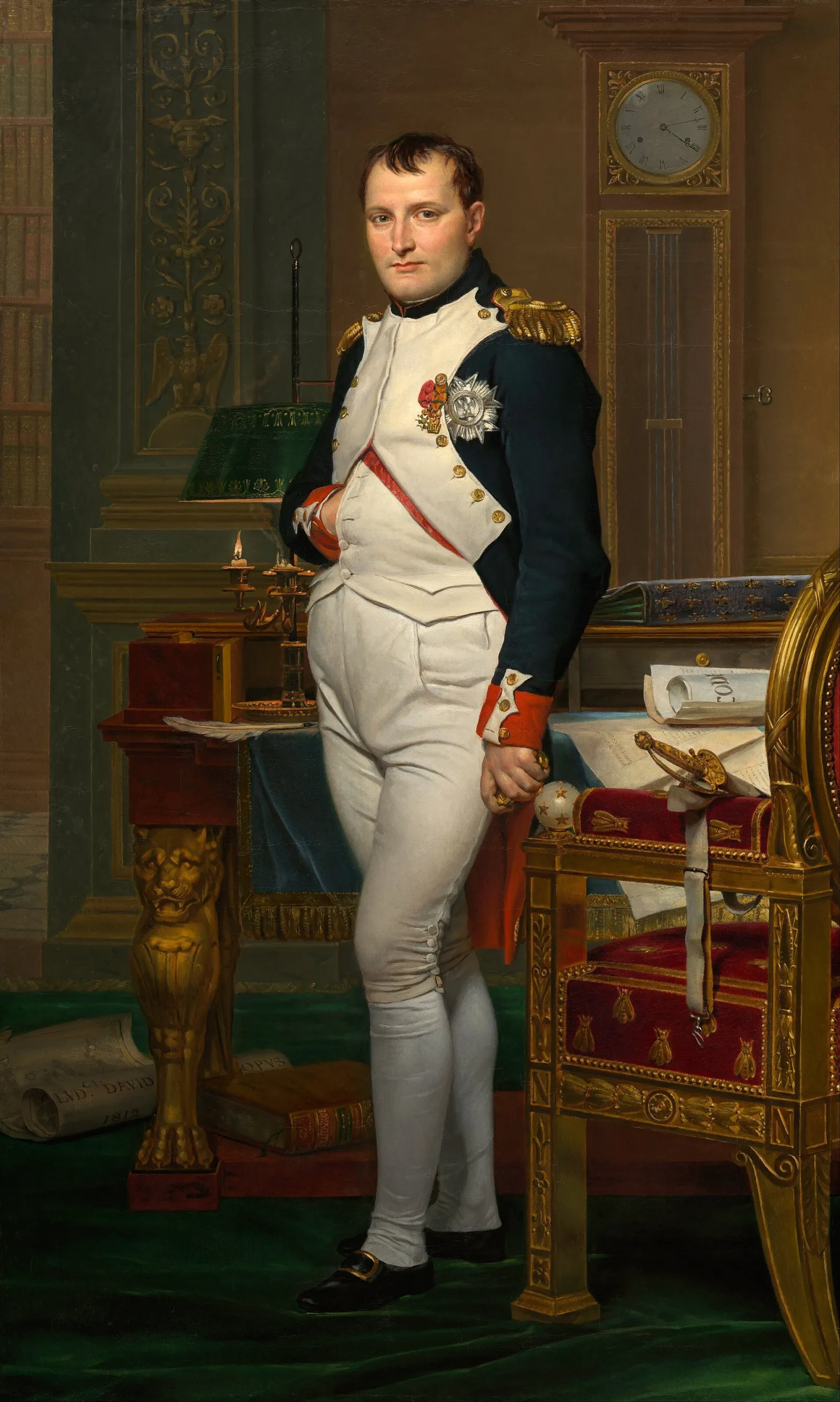
Napoleon defeated Prussia at Jena on 14 October 1806, and his troops plundered Weimar that night. Two years later, during the Congress of Erfurt, he received Goethe on 2 October 1808. According to Goethe's own note, dictated in 1824, the emperor greeted him with 'Vous êtes un homme!', discussed Werther – which he said he had read seven times and in which he criticised one motive – and spoke of tragedy, saying that politics was now fate. A few days later in Weimar he urged Goethe to come to Paris. On 14 October 1808 Goethe received the cross of the Legion of Honour.
Goethe admired Napoleon all his life as a 'demonic' personality, a force of nature in history, and refused to join the patriotic hatred of 1813. In conversations with Eckermann he returned to him often. Napoleon died on St Helena in 1821; Goethe wrote no poem on his death, but Manzoni's ode The Fifth of May, which Goethe translated into German in 1822, stood for his feelings.
Goethe kept his admiration for Napoleon after the emperor's fall and refused to join the anti-French enthusiasm of 1813, which damaged his standing among younger patriots. In 1822 he translated Alessandro Manzoni's ode on Napoleon's death, 'Il cinque maggio', and in conversations with Eckermann he spoke of Napoleon as a man of 'demonic' productivity, a phenomenon of nature rather than a model to imitate.
Importance for Goethe
On 2 October 1808, during the Congress of Erfurt, Napoleon received Goethe in audience. He greeted him with “Vous êtes un homme”, talked about “Werther”, which he said he had read seven times, and about tragedy. Soon afterwards he awarded him the cross of the Legion of Honour.
Goethe remained an admirer of Napoleon all his life and wore the order even after his fall. He saw him as a daemonic nature that shaped history. He wrote his account of the conversation only years later.
Goethe drew his characters from people he knew. Goethe Write keeps your characters, their notes and relationships together. All features ›
Comparisons: Goethe and Napoleon
Goethe Write mode: write it yourself
- Create a character with a character sheet: role, age, goal, conflict and notes.
- Link your characters to each other in the relationships view, as Goethe’s life links the people around him.
- Place events on the timeline and see who meets whom, and when.
Questions
- Did Goethe and Napoleon meet?
- Yes, on 2 October 1808 in Erfurt, and again a few days later in Weimar.
- What did Napoleon say to Goethe?
- The recorded exclamation is “Vous êtes un homme”; their talk turned mainly on “Werther” and the theatre.
Text sources
- Goethe, Unterredung mit Napoleon (1824)
- Eck. 1828–1831
- Goethe, Der fünfte Mai (1822)