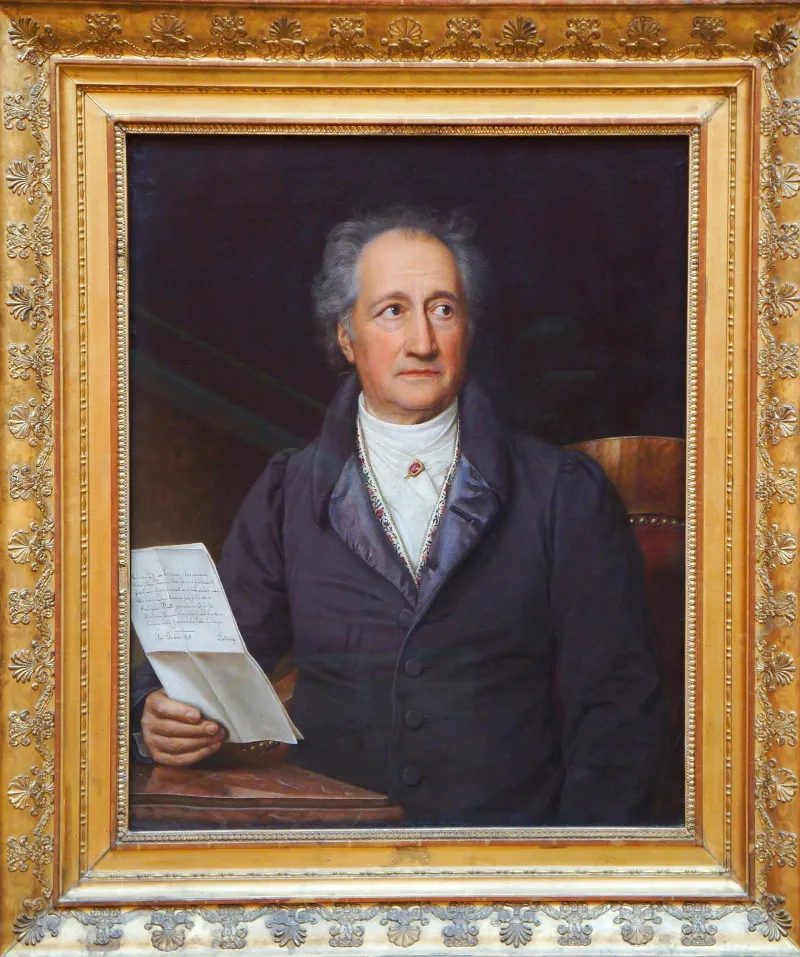

Johann Gottlieb Fichte was appointed professor of philosophy at Jena in 1794 with Goethe's approval and developed there his Doctrine of Science (Wissenschaftslehre), which made Jena the centre of German philosophy.
In 1798–99 he was accused of atheism; when he threatened to resign, the Weimar government, with Goethe's agreement, accepted his resignation. Goethe, who respected Fichte but disliked his combativeness, later regretted the loss. Fichte went to Berlin and died there in 1814.
Johann Gottlieb Fichte, born in Rammenau in Upper Lusatia on 19 May 1762, the son of a ribbon-weaver, became famous overnight with his Essay towards a Critique of All Revelation (1792), at first taken for a work by Kant. In 1794 he was called to Jena with Goethe's approval and lectured on his Science of Knowledge to crowded halls. In 1798–99 an article in his journal led to the charge of atheism; when Fichte threatened to resign, the Weimar government, with Goethe's agreement, took him at his word. He moved to Berlin, where his Addresses to the German Nation (1807–08) were delivered under French occupation; he became the first elected rector of the new university and died of typhus on 29 January 1814.
Goethe later spoke of him with respect.
Importance for Goethe
Johann Gottlieb Fichte came to Jena as a professor in 1794 with Goethe’s approval as the responsible minister. Goethe read Fichte’s “Science of Knowledge” in proof sheets and sought conversation, but remained sceptical of a philosophy developed purely from the self.
In 1799 Fichte lost his chair in the so-called Atheism Dispute; Goethe supported the dismissal after Fichte threatened to resign. For Goethe the case was a lesson about the limits of academic freedom in a small duchy.
Goethe drew his characters from people he knew. Goethe Write keeps your characters, their notes and relationships together. All features ›
Goethe Write mode: write it yourself
- Create a character with a character sheet: role, age, goal, conflict and notes.
- Link your characters to each other in the relationships view, as Goethe’s life links the people around him.
- Place events on the timeline and see who meets whom, and when.
Questions
- What was Goethe’s connection with Fichte?
- As minister he was involved in Fichte’s appointment to Jena in 1794 and supported his dismissal in the Atheism Dispute of 1799.
- What was the Atheism Dispute?
- A controversy of 1798–99 over an essay in Fichte’s journal that led to charges of atheism and cost Fichte his chair at Jena.
Text sources
- TuJ 1794, 1799