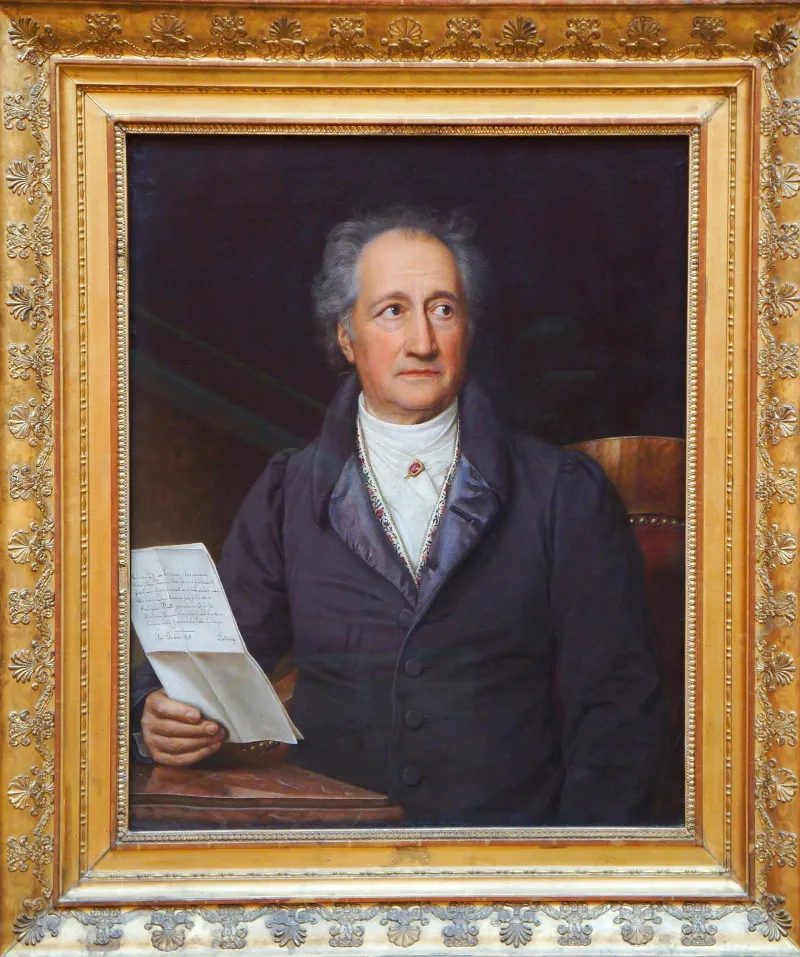

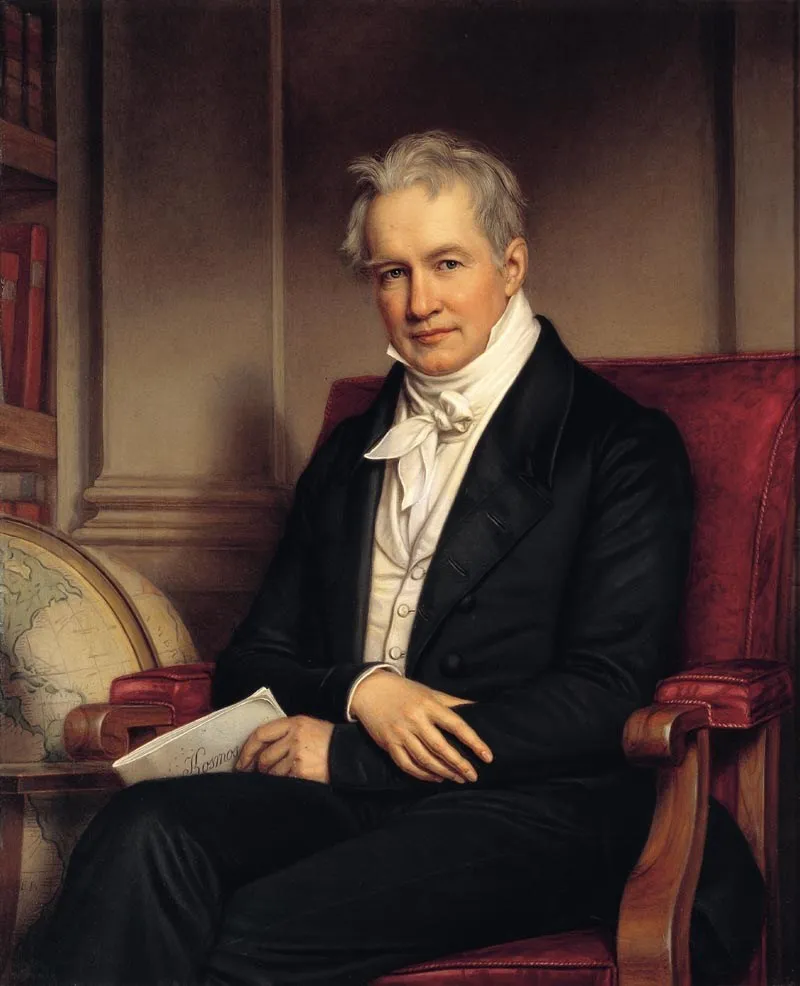
Alexander von Humboldt, the explorer of South America and author of Cosmos, met Goethe in Jena in 1794–1797, where they dissected animals, discussed galvanism and anatomy, and walked together. Goethe later compared him to a fountain with many spouts, always flowing (Eckermann, 11 December 1826).
Humboldt dedicated his Essay on the Geography of Plants (German edition 1807) to Goethe, with a frontispiece showing Apollo unveiling nature. They remained in friendly contact, though Humboldt, a Newtonian in optics and a 'Vulcanist' in geology, did not share all of Goethe's views.
Alexander von Humboldt, born in Berlin on 14 September 1769, met Goethe in Jena in 1794 and visited him again in 1797, when they experimented together with 'galvanism', the effect of electricity on nerves and muscles, and discussed comparative anatomy. Goethe was impressed by his energy and range. After his great expedition through Spanish America (1799–1804) Humboldt dedicated his Essay on the Geography of Plants (1807) to Goethe, with a frontispiece showing Apollo unveiling Nature. His late work Kosmos (1845–62) attempted a description of the whole physical world. He died in Berlin on 6 May 1859.
Goethe followed his reports from America closely and used his data in his own work on the comparative heights of mountains.
Importance for Goethe
Alexander von Humboldt was the naturalist against whom Goethe could measure his own studies. In the Jena years 1794–1797 the two discussed anatomy, botany and galvanism – talks that drew Goethe back to his own anatomical and botanical work.
In 1807 Humboldt dedicated the German edition of his “Essay on the Geography of Plants” to Goethe, with a frontispiece alluding to Goethe’s “Metamorphosis of Plants”. They shared a view of nature as a whole, though they later differed on how the earth was formed (Neptunism against volcanism).
Goethe drew his characters from people he knew. Goethe Write keeps your characters, their notes and relationships together. All features ›
Goethe Write mode: write it yourself
- Create a character with a character sheet: role, age, goal, conflict and notes.
- Link your characters to each other in the relationships view, as Goethe’s life links the people around him.
- Place events on the timeline and see who meets whom, and when.
Questions
- Who was Alexander von Humboldt to Goethe?
- A younger friend and partner in natural science, with whom Goethe discussed anatomy, botany and experiments.
- When did Goethe and Alexander von Humboldt meet?
- In 1794 in Jena, through Alexander’s brother Wilhelm, who lived there at the time and was a friend of Schiller.
Text sources
- TuJ 1795–1797
- A. v. Humboldt, Ideen zu einer Geographie der Pflanzen (1807)