

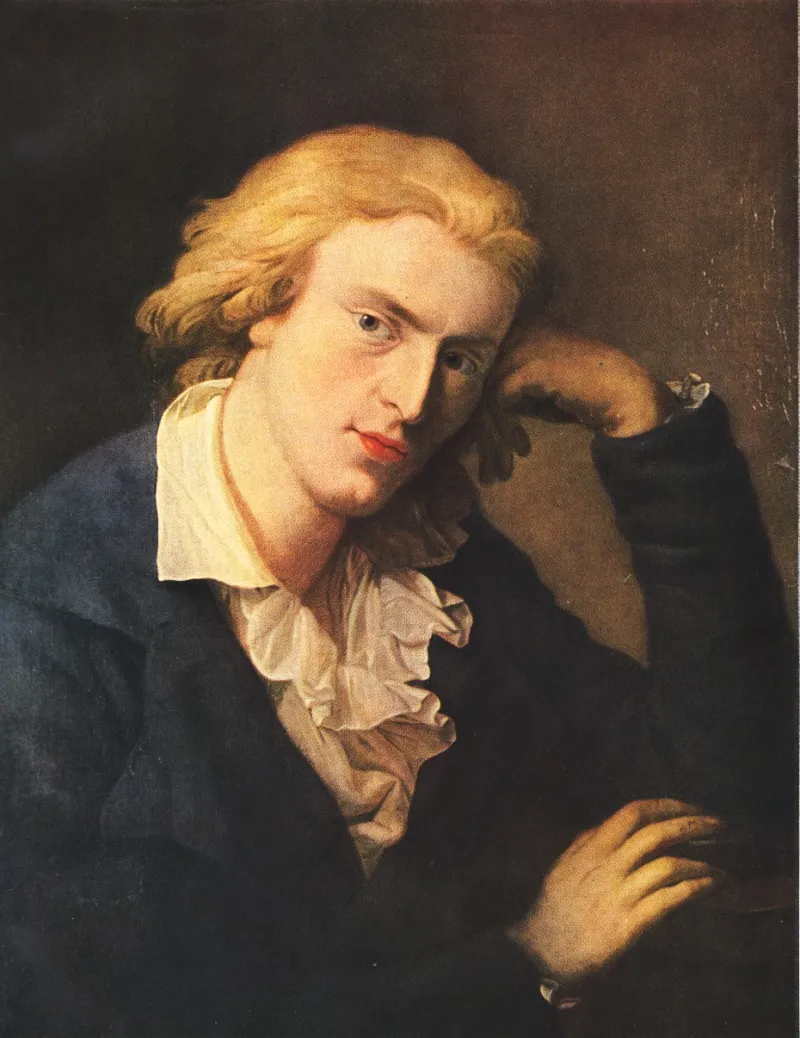
Johann Christoph Friedrich Schiller was born on 10 November 1759 in Marbach on the Neckar, the son of Johann Caspar Schiller, an army surgeon and later officer in the service of Duke Karl Eugen of Württemberg. At thirteen he was ordered into the duke's military academy, the Karlsschule near Stuttgart, where he studied first law and then medicine under a strict regime of uniforms and surveillance. He left in 1780 as a poorly paid regimental doctor.
His first play, The Robbers, printed at his own expense in 1781, premiered in Mannheim on 13 January 1782 to a famously tumultuous audience. When the duke punished him for travelling to Mannheim without leave and forbade him to write anything but medicine, Schiller fled Württemberg in September 1782. Years of debt and wandering followed – Mannheim, Bauerbach, Leipzig and Dresden – and with them Fiesco (1783), Intrigue and Love (1784), the ode 'To Joy' (1785) and Don Carlos (1787).
In July 1787 he came to Weimar, while Goethe was in Italy. Their first meeting, on 7 September 1788 in the house of the Lengefeld family at Rudolstadt, disappointed him: Goethe seemed distant, and Schiller wrote to Körner that he doubted they would ever come close. Goethe nevertheless supported his appointment in 1789 as an (initially unpaid) professor of history at Jena, where his inaugural lecture drew a crowd that filled the largest hall. On 22 February 1790 he married Charlotte von Lengefeld. A severe illness in 1791, probably a lung infection, left him chronically weakened; a three-year pension from the Danish court gave him time to study Kant. The essays On Grace and Dignity (1793), the Letters on the Aesthetic Education of Man (1795) and On Naive and Sentimental Poetry (1795–96) came out of this work.
The friendship began in Jena around 20 July 1794, after a meeting of the Natural History Society, in a conversation about the 'primal plant' that Goethe described much later in the essay 'Fortunate Encounter' (1817). Schiller's birthday letter of 23 August 1794, which analysed Goethe's way of thinking with startling precision, sealed it. Goethe called the alliance a 'new spring'. Over the next eleven years they exchanged roughly a thousand letters and saw each other constantly, in Jena and later in Weimar.
The fruits were shared projects and mutual criticism: the journal Die Horen (1795–97), the satirical Xenien in the Musen-Almanach for 1797, the 'ballad year' 1797, Schiller's detailed reading of Wilhelm Meister's Apprenticeship, his urging that Goethe return to Faust, and Goethe's productions of Schiller's plays at the Weimar court theatre. Schiller moved to Weimar in December 1799 and there finished Wallenstein (1798–99), then Mary Stuart (1800), The Maid of Orleans (1801), The Bride of Messina (1803) and William Tell (1804). He was ennobled in 1802 and bought a house on the Esplanade, today a museum.
Schiller died in Weimar on 9 May 1805, aged forty-five; the autopsy found his lungs and other organs severely damaged. Goethe, ill himself, was told only the next day. 'I am losing a friend and with him half of my existence', he wrote to Zelter on 1 June. That summer he wrote the 'Epilogue to Schiller's Song of the Bell', first spoken in Lauchstädt on 10 August 1805. In 1828–29 he published their correspondence. In 1826 he kept a skull taken for Schiller's in his house and wrote the poem now known as 'On Contemplating Schiller's Skull'; in 1827 the supposed remains were placed in the ducal vault, where Goethe was laid beside them in 1832. DNA tests published in 2008 showed that the skull was not Schiller's; his real remains are lost.
For Goethe the friendship was the decisive collaboration of his life, and the two men – very different in temperament, origin and working method – became the joint emblem of 'Weimar Classicism', most visibly in Ernst Rietschel's double statue in front of the Weimar theatre (1857).
Comparisons: Goethe and Schiller compared · The year of ballads 1797: Goethe and Schiller · Götz von Berlichingen and The Robbers
Goethe Write mode: write it yourself
- Create a character with a character sheet: role, age, goal, conflict and notes.
- Link your characters to each other in the relationships view, as Goethe’s life links the people around him.
- Place events on the timeline and see who meets whom, and when.
Text sources
- Briefwechsel zwischen Schiller und Goethe (1828–1829)
- Glückliches Ereignis (1817)
- Goethe to Zelter, 1 June 1805
- Schiller an Körner, 12. September 1788
- Goethe, Epilog zu Schillers Glocke (1805)