

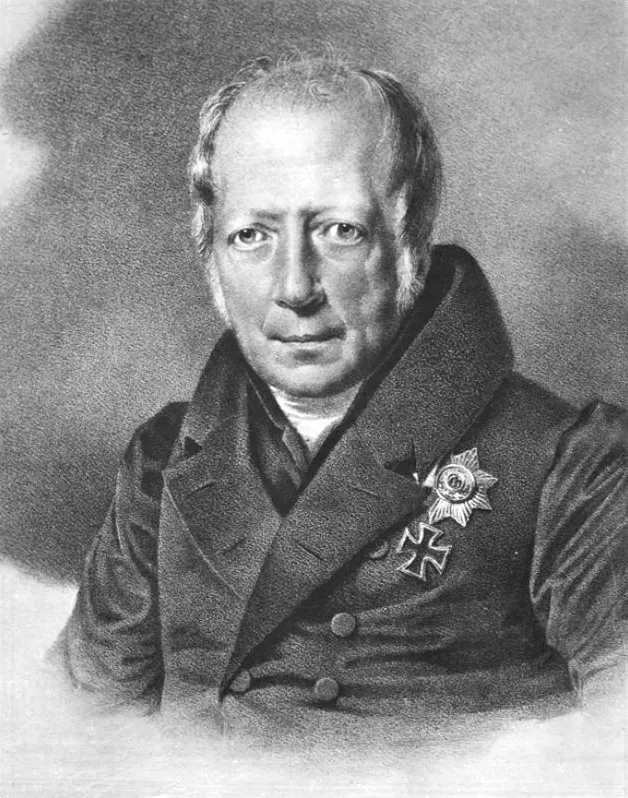
Wilhelm von Humboldt, elder brother of Alexander, lived in Jena from 1794 to 1797, close to Schiller, and took part in the conversations of the Goethe–Schiller circle. He wrote an important essay on Hermann and Dorothea (1799).
As a Prussian diplomat in Rome, minister of education (1809–10) and founder of the University of Berlin, he shaped the German idea of education (Bildung). He corresponded with Goethe until the end; Goethe's very last letter, of 17 March 1832, is addressed to him and speaks of Faust II.
Wilhelm von Humboldt, born in Potsdam on 22 June 1767, lived in Jena from 1794 to 1797 to be near Schiller and became a member of the Goethe–Schiller circle; his long essay on Hermann and Dorothea (1799) was the first major critical study of a Goethe work. As Prussian envoy in Rome (1802–08) he kept Goethe informed about Italy. In 1809–10 he reformed Prussian education and founded the University of Berlin. Later he devoted himself to the comparative study of languages. Goethe's last letter, of 17 March 1832, is addressed to him and speaks about the sealed second part of Faust. Humboldt died at Tegel on 8 April 1835.
His correspondence with Goethe spans almost forty years.
Importance for Goethe
Wilhelm von Humboldt lived in Jena in 1794–1797 and was close to Schiller and Goethe. He was Goethe’s expert reader: his book “Aesthetic Essays: On Goethe’s Hermann and Dorothea” (1799) interprets the epic as a model of classical poetry.
Later, as Prussian envoy in Rome and educational reformer, he remained Goethe’s correspondent. Goethe’s last letter, dated 17 March 1832, was to Humboldt; in it he speaks of “Faust Part Two”, which he had sealed away.
Goethe drew his characters from people he knew. Goethe Write keeps your characters, their notes and relationships together. All features ›
Goethe Write mode: write it yourself
- Create a character with a character sheet: role, age, goal, conflict and notes.
- Link your characters to each other in the relationships view, as Goethe’s life links the people around him.
- Place events on the timeline and see who meets whom, and when.
Questions
- Who was Wilhelm von Humboldt to Goethe?
- A friend and critic from the Jena years who wrote on “Hermann and Dorothea” and remained his correspondent to the end.
- To whom did Goethe write his last letter?
- To Wilhelm von Humboldt, on 17 March 1832, five days before his death.
Text sources
- Goethe to W. v. Humboldt, 17 Mar 1832
- Humboldt, Ästhetische Versuche (1799)