

Goethe here
April 1776 – June 1782
his home
1782 – 1832
retreat
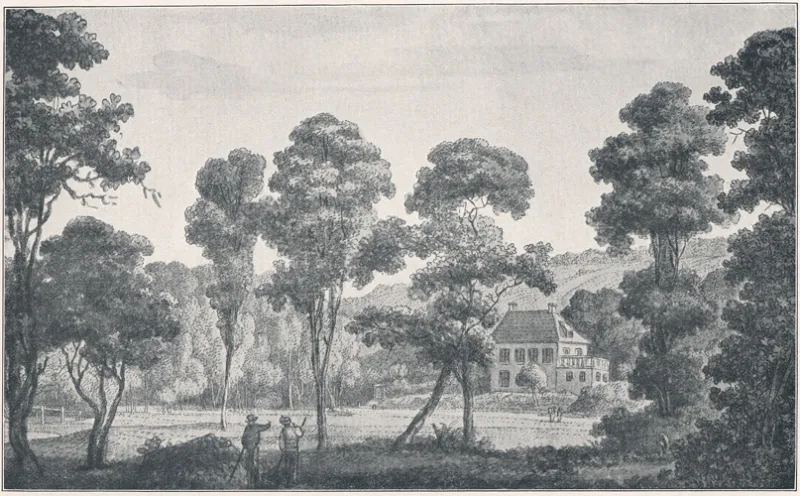
The garden house stands on a slope above the meadows of the Ilm, just outside the old town of Weimar. It was a simple vineyard cottage with a steep roof when Carl August gave it to Goethe in April 1776, together with the citizenship of Weimar that he needed to own property. Goethe had it repaired and moved in on 18 May 1776; it was his only home until June 1782, when his official duties made a town house necessary.
Here he lived simply, with his servant Philipp Seidel, and slept at times on a camp bed. He planted the garden, grew vegetables and flowers, and later laid out paths and seats. From the house he wrote hundreds of notes and letters to Charlotte von Stein. Poems such as 'To the Moon' ('Füllest wieder Busch und Tal') are associated with the house and the river, as is much of the work on Iphigenie, Egmont and Wilhelm Meister's Theatrical Mission; such links are traditional and not always documented in detail.
From 1778 the meadows around the house were gradually transformed into a landscape park on the English model, the Park on the Ilm, in which Goethe had a leading hand together with the duke. Features such as the Luisenkloster, the 'stone of good fortune' that Goethe designed in 1777 – a sphere on a cube – and later the Roman House (1792–97) belong to this landscape.
Goethe kept the garden house all his life and often retreated there, especially in old age. It is now a museum with a reconstructed interior and garden, part of the UNESCO World Heritage site 'Classical Weimar'.