

Goethe here
February 25, 1787 – March 29, 1787
first stay
May 14, 1787 – June 3, 1787
after Sicily
Goethe arrived in Naples with Tischbein on 25 February 1787. The largest city of Italy, capital of the Kingdom of the Two Sicilies, overwhelmed him with its noise, light and crowds after the gravity of Rome. 'Naples is a paradise; everyone lives in a kind of intoxicated self-forgetfulness', he wrote in the Italian Journey, and he repeated the saying 'See Naples and die'.
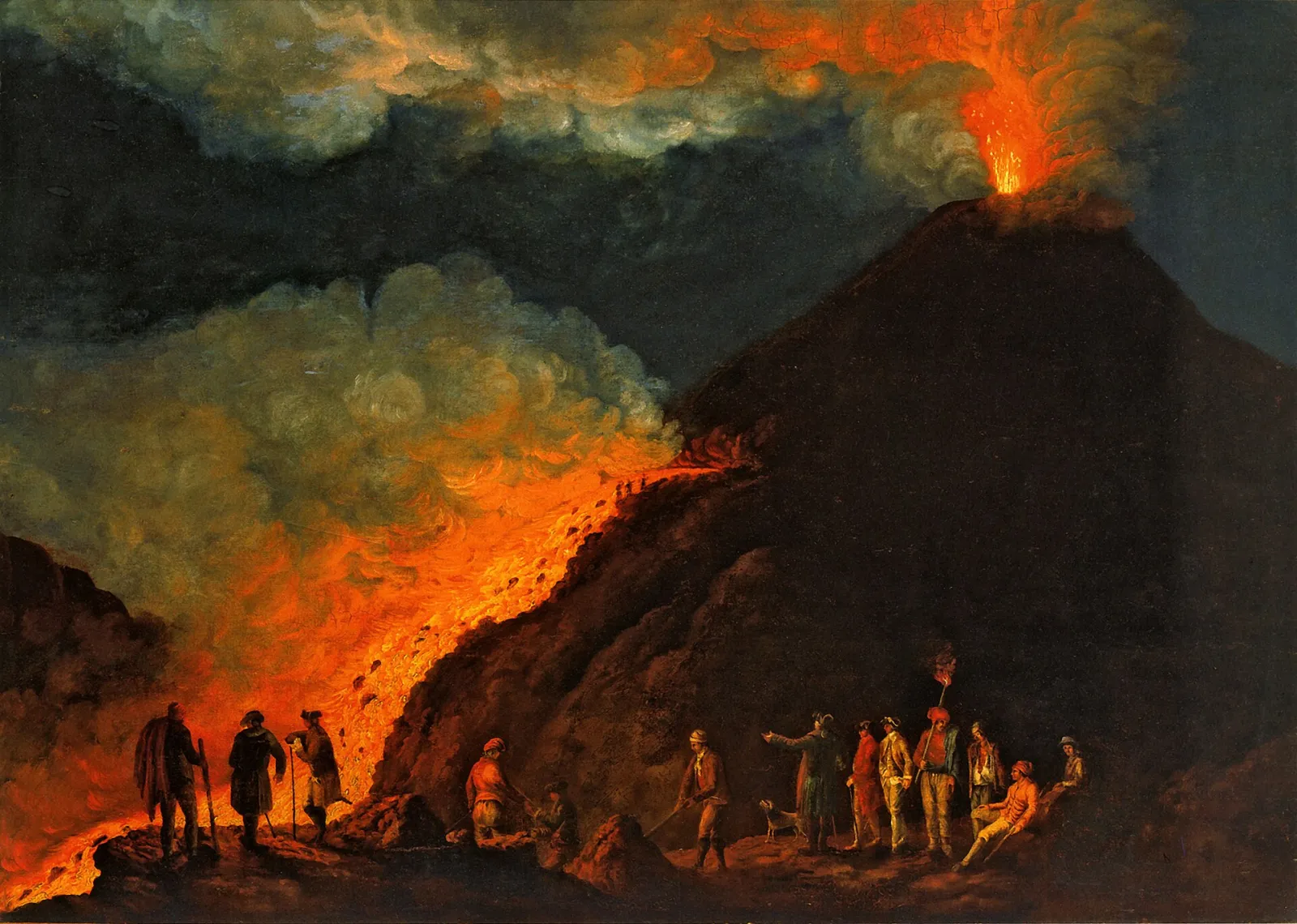
He climbed Vesuvius three times in March 1787, the last time close to a flowing stream of lava, visited Pompeii and the finds from Herculaneum in the royal museum at Portici, and travelled south to the Greek temples of Paestum, whose heavy Doric columns at first repelled and then deeply impressed him. He met the British envoy Sir William Hamilton, collector and volcanologist, and saw the 'attitudes' of Emma Hart, later Lady Hamilton, who posed in classical draperies as figures from antiquity. He also met the jurist Gaetano Filangieri and the painter Philipp Hackert, with whom he drew.
On 29 March 1787 he sailed with Christoph Heinrich Kniep for Sicily. He returned on 14 May after a stormy crossing from Messina and stayed until 3 June, seeing more of the city and its people, before travelling back to Rome.
The Naples weeks are among the most vivid in the Italian Journey: the street life, the lazzaroni, the bay at sunset, the volcanic landscape that fed his geological interests. The view over the bay from Posillipo and the ruins of Pompeii and Paestum remain the places most closely associated with his visit. The historic centre of Naples and the archaeological areas of Pompeii and Herculaneum are UNESCO World Heritage sites.