

Goethe here
April 2, 1787 – April 18, 1787
Sicily
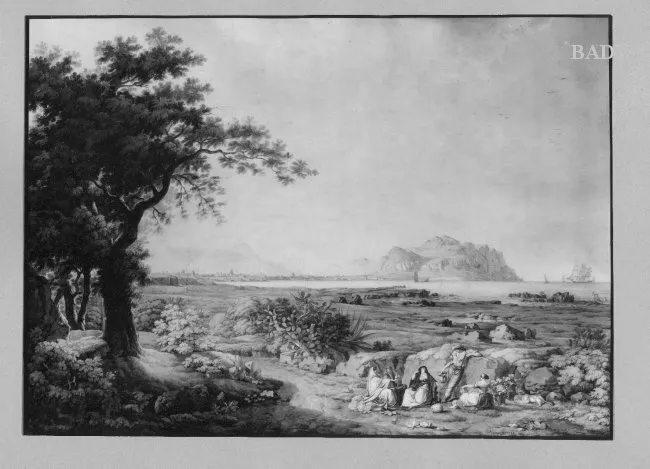
Goethe reached Palermo by sea on 2 April 1787 after a crossing of four days from Naples, during which he suffered from seasickness and worked on Tasso in his berth. He stayed until 18 April, with Kniep drawing beside him.
The city impressed him with its setting between the sea and the mountains of the Conca d'Oro, its luxuriant vegetation and its mixture of Arab, Norman and baroque buildings. He climbed Monte Pellegrino to the grotto of Santa Rosalia, the city's patron saint, and described the reclining statue of the saint with tenderness. At Bagheria he visited the Villa Palagonia with its grotesque sculptures of monsters and hybrids, which he found absurd and described with ironic horror.
In the public garden by the sea – the Villa Giulia and the adjoining botanical garden – he saw southern plants growing in the open and conceived, or sharpened, the idea of a 'primal plant' (Urpflanze), a basic form from which all plants could be understood as variations. The thought later led to The Metamorphosis of Plants (1790). In the same garden he planned a tragedy on Nausicaa from the Odyssey, of which only fragments were written.
Goethe also sought out the poor family of Giuseppe Balsamo, the adventurer known in Europe as Count Cagliostro, posing as an Englishman bringing news; he described the visit in detail and later used the Cagliostro affair in his comedy The Grand Kophta (1791).
From Palermo he set off on 18 April across the interior towards Agrigento. Palermo's Arab-Norman monuments have been a UNESCO World Heritage site since 2015; the botanical garden still holds plants of the kind Goethe admired.