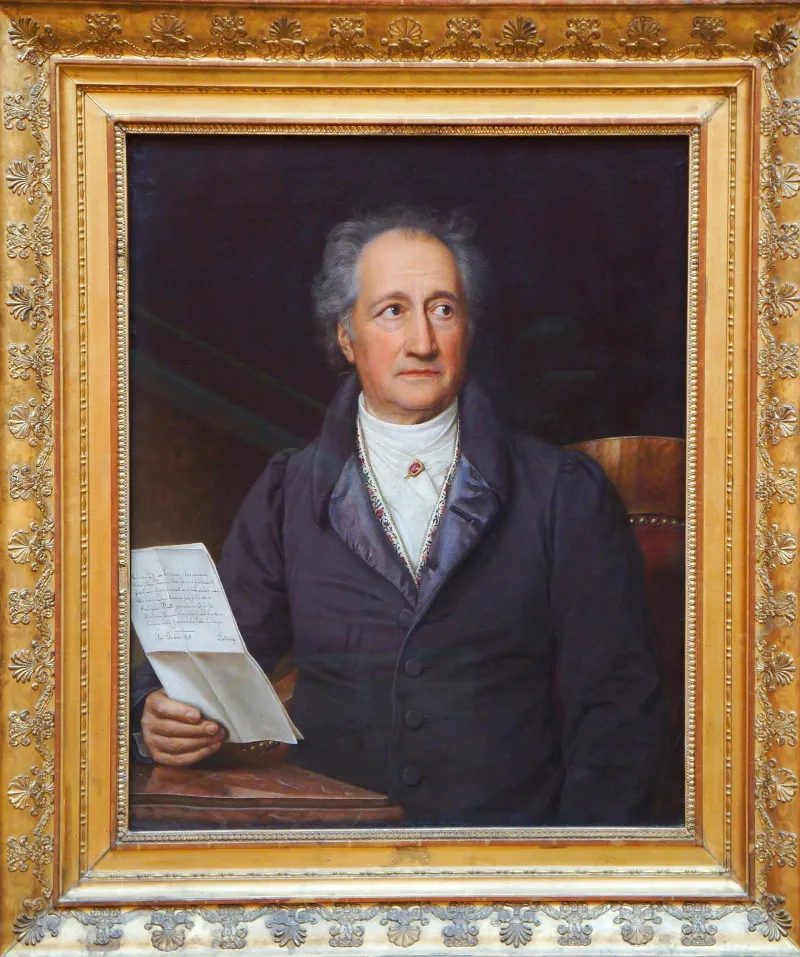

Sketching the ruined castle of Malsesine, he is suspected of spying and questioned before the podestà and the actuary, until Gregorio, who once served in Frankfort, speaks for him.
The wind, which blew against me yesterday, and drove me into the harbour of Malsesine, was the cause of a perilous adventure, which I got over with good humour, and the remembrance of which I still find amusing. According to my plan, I went early in the morning into the old castle, which having neither gate nor guard, is accessible to everybody. Entering the court-yard, I seated myself opposite to the old tower, which is built on and among the rocks. Here I had selected a very convenient spot for drawing;—a carved stone seat in the wall, near a closed door, raised some three or four feet high, such as we also find in the old buildings in our own country.
I had not sat long before several persons entered the yard, and walked backwards and forwards, looking at me. The multitude increased, and at last so stood as completely to surround me. I remarked that my drawing had excited attention; however, I did not allow myself to be disturbed, but quietly continued my occupation. At last a man, not of the most prepossessing appearance, came up to me, and asked me what I was about. I replied that I was copying the old tower, that I might have some remembrance of Malsesine. He said that this was not allowed, and that I must leave off. As he said this in the common Venetian dialect, so that I understood him with difficulty, I answered, that I did not understand him at all. With true Italian coolness he took hold of my paper, and tore it, at the same time letting it remain on the pasteboard. Here I observed an air of dissatisfaction among the by-standers; an old woman in particular said that it was not right, but that the podesta ought to be called, who was the best judge of such matters. I stood upright on the steps, having my back against the door, and surveyed the assembly, which was continually increasing. The fixed eager glances, the good humoured expression of most of the faces, and all the other characteristics of a foreign mob, made the most amusing impression upon me. I fancied that I could see before me the chorus of birds, which, as Treufreund, I had often laughed at, in the Ettersburg theatre. This put me in excellent humour, and when the podesta came up with his actuary, I greeted him in an open manner, and when he asked me why I was drawing the fortification, modestly replied, that I did not look upon that wall as a fortification. I called the attention of him and the people to the decay of the towers and walls, and to the generally defenceless position of the place, assuring him that I thought I only saw and drew a ruin.
I was answered thus: "If it was only a ruin, what could there be remarkable about it?" As I wished to gain time and favour, I replied very circumstantially, that they must be well aware how many travellers visited Italy, for the sake of the ruins only, that Rome, the metropolis of the world, having suffered the depredations of barbarians, was now full of ruins, which had been drawn hundreds of times, and that all the works of antiquity were not in such good preservation as the amphitheatre at Verona, which I hoped soon to see.
The podesta, who stood before me, though in a less elevated position, was a tall man, not exactly thin, of about thirty years of age. The flat features of his spiritless face perfectly accorded with the slow constrained manner, in which he put his questions. Even the actuary, a sharp little fellow, seemed as if he did not know what to make of a case so new, and so unexpected. I said a great deal of the same sort; the people seemed to take my remarks good naturedly, and on turning towards some kindly female faces, I thought I could read assent and approval.
When, however, I mentioned the amphitheatre at Verona, which in this country, is called the "Arena," the actuary, who had in the meanwhile collected himself, replied, that this was all very well, because the edifice in question was a Roman building, famed throughout the world. In these towers, however, there was nothing remarkable, excepting that they marked the boundary between the Venetian domain and Austrian Empire, and therefore espionage could not be allowed. I answered by explaining at some length, that not only the Great and Roman antiquities, but also those of the Middle-Ages were worth attention. They could not be blamed, I granted, if, having been accustomed to this building from their youth upwards, they could not discern in it so many picturesque beauties as I did. Fortunately the morning sun, shed the most beautiful lustre on the tower, rocks, and walls, and I began to describe the scene with enthusiasm. My audience, however, had these much lauded objects behind them, and as they did not wish to turn altogether away from me, they all at once twisted their heads, like the birds, which we call "wry necks" (Wendehälse), that they might see with their eyes, what I had been lauding to their ears. Even the podestà turned round towards the picture I had been describing, though with more dignity than the rest. This scene appeared to me so ridiculous that my good humour increased, and I spared them nothing—least of all, the ivy, which had been suffered for ages to adorn the rocks and walls.
The actuary retorted, that this was all very good, but the Emperor Joseph was a troublesome gentleman, who certainly entertained many evil designs against Venice; and I might probably have been one of his subjects, appointed by him, to act as a spy on the borders.
"Far from belonging to the Emperor," I replied, "I can boast, as well as you, that I am a citizen of a republic, which also governs itself, but which is not, indeed, to be compared for power and greatness to the illustrious state of Venice, although in commercial activity, in wealth, and in the wisdom of its rulers, it is inferior to no state in Germany. I am a native of Frankfort-on-the-Main, a city, the name and fame of which has doubtless reached you."
"Of Frankfort-on-the-Main!" cried a pretty young woman, "then, Mr. Podestà, you can at once see all about the foreigner, whom I look upon as an honest man. Let Gregorio be called; he has resided there a long time, and will be the best judge of the matter."
The kindly faces had already increased around me, the first adversary had vanished, and when Gregorio came to the spot, the whole affair took a decided turn in my favor. He was a man upwards of fifty, with one of those well-known Italian faces. He spoke and conducted himself like one, who feels that something foreign is not foreign to him, and told me at once that he had seen service in Bolongari's house, and would be delighted to hear from me something about this family and the city in general, which had left a pleasant impression in his memory. Fortunately his residence at Frankfort had been during my younger years, and I had the double advantage of being able to say exactly how matters stood in his time, and what alteration had taken place afterwards. I told him about all the Italian families, none of whom had remained unknown to me. With many particulars he was highly delighted, as, for instance, with the fact that Herr Alessina had celebrated his "golden wedding," in the year 1774, and that a medal had been struck on the occasion, which was in my possession. He remembered that the wife of this wealthy merchant was by birth a Brentano. I could also tell him something about the children and grand-children of these families, how they had grown up, and had been provided for and married, and had multiplied themselves in their descendants.
When I had given the most accurate information about almost everything which he asked, his features alternately expressed cheerfulness and solemnity. He was pleased and touched, while the people cheered up more and more, and could not hear too much of our conversation, of which—it must be confessed—he was obliged to translate a part into their own dialect.
At last he said: "Podesta, I am convinced that this is a good, accomplished, and well-educated gentleman, who is travelling about to acquire instruction. Let him depart in a friendly manner, that he may speak well of us to his fellow-countrymen, and induce them to visit Malsesine, the beautiful situation of which is well worthy the admiration of foreigners. I gave additional force to these friendly words by praising the country, the situation, and the inhabitants, not forgetting to mention the magistrates as wise and prudent personages."
This was well received, and I had permission to visit the place at pleasure, in company with Master Gregorio. The landlord, with whom I had put up, now joined us, and was delighted at the prospect of the foreign guests, who would crowd upon him, when once the advantages of Malsesine were properly known. With the most lively curiosity he examined my various articles of dress, but especially envied me the possession of a little pistol, which slipped conveniently into the pocket. He congratulated those who could carry such pretty weapons, this being forbidden in his country under the severest penalties. This friendly but obtrusive personage I sometimes interrupted to thank my deliverer. "Do not thank me," said honest Gregorio, "for you owe me nothing. If the Podestà had understood his business, and the Actuary had not been the most selfish man in the world, you would not have got off so easily. The former was still more puzzled than you, and the latter would have pocketed nothing by your arrest, the information, and your removal to Verona. This he rapidly thought over, and you were already free, before our dialogue was ended."
Towards the evening the good man took me into his vineyard, which was very well situated, down along the lake. We were accompanied by his son, a lad of fifteen, who was forced to climb the trees, and pluck me the best fruit, while the old man looked out for the ripest grapes.
While thus placed between these two kindhearted people, both strange to the world, alone, as it were, in the deep solitude of the earth, I felt, in the most lively manner, as I reflected on the day's adventure, what a whimsical being Man is—how the very thing, which in company he might enjoy with ease and security, is often rendered troublesome and dangerous, from his notion, that he can appropriate to himself the world and its contents after his own peculiar fashion.
Towards midnight my host accompanied me to the barque, carrying the basket of fruit with which Gregorio had presented me, and thus, with a favorable wind, I left the shore, which had promised to become a Læstrygonicum shore to me.
And now for my expedition on the lake. It ended happily, after the noble aspect of the water, and of the adjacent shore of Brescia had refreshed my very heart. On the western side, where the mountains cease to be perpendicular, and near the lake, the land becomes more flat, Garignano, Bojaco, Cecina, Toscolan, Maderno, Verdom, and Salo, stand all in a row, and occupy a reach of about a league and a half; most of them being built in long streets. No words can express the beauty of this richly inhabited spot. At 10 o'clock in the morning I landed at Bartolino, placed my luggage on one mule and myself on another. The road went now over a ridge, which separates the valley of the Etsch from the hollow of the lake. The primæval waters seem to have driven against each other from both sides, in immense currents, and to have raised this colossal dam of gravel. A fertile soil was deposited upon the gravel at a quieter period, but the labourer is constantly annoyed by the appearance of the stones on the surface. Every effort is made to get rid of them, they are piled in rows and layers one on another, and thus a sort of thick wall is formed along the path. The mulberry-trees, from a want of moisture, have a dismal appearance at this elevation. Springs there are none. From time to time puddles of collected rain-water may be found, with which the mules and even their drivers quench their thirst. Some wheels are placed on the river beneath, to water, at pleasure, those plantations that have a lower situation.
The magnificence of the new country, which opens on you as you descend, surpasses description. It is a garden a mile long and broad, which lies quite flat at the foot of tall mountains and steep rocks, and is as neatly laid out as possible By this way, about 1 o'clock on the 10th of September, I reached Verona, where I first write this, finish, and put together the first part of my diary, and indulge in the pleasing hope of seeing the amphitheatre in the evening.
Concerning the weather of these days I have to make the following statement:—The night from the 9th to the 10th was alternately clear and cloudy, the moon had always a halo round it. Towards 5 o'clock in the morning all the sky was overcast with gray, not heavy clouds, which vanished with the advance of day. The more I descended the finer was the weather. As at Botzen the great mass of the mountains took a northerly situation, the air displayed quite another quality. From the different grounds in the landscape, which were separated from each other in the most picturesque manner, by a tint more or less blue, it might be seen, that the atmosphere was full of vapors equally distributed, which it was able to sustain, and which, therefore, neither fell in the shape of dew, nor were collected in the form of clouds. As I descended further I could plainly observe, that all the exhalations from the Botzen valley, and all the streaks of cloud which ascended from the more southern mountains, moved towards the higher northern regions, which they did not cover, but veiled with a kind of yellow fog. In the remotest distance, over the mountains, I could observe what is called a "water-gull." To the south of Botzen they have had the finest weather all the summer, only a little water (they say aqua to denote a light rain), from time to time, and then a return of sunshine. Yesterday a few drops occasionally fell, and the sun throughout continued shining. They have not had so good a year for a long while; everything turns out well; the bad weather they have sent to us.
I mention but slightly the mountains and the species of stone, since Ferber's travels to Italy, and Hacquet's journey along the Alps, give sufficient information respecting this district. A quarter of a league from the Brenner, there is a marble quarry, which I passed at twilight. It may, nay, must lie upon mica-slate as on the other side. This I found near Colman, just as it dawned; lower down there was an appearance of porphyry. The rocks were so magnificent, and the heaps were so conveniently broken up along the highway, that a "Voigt" cabinet might have been made and packed up at once. Without any trouble of that kind I can take a piece, if it is only to accustom my eyes and my curiosity to a small quantity. A little below Colman, I found some porphyry, which splits into regular plates, and between Brandrol and Neumark some of a similar kind, in which, however, the laminæ separated in pillars. Ferber considered them to be volcanic productions, but that was fourteen years ago, when all the world had its head on fire. Even Hacquet ridicules the notion.
Of the people I can say but little, and that is not very favorable. On my descent from the Brenner, I discovered, as soon as day came, a decided change of form, and was particularly displeased by the pale brownish complexion of the women. Their features indicated wretchedness, the children looked equally miserable;—the men somewhat better. I imagine that the cause of this sickly condition may be found in the frequent consumption of Indian corn and buckwheat. Both the former, which they also call "Yellow Blende," and the latter, which is called "Black Blende," is ground, made into a thick pap with water, and thus eaten. The Germans on this side, pull out the dough, and fry it in butter. The Italian Tyrolese, on the contrary, eat it just as it is, often with scrapings of cheese, and do not taste meat throughout the year. This necessarily glues up and stops the alimentary channels, especially with the women and children, and their cachectic complexion is an indication of the malady. They also eat fruit and green beans, which they boil down in water, and mix with oil and garlic. I asked if there were no rich peasants. "Yes, indeed," was the reply. "Don't they indulge themselves at all? don't they eat anything better?" "No, they are used to it." "What do they do with their money then? how do they lay it out?" "Oh, they have their ladies, who relieve them of that." This is the sum and substance of a conversation with mine host's daughter at Botzen.
I also learned from her, that the vine-tillers were the worst off, although they appeared to be the most opulent, for they were in the hands of commercial towns-people, who advanced them enough to support life in the bad seasons, and in winter took their wine at a low price. However, it is the same thing everywhere.
My opinion concerning the food is confirmed by the fact, that the women who inhabit the towns appear better and better. They have pretty plump girlish faces, the body is somewhat too short in proportion to the stoutness, and the size of the head, but sometimes the countenances have a most agreable expression. The men we already know through the wandering Tyrolese. In the country their appearance is less fresh than that of the women, perhaps because the latter have more bodily labour, and are more in motion, while the former sit at home as traders and workmen. By the Garda Lake I found the people very brown, without the slightest tinge of red in their cheeks; however they did not look unhealthy, but quite fresh and comfortable. Probably the burning sunbeams, to which they are exposed at the foot of their mountains, are the cause of their complexion.