

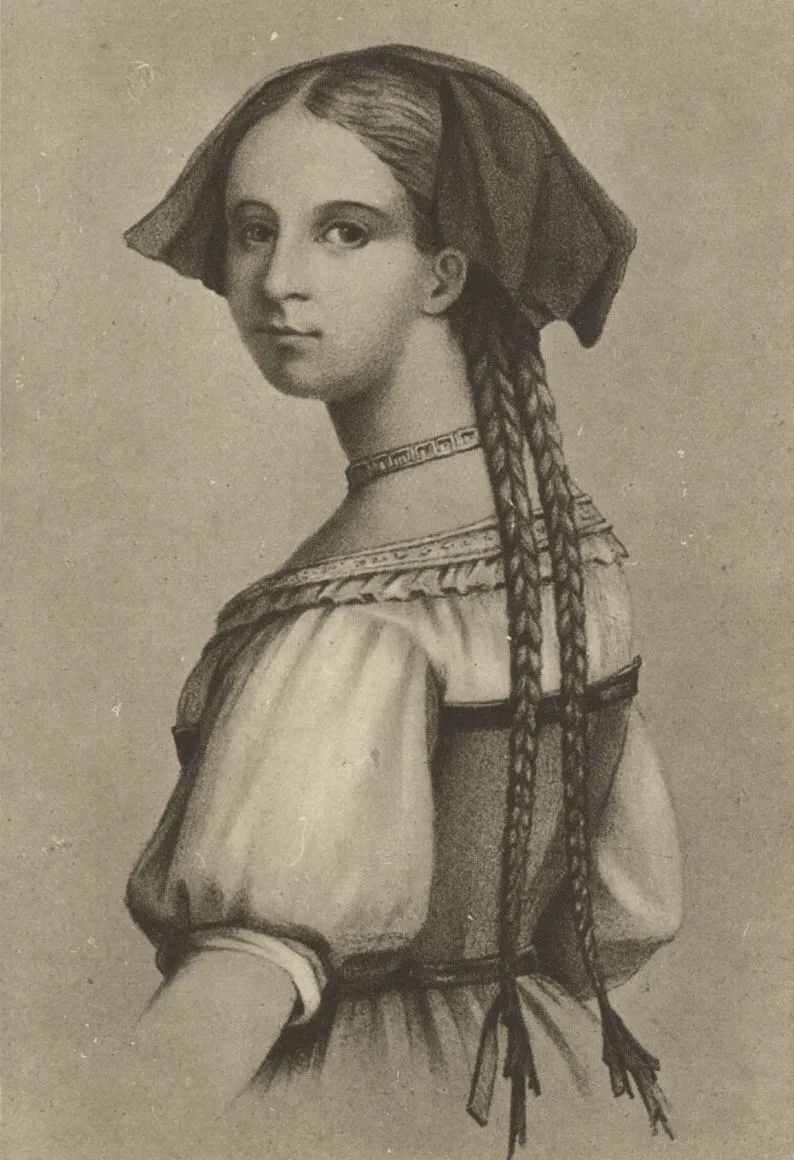
Friederike Elisabeth Brion was the third daughter of Johann Jakob Brion, Lutheran pastor of Sesenheim, a village in Lower Alsace north-east of Strasbourg. Goethe met her in October 1770 when a fellow student, Weyland, brought him to the parsonage; he arrived in disguise as a shabby theology student, and the comedy of his unmasking is one of the most charming scenes of Poetry and Truth.
Over the following months he visited often, stayed for weeks in May and June 1771 and wrote for her the poems that mark the beginning of modern German lyric poetry – Welcome and Farewell, the May Song, and others known as the Sesenheim songs. He also painted ribbons for her. Friederike was eighteen, cheerful, simple and graceful.
In August 1771, before leaving Alsace, Goethe visited her for the last time and then ended the relationship by letter from Frankfurt. She was deeply hurt. Goethe visited her once more, in September 1779, and found her friendly and without reproach, which relieved him. Friederike never married. After her father's death she lived with her brother and sister, later at Meissenheim in Baden, where she died in 1813.
Goethe's account in Poetry and Truth (1812) made her famous; later in the nineteenth century the 'Sesenheim question' produced many books and some fantasies, including unfounded rumours about her later life. What is certain is what Goethe himself admitted: that he had wounded 'the most beautiful heart' and long felt guilt.
Importance for Goethe
Friederike Brion, a pastor’s daughter in Sesenheim in Alsace, was Goethe’s great love of his Strasbourg years. He met her in October 1770; for her he wrote the “Sesenheim Songs”, among them “Welcome and Farewell”, “May Song” and the early form of “Heidenröslein”.
In August 1771 he left her without commitment, which long weighed on him; traces of it appear in Gretchen in “Faust” and the forsaken Marie in “Götz”. He visited her once more in 1779. In “Poetry and Truth” he tells the Sesenheim idyll at length.
Goethe drew his characters from people he knew. Goethe Write keeps your characters, their notes and relationships together. All features ›
Goethe Write mode: write it yourself
- Create a character with a character sheet: role, age, goal, conflict and notes.
- Link your characters to each other in the relationships view, as Goethe’s life links the people around him.
- Place events on the timeline and see who meets whom, and when.
Questions
- Which poems did Goethe write for Friederike Brion?
- The “Sesenheim Songs”, including “Welcome and Farewell” and “May Song”.
- How did Goethe and Friederike Brion meet?
- In October 1770 a Strasbourg friend took him to the parsonage at Sesenheim.
Text sources
- DuW II 10–11
- Briefe aus der Schweiz 1779
- Goethe to Ch. v. Stein, 28 Sept 1779