

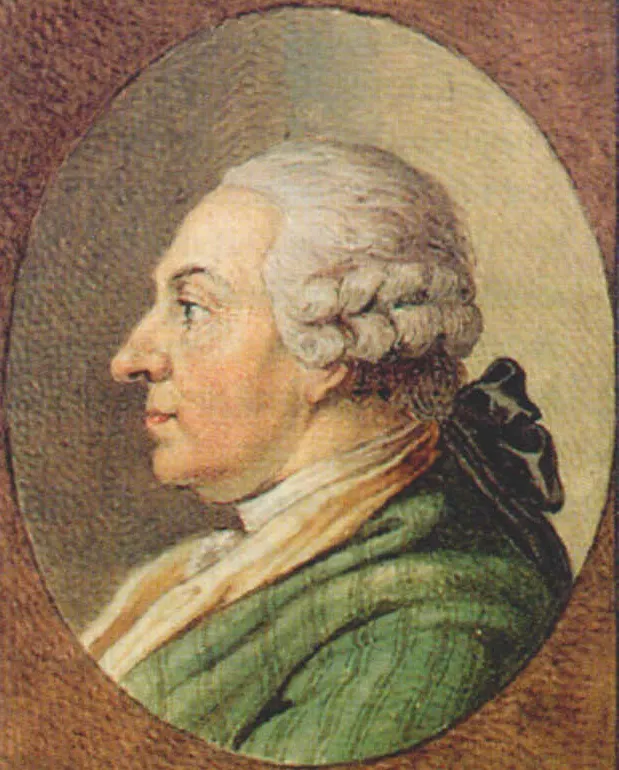
Johann Caspar Goethe was born in Frankfurt in 1710, the son of Friedrich Georg Goethe, a tailor from Thuringia who had married the widow of the landlord of the Weidenhof inn and grown rich. The son received the education of a gentleman: grammar school in Coburg, law studies in Leipzig and Giessen, a doctorate in 1738, practice at the Imperial Chamber Court in Wetzlar and the Diet in Regensburg, and in 1740 a long journey through Italy, which he described in Italian in a manuscript he kept all his life.
Back in Frankfurt he hoped for a municipal office and was disappointed. In 1742 he bought from Emperor Charles VII the title of Imperial Councillor, which gave him rank but barred him from the city council. He married Catharina Elisabeth Textor, twenty-one years his junior, in 1748, and devoted the rest of his life to his house, his collections – books, Italian views, paintings by Frankfurt artists – and the education of his children.
To his son he was a demanding, systematic teacher who planned every subject and checked every exercise. Goethe later portrayed him in Poetry and Truth with respect and a certain irony: a man of order and duty, pedantic, honest and, as the son came to see, unhappy in his idleness. He insisted that Wolfgang study law, followed his first publications with pride, carefully kept the reviews of Götz and Werther, and worked behind the scenes in his son's law practice. He did not approve of the move to Weimar, fearing for his son's independence at a princely court.
In his last years a series of strokes left him weakened in body and mind. He died in Frankfurt on 25 May 1782, a few weeks after his son was ennobled. Goethe did not attend the funeral. The father's thoroughness – the habit of collecting, recording and finishing – remained one of the son's most lasting inheritances.
Importance for Goethe
His father shaped Goethe’s education up to university: he taught the children at home, had them learn languages, drawing and music, and decided that Wolfgang would study law. His Italian travel account and the views of Rome in the Frankfurt house awakened the son’s longing for Italy.
Goethe found his father strict and pedantic but owed him his sense of order and love of collecting. In 1786 he set out on the Italian journey his father had once made; in the “Italian Journey” and “Poetry and Truth” the father is always in the background.
Goethe drew his characters from people he knew. Goethe Write keeps your characters, their notes and relationships together. All features ›
Goethe Write mode: write it yourself
- Create a character with a character sheet: role, age, goal, conflict and notes.
- Link your characters to each other in the relationships view, as Goethe’s life links the people around him.
- Place events on the timeline and see who meets whom, and when.
Questions
- Who was Goethe’s father?
- Johann Caspar Goethe (1710–1782), a lawyer and Imperial Councillor in Frankfurt who educated his children himself.
- What was Goethe’s relationship with his father like?
- Respectful but tense; Goethe found him strict, yet adopted his educational ideals and his love of Italy.
Text sources
- DuW I–IV
- J. C. Goethe, Viaggio per l'Italia (manuscript)
- Lewes 1855, book 1