

Two souls, alas, are dwelling in my breast.
Zwei Seelen wohnen, ach! in meiner Brust.
The young man who came home to Frankfurt in September 1768 was pale and thin, and his father received him with ill-concealed disappointment. Johann Caspar had spent a great deal of money on three years of study and had got back an invalid without a degree. The mother and sister were tender; the father was correct and cool. For the next eighteen months the house on the Hirschgraben became a sickroom, and Goethe's life turned inward.
The crisis
He seemed at first to recover, but in December 1768 he fell dangerously ill again, with severe digestive pain and a swelling of the neck that had to be cut open. The family physician, Dr. Johann Friedrich Metz, a man with mystical leanings, was at his wits' end and finally gave him a secret remedy, a salt prepared by himself, which seemed to help. Goethe later wrote that in these weeks he was close to death and that he came out of the crisis changed. Through the long winter he lay in bed or sat in his room, drawing, reading and writing letters.
Fräulein von Klettenberg
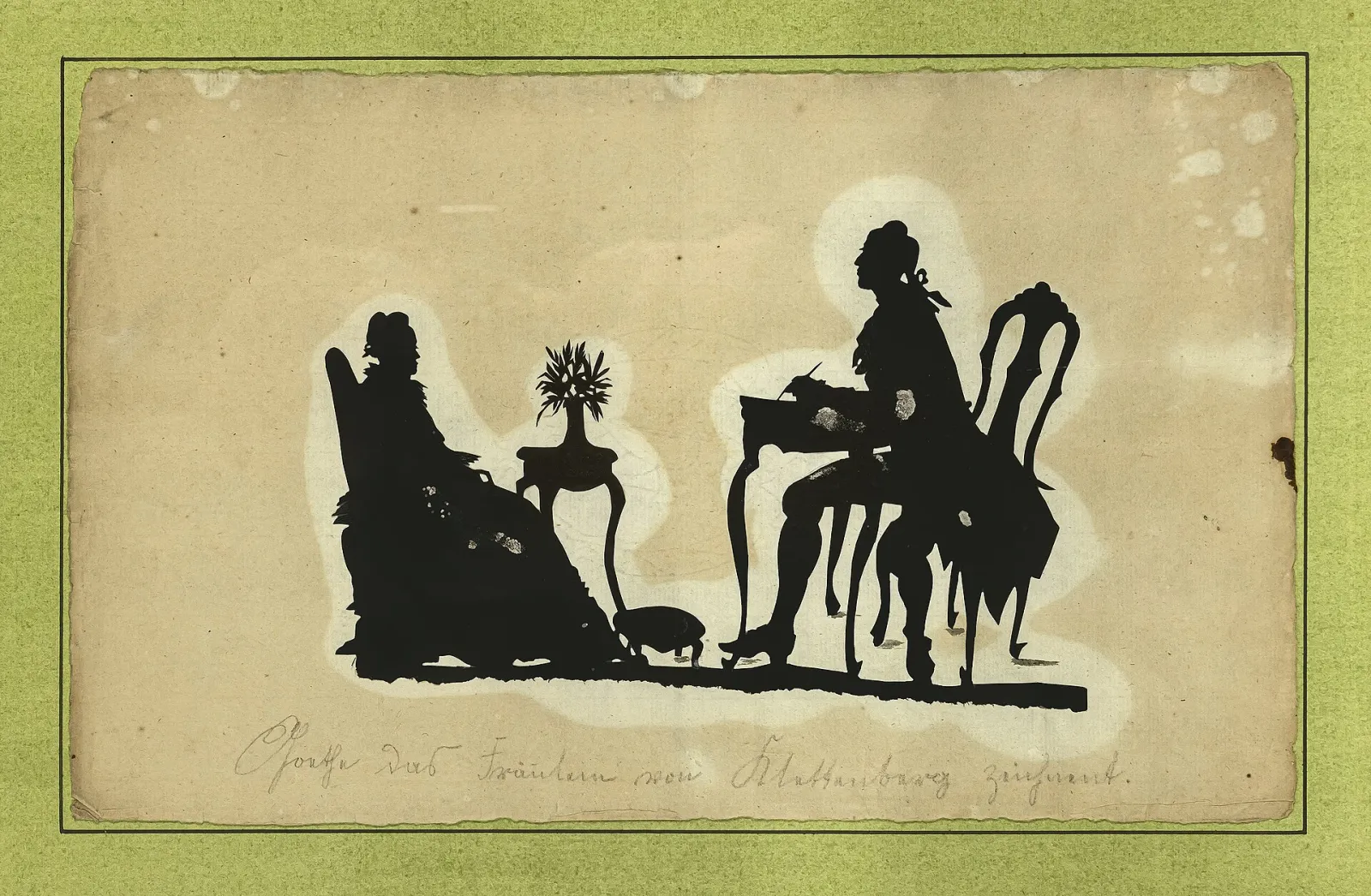
The person who mattered most in these months was a friend of his mother: Susanna Katharina von Klettenberg, a woman in her mid-forties, of good family, unmarried and herself frequently ill, who belonged to the circle of Frankfurt Pietists close to the Moravian Brethren of Herrnhut. Pietism was a movement of the heart within Lutheranism: it valued personal experience of God, inner conversion and the fellowship of believers over doctrine and church routine. Fräulein von Klettenberg was gentle, clever, cheerful in her faith and without fanaticism, and Goethe loved talking with her. For a while he went to the meetings of the brethren and tried, honestly, to find the faith they described. He did not find it, at least not in their form; but he never forgot her. More than twenty-five years later he drew her portrait in the Confessions of a Beautiful Soul, the sixth book of Wilhelm Meister's Apprenticeship, using her own papers.
Alchemy
Through Dr. Metz and Fräulein von Klettenberg he also came to the strange books of the alchemists and hermetic philosophers: the Opus mago-cabbalisticum of Georg von Welling, Paracelsus, Basil Valentine and others. He set up a small furnace in his room, made experiments with salts and liquids, and tried to make sense of a world in which matter and spirit were bound together. It was not science as we know it, and he knew it; but it was the beginning of his lifelong curiosity about how nature works, and it fed the opening scenes of Faust, where an old scholar sits among his retorts and summons the Earth Spirit.
Letters and drawings
His letters of these months to Käthchen Schönkopf in Leipzig – now a friendship, no longer a love – and to Friederike Oeser, the daughter of his drawing teacher, are lively, ironic and full of self-observation. He continued to draw and etch. He revised The Accomplices and took the songs that were to appear as New Songs through the press. He read the Bible, Plato, the early Church Fathers and Gottfried Arnold's Impartial History of the Church and Heretics (1699–1700), which taught him that the heretics had often been right.
A new beginning
By the beginning of 1770 he was well enough to resume his studies, and his father chose Strasbourg: a university where a German could study law in a French city, finish quickly and acquire French polish on the way. Goethe himself was glad to leave a home that had become narrow. He set off at the end of March 1770 and arrived in Strasbourg on 2 April. The searching, inward months in Frankfurt had prepared him, without his knowing it, for the meeting that would change everything there.
A house of convalescence
For a year and a half the house on the Hirschgraben was the whole of Goethe's world. Cornelia, now eighteen, was his closest companion; brother and sister read together, discussed books and the people they knew, and shared their irritation with their father's pedantry. Cornelia's own diary from these months, written in French for a friend, shows her unhappiness with the narrow life of a daughter of the house. Goethe's mother, cheerful and practical, managed both the sick son and the strict husband. The father's collections – Italian views, books, prints, a natural history cabinet – were all around him, and he spent hours with them.
What exactly was wrong with Goethe remains unclear. Contemporary descriptions speak of a haemorrhage, digestive pains and the swelling in the neck; modern writers have suggested a tuberculous infection of the lymph glands, a stomach ulcer or other causes, but the sources do not allow a firm diagnosis. Goethe himself saw the illness in hindsight as a crisis of the whole person, of body and mind together, out of which he emerged with new seriousness.
The Moravians
Fräulein von Klettenberg's circle was connected with the Moravian Brethren, the community of Count Zinzendorf, whose congregations practised a warm, emotional devotion to the suffering Christ. According to Poetry and Truth, Goethe attended meetings of the Frankfurt brethren and in 1769 also went to a Moravian synod at Marienborn in the Wetterau, where he observed the community at close quarters. He admired their sincerity and their sense of fellowship, but could not accept the doctrine of original sin and the total dependence on grace that they taught. He was, he later wrote, too convinced of the good and active powers in human nature.
This encounter left a lasting mark. Goethe's later respect for personal religion that does not seek to dominate others, and his distrust of dogma, both go back to these months. The figure of the 'beautiful soul' in Wilhelm Meister is his tribute to a piety he could honour without sharing.
First steps towards science
The alchemical experiments in the attic room were naive, but they were Goethe's first hands-on attempts to understand nature. He read about chemistry as well as alchemy, distilled and dissolved, and kept notes. Looking back, he saw in these experiments the beginning of a habit of mind that stayed with him: the wish to see how things are made and transformed, rather than to learn about them only from books. The same curiosity would later lead him to mines, to plants and bones, and to the long study of light and colour.
Sources of this chapter
Goethe, Dichtung und Wahrheit, part 2, book 8 (1812): return, illness, Dr. Metz, Fräulein von Klettenberg, alchemy. Wilhelm Meisters Lehrjahre, book 6 (1795). Letters to Käthchen Schönkopf and Friederike Oeser (Weimar Edition IV, vol. 1). Lewes, Life and Works (1855). Bielschowsky, Goethe, vol. 1 (1896).
Sources of this chapter
- Goethe, Dichtung und Wahrheit, part 2, book 8 (1812)
- Goethe, Wilhelm Meisters Lehrjahre, book 6, Bekenntnisse einer schönen Seele (1795)
- Goethe's letters to Käthchen Schönkopf and Friederike Oeser, 1768–1769, Weimar Edition IV, vol. 1
- G. H. Lewes, The Life and Works of Goethe (1855), book 1, chapter 6
- A. Bielschowsky, Goethe, vol. 1 (1896), chapter 4