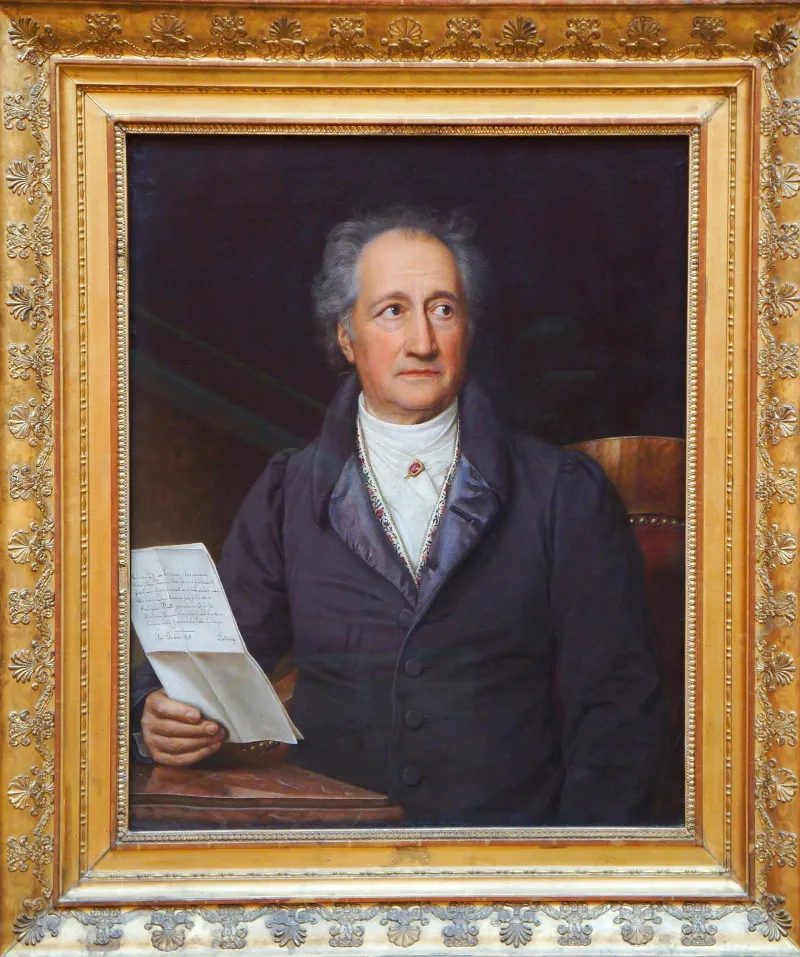

Johann Wolfgang Textor, after whom Goethe was named, was a lawyer and from 1747 Schultheiss – the highest judicial and administrative officer – of the free city of Frankfurt. In that capacity he took part in the coronation ceremonies of the Emperor Francis I in 1745 and of Joseph II in 1764, and was ennobled as an imperial councillor.
In Poetry and Truth Goethe describes him as a calm, dignified old man who tended his garden, especially his roses and fruit trees, with great care and who had a reputation for prophetic dreams. The grandson visited him often and received from him the free ticket to the French theatre during the occupation. Politically Textor sided with the Emperor and Austria in the Seven Years' War, which led to bitter quarrels with his son-in-law, the Prussian sympathiser Johann Caspar Goethe.
After the difficult birth of his grandson in 1749 he arranged for the appointment of a trained obstetrician for the city's poor. A stroke in 1770 took away his speech; he died in February 1771, while Goethe was in Strasbourg.
Goethe's sense of his grandfather comes largely from Poetry and Truth, written half a century later: the quiet old man in his garden, the town's highest office worn with dignity, and the family belief that he could foresee events in dreams. That last trait Goethe reports as family lore, not as fact. Textor's fall from health after a stroke in 1770 and his death on 6 February 1771 came while Goethe was in Strasbourg.
Importance for Goethe
Johann Wolfgang Textor, Frankfurt’s Schultheiss and so the city’s highest official, was Goethe’s godfather; the grandson bears his first names. In his grandfather’s house the boy saw the dignity of the old imperial city: councillors, court days, imperial coronations.
In “Poetry and Truth” Goethe portrays his grandfather as a quiet, orderly man with a splendid fruit garden, said to have had a gift of foresight. He tells the coronation of Joseph II in 1764, which he witnessed at fourteen, in the light of this family.
Goethe drew his characters from people he knew. Goethe Write keeps your characters, their notes and relationships together. All features ›
Goethe Write mode: write it yourself
- Create a character with a character sheet: role, age, goal, conflict and notes.
- Link your characters to each other in the relationships view, as Goethe’s life links the people around him.
- Place events on the timeline and see who meets whom, and when.
Questions
- Who was Goethe named after?
- His maternal grandfather and godfather, Johann Wolfgang Textor.
- Who were Goethe’s grandfathers?
- On his mother’s side Johann Wolfgang Textor, Schultheiss of Frankfurt; on his father’s side the tailor and innkeeper Friedrich Georg Goethe.
Text sources
- DuW I 1–3